The journal and the general ledger: the same entries in two orders
Like the appointment book and the customer cards in a hair salon: the journal lists transactions in date order, the general ledger account by account. Four journal entries, the T account of a bank account, the subsidiary ledger printout, and which printout to ask your mali müşavir for and when.
The journal (yevmiye defteri) is the book in which transactions are written in date order, entry by entry, as debit and credit (VUK art. 183). The general ledger (büyük defter, defteri kebir) distributes the same entries from the journal to the accounts and shows the balance of each account (VUK art. 184). Those keeping books on the balance-sheet basis keep both; in many businesses these books are kept as e-Ledgers (e-Defter).
Necla Hanım's two books
The rules described in this lesson are those of Turkish law.
Necla Hanım's hair salon is a limited company; she has two employees. Two things sit on the counter. One is the appointment book: day by day, hour by hour, who came and what they had done. The other is the box of customer cards: on each customer's card, all that customer's visits, hair colour number and what they paid.
The same visit is written in two places, but it answers two different questions. The appointment book answers "what happened on Tuesday?", the customer card answers "how many times did this customer come this year?"
The two main books of accounting work the same way. The journal (yevmiye defteri) is the appointment book, and the general ledger (büyük defter; defteri kebir, its name in the law) is the customer cards.

Who keeps them?
Those keeping books on the balance-sheet basis (bilanço esası) keep a journal, a general ledger and an inventory book (envanter defteri) (Tax Procedure Law, Vergi Usul Kanunu, VUK, art. 182). The Turkish Commercial Code also regulates a trader's obligation to keep commercial books (Türk Ticaret Kanunu, TTK, art. 64). In many businesses today the journal and the general ledger are kept electronically as e-Ledgers (e-Defter); the obligation to switch to e-Defter depends on conditions such as turnover, and your mali müşavir (accountant) knows your situation. We explained notary certification of paper books and how e-Defter differs in the lesson The year-end file for your mali müşavir.
The third book, the inventory book, is the list of goods, cash, receivables and debts counted at the end of the year. We don't go into it in this lesson; you saw the year-end count in the lesson The December count. Here we look at the two books where day-to-day entries live.
If you keep a business book (işletme defteri), you have a single business book instead of these two (The business account summary); if you are under simplified taxation, you do not keep legal books.
The journal: in date order, entry by entry
The law defines the journal as the book in which the transactions that must be recorded are written in date order and in the form of entries (VUK art. 183). Each entry is one transaction: it has a number, a date, a description, the document it is based on, and debit and credit lines.
Four entries from Necla Hanım's first week of October (sample figures):
| Entry | Date | Account | Debit | Credit |
|---|---|---|---|---|
| 1 | 2 October | 102 Banks | 15,000 | |
| 120 Trade receivables (collection from a wedding hall) | 15,000 | |||
| 2 | 3 October | 335 Debts to personnel (September salaries) | 80,000 | |
| 102 Banks | 80,000 | |||
| 3 | 5 October | 320 Trade payables (supplier of hair dye and care products) | 20,000 | |
| 102 Banks | 20,000 | |||
| 4 | 6 October | 102 Banks | 10,000 | |
| 100 Cash (paid into the bank from the cash box) | 10,000 |
In every entry debit and credit are equal. Anyone reading the journal from start to finish follows the salon's first week of October day by day: a receivable was collected, salaries were paid, a supplier was paid off, extra money in the cash box went to the bank.
The general ledger: account by account
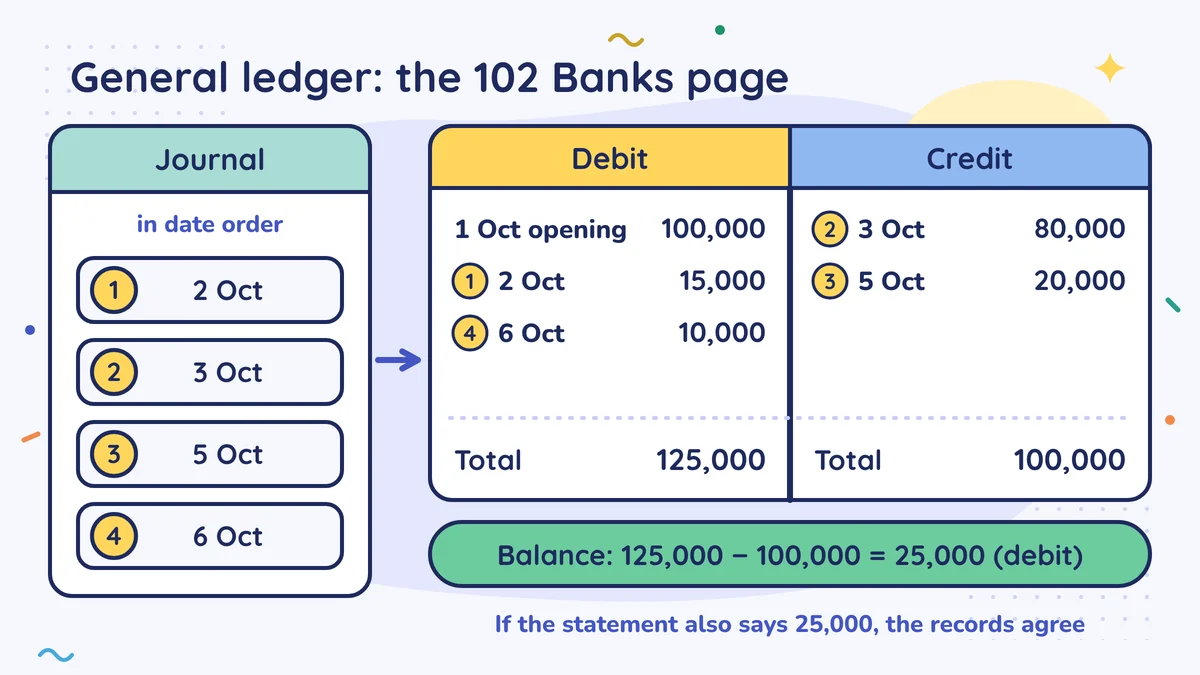
The general ledger takes the entries posted to the journal and distributes them to each account's own page. It adds no new information; it lists the same entries in a different order. The page is often drawn like the letter T: debit on the left, credit on the right. This is called a T account.
On 1 October there were 100,000 lira in the bank. Necla Hanım's 102 Banks page:
| Debit | Amount | Credit | Amount |
|---|---|---|---|
| 1 October brought forward | 100,000 | 3 October salaries (entry 2) | 80,000 |
| 2 October collection (entry 1) | 15,000 | 5 October supplier (entry 3) | 20,000 |
| 6 October from the cash box (entry 4) | 10,000 | ||
| Total | 125,000 | Total | 100,000 |
Balance: 125,000 − 100,000 = 25,000 lira, a debit balance. So there should be 25,000 lira in the bank. If the bank statement on the evening of 6 October also says 25,000, the records agree.
The subsidiary ledger: cards inside the card
120 Trade receivables is a single account, but there may be dozens of customers under it. The printout that shows each customer's movements separately is called in practice the subsidiary ledger (muavin, auxiliary book) or account statement. The answer to the question "how much does this customer owe us?" is here. The account statement sent when you do a reconciliation (mutabakat) with a customer, that is, confirming the balance with each other, also comes from here.
What does it mean for you?
Your mali müşavir keeps the books. But if you know the difference between the two books, you ask for the right printout:
- If you are wondering "what happened last month?", ask for the journal printout; the transactions come in date order.
- If you are asking "why is there this much in the bank?" or "how much do I owe this supplier?", ask for the general ledger or subsidiary ledger printout of that account.
In both printouts every line is based on a document. If you see a line you don't recognise, ask for its document; behind every entry there should be an invoice, a bank receipt or a payroll (Invoices, receipts and documents). The law also limits how late entries can be (VUK art. 219): the general rule is 10 days; in offices that work with accounting vouchers (muhasebe fişi), the entry on the voucher must be posted to the book within 45 days at the latest. It is common for documents to go to the mali müşavir all together at the end of the month; to stay within these periods, set the delivery day together with your mali müşavir. The real problem is a document arriving after that month's return has been prepared.
Since Necla Hanım learned this distinction, she asks her mali müşavir for just one thing every month: "Could you send the bank subsidiary ledger?" She puts it side by side with the bank statement, and it is done in five minutes.
In one sentence
The journal shows transactions in date order, and the general ledger shows the same entries account by account; the first answers "what happened?", the second "what is in this account?".
Do this this week
Ask your mali müşavir for last month's 102 Banks printout (general ledger or subsidiary ledger). Put it side by side with the same month's bank statement and compare the month-end balances; if they differ, find on which day the difference started and write to your mali müşavir.
Common mistakes
- Thinking the general ledger is a separate record. The general ledger is the journal's entries distributed to the accounts; a transaction that is not in the journal is not in the general ledger either.
- Following the bank only through the bank's mobile app. If the 102 balance in the books doesn't match the statement, an entry is missing or extra. Finding the difference within the month is easier than finding it at year end.
- Getting documents to your mali müşavir late. It is common for documents to go all together at the end of the month; but a document that arrives after the return has been prepared can turn into an entry in the wrong month or a missing entry. Talk to your mali müşavir about which day you will deliver documents, and stick to that day.
Sources
- Tax Procedure Law No. 213 (213 sayılı Vergi Usul Kanunu), art. 182 (books to be kept on the balance-sheet basis), art. 183 (journal), art. 184 (general ledger), art. 219 (recording period) (mevzuat.gov.tr)
- MuhasebeNews: text of VUK art. 183 (journal in date order and in the form of entries) and art. 219 (recording periods)
- MuhasebeTR (Vedat Nair): VUK art. 219 recording periods (10 days; 45 days to the main book when recording with accounting vouchers) and e-Defter approval periods
- Turkish Commercial Code No. 6102 (6102 sayılı Türk Ticaret Kanunu), art. 64 (commercial books) (mevzuat.gov.tr)
- Hukuki Haber (Att. E. Mücahit Demiray): Commercial books 2, the general ledger; distributing the journal's transactions to the accounts
- Ankara University Faculty of Political Science, General Accounting II lecture notes: definition of the trial balance, equality of the debit and credit columns, provisional trial balance
- TÜRMOB (Union of Chambers of Certified Public Accountants of Turkey)
Translated from the Turkish lesson. Last checked against Turkish rules: 13 October 2026. Not yet reviewed by a licensed accountant.
This is general information about Turkish rules, not financial, tax or legal advice. Rules change; check the date and the sources, and ask a licensed accountant (mali müşavir) about your own situation. Disclaimer