Reading the trial balance: what should you look at in the one your mali müşavir sends?
The trial balance your mali müşavir sends every month is pages of codes and figures; but you don't need to read all of it. The columns of the trial balance, reverse balances, checking cash and bank, the VAT, partner and sales lines, why 153 does not show the goods on the shelf, and asking for a detailed trial balance.
The trial balance (mizan) is a control table that shows the debit and credit totals and the balances of all accounts in a single list; the debit and credit totals must always come out equal. When reading it, look for reverse balances (for example the cash account showing a credit balance), whether cash matches the drawer and bank matches the statement, and the VAT, receivables from partners and sales lines. Equal totals do not show that the records are complete.
Volkan Bey's long list
The rules described in this lesson are those of Turkish law.
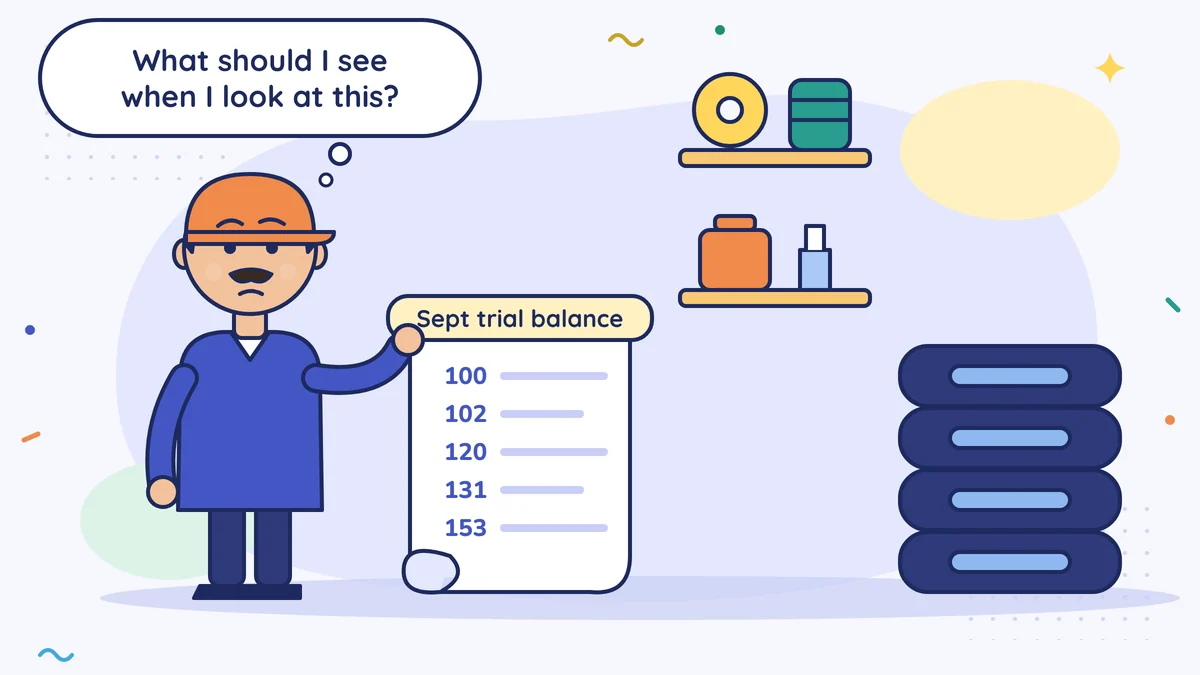
Volkan Bey's car spare parts company is a limited company. In the middle of every month a file arrives from his mali müşavir (accountant): "September trial balance." Pages of codes, four columns of figures. For years Volkan Bey opened the file and closed it again. This year he asked a question: "What should I see when I look at this?"
The trial balance (mizan) is the table in which all the accounts are listed together, with their debit and credit totals and their balances. The word mizan means scale in Arabic; its name comes from its job: it shows whether the two sides are equal. This is the control table your mali müşavir looks at before returns and year-end statements.
Like a dashboard
You look at your car's dashboard every morning, but you don't read every gauge one by one. Is there enough fuel, is a warning light on: that is what you look at. The trial balance is the business's dashboard. You don't need to understand every line; it is enough to know where a warning light will come on.
The columns of the trial balance
A shortened section of Volkan Bey's trial balance at 30 September 2026 (sample figures; the amounts build up from the start of the year):
| Account | Debit total | Credit total | Debit balance | Credit balance |
|---|---|---|---|---|
| 100 Cash | 420,000 | 380,000 | 40,000 | |
| 102 Banks | 3,100,000 | 2,950,000 | 150,000 | |
| 120 Trade receivables | 2,400,000 | 2,130,000 | 270,000 | |
| 131 Receivables from partners | 90,000 | 0 | 90,000 | |
| 153 Merchandise | 1,500,000 | 0 | 1,500,000 | |
| 190 VAT carried forward | 60,000 | 30,000 | 30,000 | |
| 320 Trade payables | 1,600,000 | 1,910,000 | 310,000 | |
| 360 Taxes and funds payable | 300,000 | 345,000 | 45,000 | |
| 500 Capital | 0 | 250,000 | 250,000 | |
| 600 Domestic sales | 0 | 2,000,000 | 2,000,000 | |
| 770 General administrative expenses | 525,000 | 0 | 525,000 | |
| Total | 9,995,000 | 9,995,000 | 2,605,000 | 2,605,000 |
Because every transaction is written twice, the debit and credit totals are equal; the balance columns also come out equal to each other. In books kept with software this equality is almost always there. The real job is to check whether the lines match reality.
Seven warning lights
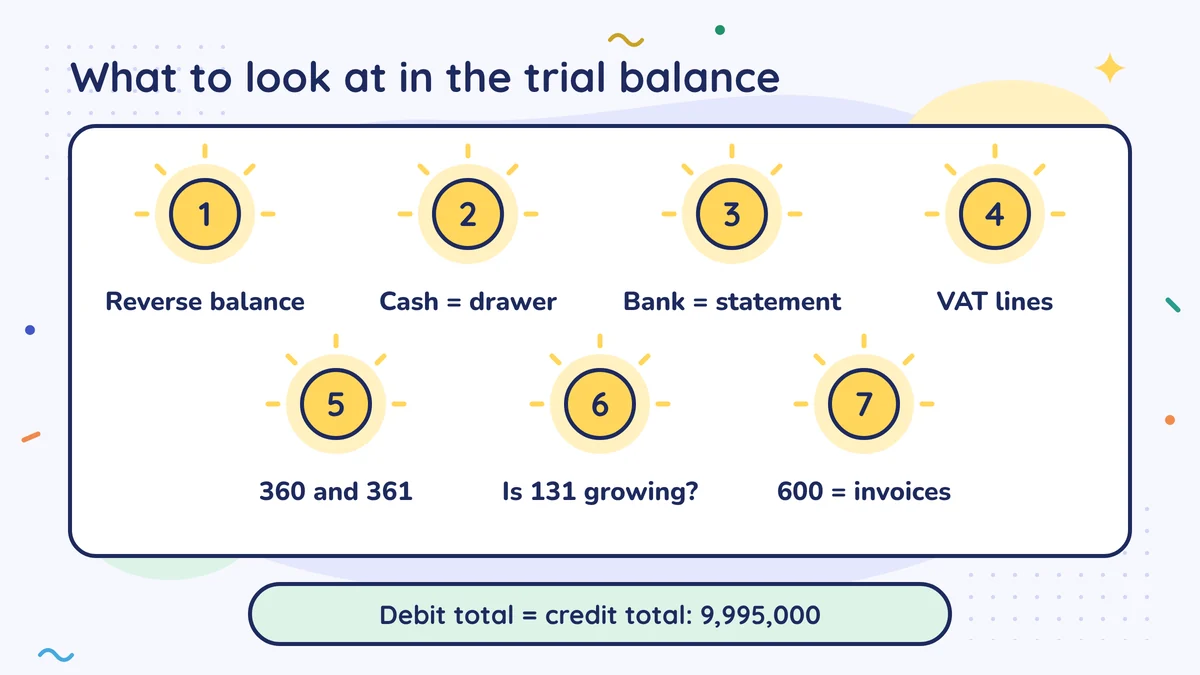
1. Reverse balance. Every account has a normal side (chart of accounts). The Communiqué is clear about cash: the cash account either shows a debit balance or is zero; it never shows a credit balance. If cash looks negative, money that came in was not recorded or money that went out was written twice. In a tax audit (vergi incelemesi), negative cash may be seen as a sign of a collection that was not recorded (Accounts that look risky); so find the reason with documents. 120 showing a credit balance for one customer may show that too much money was taken from the customer or that an invoice that should have been issued was not. 320 showing a debit balance for a supplier may be an overpayment or an unrecorded purchase invoice. The right correction is often to complete the missing document; find the reason with your mali müşavir.
2. Is cash the same as the drawer? The balance of 100 should be the same as the money counted in the drawer on the date of the trial balance (The December count).
3. Is the bank the same as the statement? Each sub-account of 102 should match that bank's statement balance on the same day.
4. VAT lines. For a month whose VAT return has been prepared, 191 and 391 should be closed. The amount in 190 should be the same as the VAT carried forward to the next period in the latest VAT return.
5. 360 and 361. The amounts here should match the tax and SGK (social security) premiums arising from the returns for the trial balance's month and payable the following month. If you see a balance left over from past months, ask whether there is an unpaid debt.
6. Is 131 growing? If receivables from partners increase every month, go back to the lesson A partner taking money out of the company.
7. Does 600 match the invoices? 600 is the total, excluding VAT, of the sales invoices you have issued and the cash register sales since the start of the year; returns are kept separately in 610. It should be close to the total, excluding VAT, of your e-Invoice and e-Archive list and your cash register Z reports (end-of-day reports).
Don't get stuck on 153
Volkan Bey's 153 shows 1,500,000 lira, but there aren't that many parts in the warehouse. In many businesses this account builds up the opening stock and purchases during the year; the cost of goods sold is deducted at the end of the year with a count. That is why in a mid-month trial balance 153 often does not show the goods on the shelf. Ask your mali müşavir how it is kept in your own company.
What did Volkan Bey find?
On the evening of the last day of the month Volkan Bey had counted the drawer and found 8,000 lira. The trial balance said 40,000. When he looked into it with his mali müşavir, it turned out that 32,000 lira had been taken from the cash box and paid into the bank on the last day of September. The money was on the statement, but the statement the mali müşavir had was taken before that day, and the deposit had not been recorded; so the bank balance in the trial balance was also 32,000 lira below the statement. The month-end statement was obtained and the entry was made: cash went down to 8,000, bank went up from 150,000 to 182,000 and matched the statement.
The second stop was 131. The 90,000 lira was money Volkan Bey had transferred from the company account to his own account during the year. He and his mali müşavir made a plan to close it.
Provisional trial balance, final trial balance
The trial balance that comes during the month is provisional; it changes as new documents arrive. The trial balance taken at the end of the year after the closing entries have been made is called the final trial balance; the balance sheet (bilanço) and income statement (gelir tablosu) come from it. Ask your mali müşavir for the trial balance in detail, that is, with its sub-accounts: a single customer or supplier showing a reverse balance can only be seen in the sub-account.
In one sentence
The trial balance shows each account's debit, credit and balance in a single list; you don't look at every line, but at reverse balances, whether cash and bank match reality, and the VAT, partner and sales lines.
Do this this week
On the evening of the last day of the month, count the money in the drawer and note it down. Ask your mali müşavir for that month's detailed trial balance; compare 100 Cash with your note, and each sub-account of 102 Banks with the statement balance on the same day. If there is a difference, write its amount and date to your mali müşavir.
Common mistakes
- Thinking the trial balance is correct because the totals are equal. An invoice that was never recorded leaves both sides short; the totals still come out equal. The equality catches writing mistakes, not missing documents.
- Thinking 153 is the goods on the shelf. In a mid-year trial balance, in many businesses this account is the total of opening stock and purchases; the cost of what was sold is deducted at the end of the year.
- Looking only at the main accounts. A customer showing a reverse balance gets lost in the total line of 120; ask for a detailed trial balance.
Sources
- Ankara University Faculty of Political Science, General Accounting II lecture notes: definition of the trial balance, equality of the debit and credit columns, provisional trial balance
- Muhasebetr (Kenan Gümüş): the 100 Cash account; under the Communiqué cash always shows a debit balance or is zero, and never shows a credit balance
- Muhasebetr (Koray Ateş): account reconciliation differences; 120 accounts showing a credit balance and the right way to correct them
- General Communiqué on the Application of the Accounting System No. 1 (1 Sıra No'lu Muhasebe Sistemi Uygulama Genel Tebliği), Official Gazette 26.12.1992 / 21447 repeated issue (Alomaliye copy)
- Muhasebetr: The uniform chart of accounts (account classes and account names)
- TÜRMOB (Union of Chambers of Certified Public Accountants of Turkey)
Translated from the Turkish lesson. Last checked against Turkish rules: 13 October 2026. Not yet reviewed by a licensed accountant.
This is general information about Turkish rules, not financial, tax or legal advice. Rules change; check the date and the sources, and ask a licensed accountant (mali müşavir) about your own situation. Disclaimer