Debit and credit: the two sides of every transaction
If your mali müşavir's printout says "Cash, debit: 7,200", the cash box does not owe anyone anything. In accounting, debit (borç) and credit (alacak) are the left and right sides of an account. The logic of double-entry bookkeeping through four transactions of a kitchenware shop, and which account increases on which side.
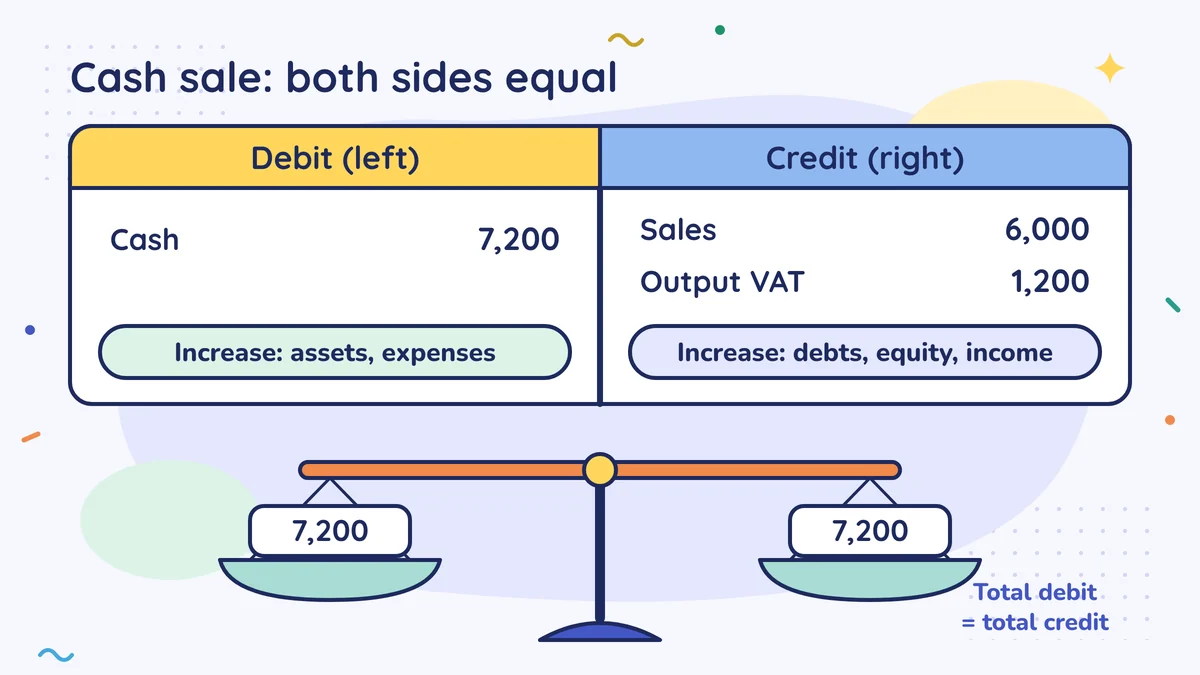
In double-entry bookkeeping every transaction affects at least two accounts and is written with the same amount on the debit side of one account and the credit side of another. Debit is the left side of an account and credit is the right side: assets and expenses increase on the debit side; debts, equity (özkaynak) and income increase on the credit side. That is why the debit total of all entries is always equal to the credit total.
Tülin Hanım's "borç" surprise
The rules described in this lesson are those of Turkish law.
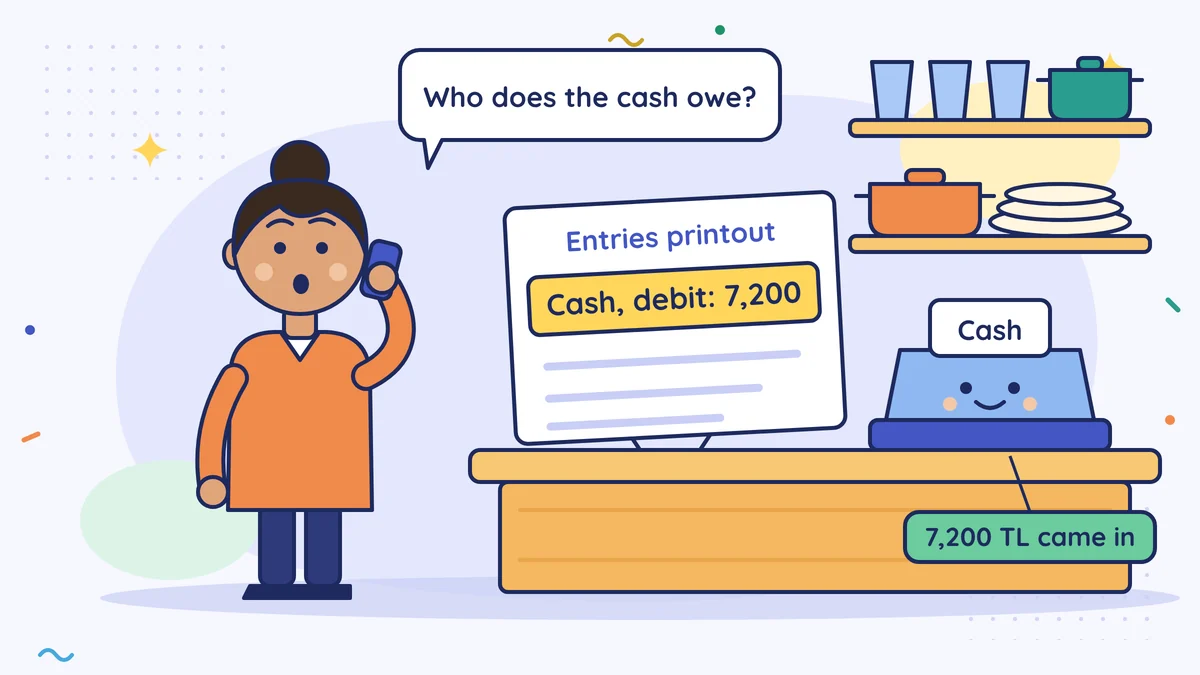
Tülin Hanım's kitchenware shop has been a limited company for two years. She sells glasses, pans and cutlery. Last week she asked her mali müşavir (accountant) for a printout of the entries. On the first line she saw: "Kasa, borç: 7,200" (Cash, debit: 7,200). In everyday Turkish, borç means "debt". She phoned straight away: "Who does the cash box owe? I never wrote down a debt to anyone."
The cash box didn't owe anyone. That day 7,200 lira had come into it. In accounting the words debit (borç) and credit (alacak) are not used in their everyday meaning; they are the names of the left and right sides of an account. In this lesson we look at these two words and at why every transaction is written down twice.
This lesson is for companies and for those keeping books on the balance-sheet basis (bilanço esası). If you keep a business book (işletme defteri), your book works with two columns, expenses and revenue (The business account summary); if you are under simplified taxation, you do not keep legal books, and your documents are recorded in the Defter-Beyan System. Either way, these words help you when you talk to your mali müşavir.
The shopping bag at the market
At the market you gave the tomato seller 100 lira and bought 100 lira of tomatoes. 100 lira left your wallet, and 100 lira of tomatoes went into your bag. You became neither richer nor poorer; your money changed form.
Accounting looks at every transaction this way: something goes out of one place and something comes into another. Both sides are written down. This is called double-entry bookkeeping (çift taraflı kayıt). It has a single rule: in an entry, the debit total equals the credit total.
Debit on the left, credit on the right
Think of every account as a page split down the middle. The left side is called debit, the right side credit. Which side is an increase and which a decrease depends on the type of account:
| Account type | Increases on | Decreases on | Example |
|---|---|---|---|
| Asset (what you have) | Debit | Credit | Cash, bank, amounts owed by customers, goods on the shelf |
| Liabilities and equity (whose money) | Credit | Debit | Debt to supplier, loan, capital |
| Expense | Debit | Closed at the end of the period | Rent, electricity, salaries |
| Income | Credit | Closed at the end of the period | Sales |
This table comes from the same place as the two sides of the balance sheet: assets stand on the left, sources on the right. Because income increases the company's own share, it works on the right like a source; because an expense reduces that share, it works on the left.
The difference between the two sides of an account is called the balance (bakiye), that is, what is left in the account. Whichever side is bigger, the balance takes its name. In a customer's account, everyday language and accounting language match: "the customer's account shows a debit balance" means the customer owes you. In the cash account, though, a debit balance simply means "there is money in the cash box".
Tülin Hanım's four transactions (sample figures)
In 2026 the general VAT rate is 20%; in the example this rate applies to Tülin Hanım's goods.
1. Goods from a supplier on credit. A 10,000 lira set of glasses arrived; the invoice shows 2,000 lira of VAT, and payment is due at the end of the month.
| Account | Debit | Credit |
|---|---|---|
| Merchandise (ticari mallar) | 10,000 | |
| Deductible VAT (indirilecek KDV) | 2,000 | |
| Trade payables (satıcılar, debt to the supplier) | 12,000 |
Goods came onto the shelf: an asset increased, debit side. A debt to the supplier arose: a source increased, credit side. The VAT on the invoice waits in a separate account; at the end of the month it is deducted from the VAT collected from customers on sales (Deductible VAT).
2. A cash sale. A customer bought a 6,000 lira set of pans and paid 7,200 lira in cash including VAT.
| Account | Debit | Credit |
|---|---|---|
| Cash (kasa) | 7,200 | |
| Sales (satışlar) | 6,000 | |
| Output VAT (hesaplanan KDV) | 1,200 |
This was the line that surprised Tülin Hanım. The cash increased, so it is on the debit side. A sale is income, so it is on the credit side. The 1,200 lira of VAT collected from the customer is not Tülin Hanım's income; it stays in a separate account as money to be passed on to the state.
The set of pans leaving the shelf is not in this entry. In many businesses the cost of goods sold is calculated in one go at the end of the year with a count: opening stock, plus purchases, minus closing stock (The income statement line by line).
3. Payment to the supplier. At the end of the month 12,000 lira was sent from the bank to the supplier.
| Account | Debit | Credit |
|---|---|---|
| Trade payables | 12,000 | |
| Bank | 12,000 |
The debt was closed: a source decreased, debit side. The money in the bank decreased: an asset decreased, credit side. There is neither income nor expense in this transaction; profit did not change.
4. Electricity bill. The shop's 1,000 lira electricity bill was paid from the bank with its 200 lira of VAT.
| Account | Debit | Credit |
|---|---|---|
| Expense (electricity) | 1,000 | |
| Deductible VAT | 200 | |
| Bank | 1,200 |
An expense is written on the debit side. This entry reduces profit by 1,000 lira.
Why is it written twice?
The first reason is to catch mistakes. Because the two sides are equal in every entry, the totals of all the accounts must come out equal too. If they don't, somewhere there is a wrongly written amount or a missing line. The trial balance your mali müşavir looks at every month is the table for this check.
The second reason is to answer a question. A single-column book says "12,000 lira went out of the bank". Double-entry bookkeeping also answers the question "where did it go?": to the debt to the supplier. This is how both the balance sheet and the income statement (gelir tablosu) come out of the same entries.
Translate your own transaction
When you translate a transaction into the language of debit and credit, ask two questions:
- Which two accounts changed? What came in, what went out?
- Did these accounts increase or decrease? Look at the table above.
Your mali müşavir keeps the records. But when you see the word "borç" (debit) on a printout, you won't panic; you will ask the right question.
Tülin Hanım's phone call ended like this: "So the cash box isn't in debt, there is money in the cash box." Her mali müşavir laughed: "Exactly."
In one sentence
In accounting, debit is the left side and credit the right; every transaction is written with the same amount on the debit side of at least one account and the credit side of another, and the two sides always stay equal.
Do this this week
Pick three transactions you made this week: a sale, a purchase and a payment. Write each on paper in two columns: debit on the left, credit on the right. Use the table in the lesson to find which account goes on which side; in a payment, your debt to the supplier decreases (left) and the money in your bank decreases (right). Check that the two columns add up to the same total in each transaction, and ask your mali müşavir about any one you get stuck on.
Common mistakes
- Taking borç (debit) in accounting for debt in everyday language. A debit balance in the cash account shows there is money in the cash box, not that it owes anyone.
- Thinking a payment to a supplier is an expense. The payment closes a debt. The goods or service were already recorded with the invoice; writing the payment as an expense as well counts the same thing twice.
- Adding VAT to sales or expenses. The VAT collected from customers is not sales; the VAT you pay on purchases and are able to deduct is not an expense either. Both wait in separate accounts and are compared in the VAT return.
Sources
- General Communiqué on the Application of the Accounting System No. 1 (1 Sıra No'lu Muhasebe Sistemi Uygulama Genel Tebliği), Official Gazette 26.12.1992 / 21447 repeated issue (Alomaliye copy)
- Ankara University Faculty of Political Science, General Accounting II lecture notes: entries during the period, the general ledger and trial balance equality
- Value Added Tax Law No. 3065 (3065 sayılı Katma Değer Vergisi Kanunu), art. 29 (deduction) (mevzuat.gov.tr)
- KPMG: VAT rates under Presidential Decision 9126; general rate 20%
- TÜRMOB (Union of Chambers of Certified Public Accountants of Turkey)
Translated from the Turkish lesson. Last checked against Turkish rules: 13 October 2026. Not yet reviewed by a licensed accountant.
This is general information about Turkish rules, not financial, tax or legal advice. Rules change; check the date and the sources, and ask a licensed accountant (mali müşavir) about your own situation. Disclaimer