The year-end file for your mali müşavir: account reconciliation, bad debts, fixed asset list
The file that goes to your mali müşavir before the year closes: confirming 31 December balances with customers and suppliers, reporting receivables in court or enforcement proceedings in December (the 25,000 lira limit for 2026), the fixed asset list and the 12,000 lira rule, and, if you are a company, certifying your books in December.
At the end of the year three lists go to your mali müşavir: the reconciliation replies in which you confirmed 31 December balances with your main customers and suppliers; the list of receivables in court or enforcement proceedings, or unpaid despite a written request; and the list of fixed assets bought, sold or thrown away during the year. In 2026 a fixed asset costing no more than 12,000 lira each can be recorded directly as an expense; those above this are spread over the years through depreciation (VUK art. 313). If you are a company, the last day for the 2027 opening certification of newly opened paper books (such as the inventory book) is 31 December 2026; if you will continue with your old book, you go to the notary in January.
Hasan Abi the furniture maker's "Let's talk in January"
The rules described in this lesson are those of Turkish law.
Hasan Abi's workshop makes tables, cupboards and kitchen worktops. Most of his customers are interior designers and building contractors; half the work is on credit terms. Every December his mali müşavir (accountant) asks the same questions: "Who owes you what? Are there any bad debts? Did you buy or sell any machines this year?" Every year Hasan Abi gives the same answer: "Let's talk in January."
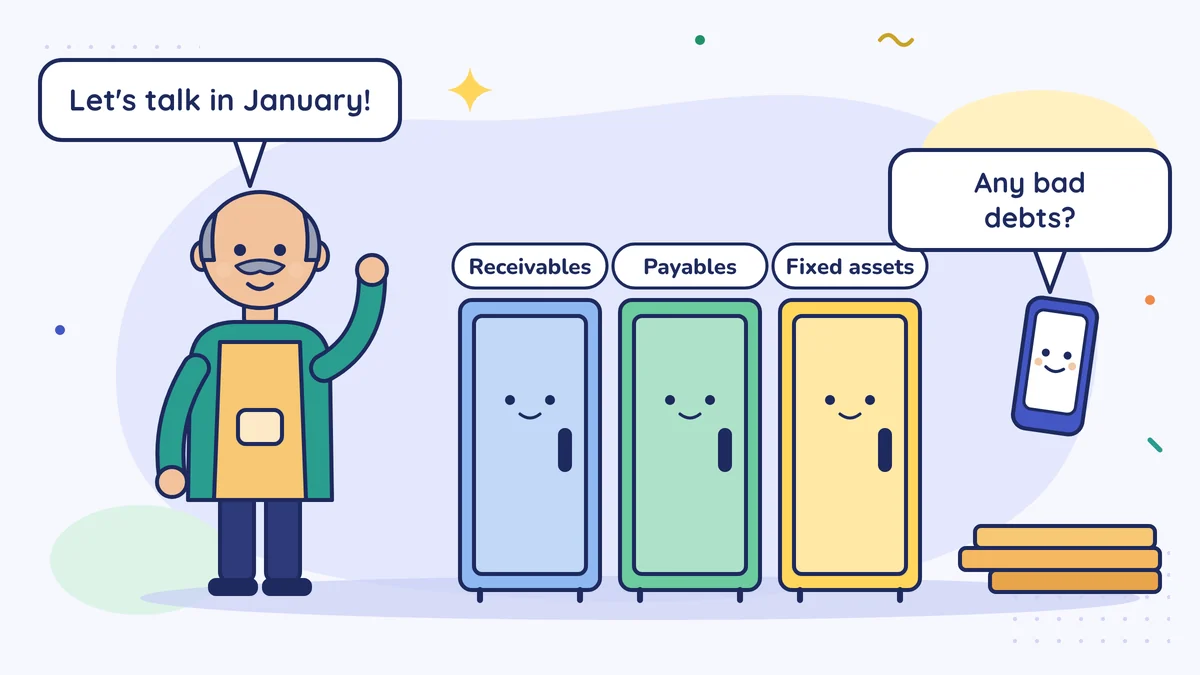
When January comes, the questions are answered on the phone, not on paper; half is remembered, half is forgotten. In the big house clean before a holiday, you go cupboard by cupboard and decide what stays and what goes. The year-end file is like that: receivables, payables and fixed assets, each one a separate cupboard.
1. Account reconciliation: do both sides see the same figure?
A current account (cari hesap), that is, the credit book, has two sides. If your records show a 48,000 lira receivable from a customer, their records should show a 48,000 lira debt to you. Comparing these two figures at the end of the year is called account reconciliation (cari mutabakat).
How it is done:
- List the customers and suppliers you do the most business with.
- Send each of them a written message: "As of 31.12.2026 our records show a receivable of 48,000 lira from you. Is it the same in your records?"
- Keep the replies. If there is a difference, find the reason: usually it is a forgotten invoice, an unprocessed return or a payment still on its way.
An example reconciliation letter is in the article How is account reconciliation done? (in Turkish). If you send the messages in the first week of January, the replies arrive before your mali müşavir closes the books.
2. Receivables you cannot collect: tell your mali müşavir in December
Some receivables never come in. We covered the two routes in the Tax Procedure Law, the doubtful receivable (şüpheli alacak) (art. 323) and the worthless receivable (değersiz alacak) (art. 322), in the lesson Credit sales and payments. At the end of the year there are three things you need to know.
- The provision is set aside at the close of the year in which the lawsuit or enforcement proceedings began. The provision (karşılık) set aside for a doubtful receivable makes that receivable an expense of that year. The Revenue Administration (Gelir İdaresi) does not accept a provision that was not set aside in that year being set aside in later years (there is also a ruling of the Council of State, Danıştay, to the contrary). So the list of receivables you took to court or to enforcement this year should go to your mali müşavir in December.
- For amounts not worth a lawsuit, the 2026 limit is 25,000 lira. A receivable below this amount may count as a doubtful receivable if it was not paid despite being requested more than once in writing or by formal protest (protesto) (VUK art. 323; VUK General Communiqué No. 588, 588 Sıra No'lu VUK Genel Tebliği). The day the letter reached the other party must be provable: by registered letter with return receipt (iadeli taahhütlü mektup), courier or KEP (registered electronic mail, kayıtlı elektronik posta). The Revenue Administration does not accept email, SMS or WhatsApp messages as sufficient proof.
- This route is for those keeping books on the balance-sheet basis (bilanço esası). If you keep a business book (işletme defteri), no provision is set aside; still give your mali müşavir the list of your unpaid receivables.
Hasan Abi had two receivables: 120,000 lira from a building contractor, which his lawyer had taken to enforcement, and 18,000 lira from a customer, which he had requested twice, on different days, by registered letter with return receipt, and which had not been paid. He gave both to his mali müşavir with their documents; the mali müşavir decided which one a provision would be set aside for.
3. Fixed asset list: what did you buy, sell, throw away?
A fixed asset (demirbaş) is something you use in the business for more than one year: a workbench, a machine, a computer, a vehicle. That is how it differs from goods you buy in order to sell.
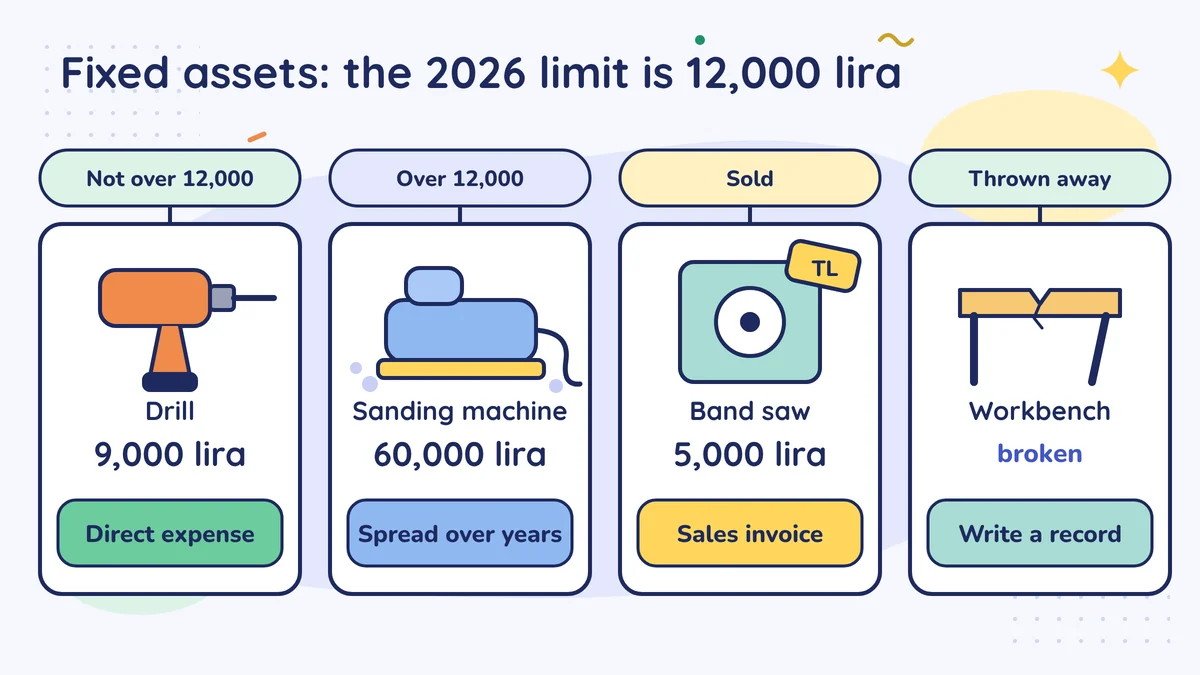
- In 2026 a fixed asset costing no more than 12,000 lira each can be recorded directly as an expense (VUK art. 313; VUK General Communiqué No. 588). If you are a VAT taxpayer, this limit is checked against the price excluding VAT.
- A fixed asset above this amount becomes an expense not all at once but spread over the years. This is called depreciation (amortisman). The Ministry of Finance's list determines over how many years each item becomes an expense (VUK General Communiqué No. 333, 333 Sıra No'lu VUK Genel Tebliği, and later amendments); your mali müşavir does the calculation.
Hasan Abi's 2026 went like this: he bought a sanding machine for 60,000 lira and a drill for 9,000 lira, sold the old band saw for 5,000 lira, and threw away a broken workbench.
| What happened | How it is recorded |
|---|---|
| Drill, 9,000 lira | Below 12,000 lira; can be recorded directly as an expense |
| Sanding machine, 60,000 lira | Spread over the years. For example, if the list says 5 years, 12,000 lira a year becomes an expense |
| Saw sold, 5,000 lira | A sales invoice is issued; the machine is removed from the records |
| Workbench thrown away | Removing it from the records has its own procedure; write when and why it was thrown away in a dated record and ask your mali müşavir |
Six columns are enough for your fixed asset list: what, when bought, how many lira, invoice number, where it is kept, status (in use, sold, thrown away). Something sold or thrown away is not deleted from the list; its status changes.
A note: the inflation adjustment (enflasyon düzeltmesi) you have often heard about in recent years on the balance-sheet basis will not be made for tax purposes in the 2025, 2026 and 2027 accounting periods, including the provisional tax (geçici vergi) periods (VUK provisional art. 37; Law No. 7571, Official Gazette 25.12.2025, issue 33118). The only exception is businesses dealing solely in the buying, selling and manufacturing of worked gold and silver; if you are a jeweller, ask your mali müşavir.
4. If you are a company: certifying the books is December's last job
For books kept on paper there are two routes. If a new book is to be opened (such as the inventory book), its opening certification is done at a notary in the month before the year in which it will be used; for 2027 the last day is 31 December 2026. If the blank pages of the old book are enough, the inventory book and the decision book (the board of directors' decision book in a joint-stock company, the board of managers' decision book in a limited company) are taken to a notary for interim certification in the first month of the new year; since 31 January 2027 is a Sunday, don't leave this to the last week. The same rule applies to the inventory book for a sole proprietorship keeping books on the balance-sheet basis. The share register and the general meeting minutes book can be used without being certified again every year, as long as their blank pages last (Turkish Commercial Code, Türk Ticaret Kanunu, art. 64). For the journal (yevmiye defteri) and the general ledger (büyük defter) kept as an e-Ledger (e-Defter), you do not go to a notary. The certification of books kept in the Defter-Beyan System is also done through the system. Ask your mali müşavir at the start of December which of your books need to go to the notary.
Hasan Abi's file
This year Hasan Abi didn't wait for January. On 20 December he sent his mali müşavir a single file: the list of receivables in enforcement and unpaid, the fixed asset list, and the invoice for the saw he sold. On 4 January he sent reconciliation messages to twelve customers and suppliers. One replied, "we show 6,000 lira less"; the missing item was a return invoice issued in November. The year-end conversation that used to take half an hour on the phone took ten minutes this time.
Do this this week
Write every fixed asset you bought, sold or threw away this year on a single list (what, when, how many lira, invoice number, where, status) and send the list to your mali müşavir in the first week of December.
Common mistakes
- Remembering a bad debt in January. The provision for a doubtful receivable is set aside at the close of the year in which the lawsuit or enforcement proceedings began; if that year is missed, setting it aside the next year becomes disputed. The list should go to your mali müşavir in December.
- Not mentioning a fixed asset that was sold or thrown away. A machine that is in the records but not in the workshop goes on being depreciated for years; issue an invoice for what you sell and write down what you throw away.
- Doing the reconciliation verbally. "We talked on the phone, it matches" is not a record. The message and the reply should be in writing and kept.
Sources
- Tax Procedure Law No. 213 (Vergi Usul Kanunu), art. 313 (depreciation and direct expense), art. 322–323 (worthless and doubtful receivables) (mevzuat.gov.tr)
- TÜRMOB: VUK General Communiqué No. 588 (588 Sıra No'lu VUK Genel Tebliği), 2026 amounts (12,000 lira for art. 313, 25,000 lira for art. 323)
- Muhasebetr: 2026 thresholds and amounts (had ve miktarlar)
- KPMG: The provision that inflation adjustment will not apply in 2025, 2026 and 2027 (Law No. 7571, Official Gazette 25.12.2025)
- İSMMMO: Law No. 7571, VUK provisional art. 37 (Official Gazette 25.12.2025, issue 33118)
- Alomaliye: Doubtful receivables (the year the provision is set aside, proving the written request, the balance-sheet basis condition)
- Alomaliye: 2026 book certification dates (e-Defter, Defter-Beyan System)
Translated from the Turkish lesson. Last checked against Turkish rules: 12 October 2026. Not yet reviewed by a licensed accountant.
This is general information about Turkish rules, not financial, tax or legal advice. Rules change; check the date and the sources, and ask a licensed accountant (mali müşavir) about your own situation. Disclaimer