The uniform chart of accounts: the accounts you see most often, from 100 cash to 770
You don't need to be an accountant to know what your mali müşavir means by "there's 340,000 in 120". Reading account codes like an address, the nine main blocks, the accounts you will hear most often, 191 and 391 which close every month, and the path of expenses from 770 to 632.
The uniform chart of accounts (tekdüzen hesap planı) is the common list of accounts used by those keeping books on the balance-sheet basis. The first digit of the code gives the main block: 1 current assets, 2 fixed assets, 3 and 4 liabilities, 5 equity (özkaynak), 6 income statement (gelir tablosu), 7 cost accounts. The ones seen most often are 100 cash, 102 banks, 120 trade receivables, 320 trade payables, 191 deductible VAT, 391 output VAT, 600 domestic sales and 770 general administrative expenses.
Erkan Bey's "what was 120?" question
The rules described in this lesson are those of Turkish law.
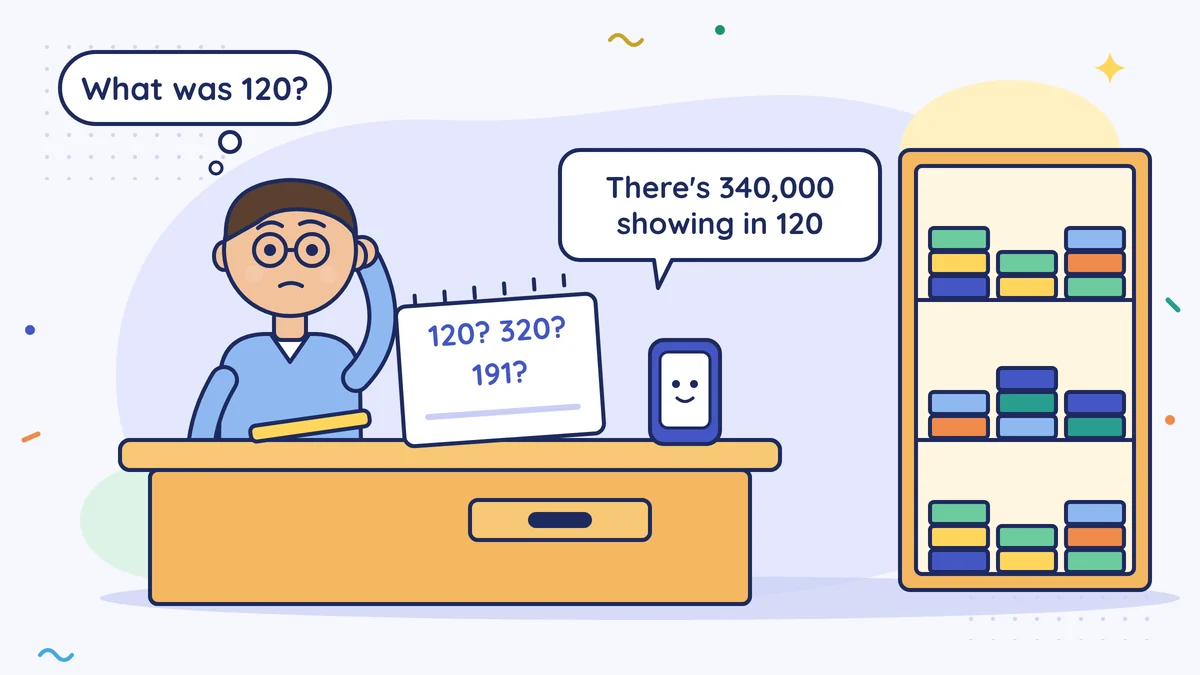
Erkan Bey's stationery wholesale business is a limited company; it sells notebooks, pens and paper to schools and offices. His phone calls with his mali müşavir (accountant) are full of numbers: "There's 340,000 showing in 120, let's take a look at 320 too, 191 came out higher this month, VAT carried forward." Erkan Bey takes notes every time, and when he hangs up he asks: "What was 120?"
These numbers are part of a common language that every mali müşavir uses: the uniform chart of accounts (tekdüzen hesap planı). In this lesson we look at the map of that language and at the accounts you will hear most often.
Why does everyone use the same numbers?
The uniform chart of accounts was laid down by the General Communiqué on the Application of the Accounting System No. 1 (1 Sıra No'lu Muhasebe Sistemi Uygulama Genel Tebliği), and those keeping books on the balance-sheet basis (bilanço esası) use this chart (apart from institutions with their own chart of accounts, such as banks and insurance companies). So the 120 of a mali müşavir in İzmir and the 120 of one in Erzurum are the same thing: amounts owed by customers. Whether you change your mali müşavir or a bank asks for statements for a loan, everyone reads the same map.
If you keep a business book (işletme defteri), this chart is not in your book; read this lesson to understand your mali müşavir's language.
Like an address
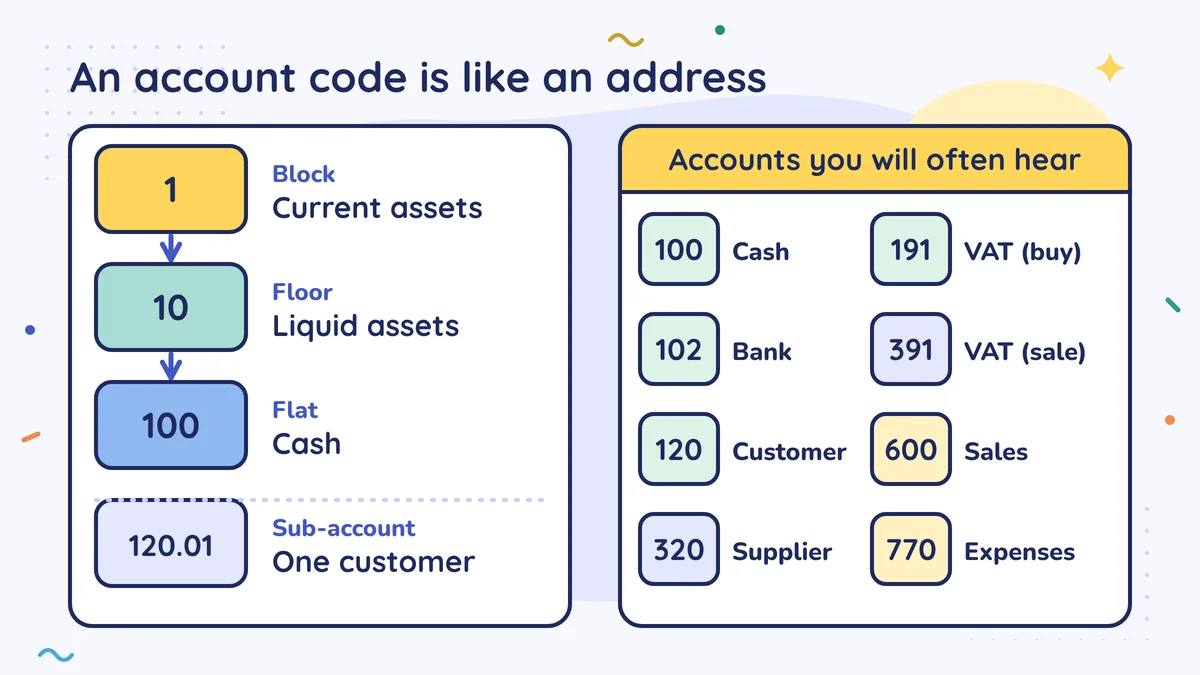
Read an account code like an address in a housing estate. The first digit is the block, the first two digits the floor, three digits the flat:
- 1 Current assets (block)
- 10 Liquid assets (hazır değerler) (floor)
- 100 Cash (flat)
The parts after a dot that come after the flat are the business's own sub-accounts: 120.01 one customer, 120.02 another customer. The three-digit codes are the same for everyone; each business opens sub-accounts to suit its own needs.
Nine blocks
| First digit | Name | What sits there? |
|---|---|---|
| 1 | Current assets | Things that will turn into money within one year: cash, bank, receivables, stock |
| 2 | Fixed assets | Things used for years: machinery, vehicles, fixtures |
| 3 | Short-term liabilities | Debts to be paid within one year |
| 4 | Long-term liabilities | Debts to be paid after one year |
| 5 | Equity | Capital and profit left in the company |
| 6 | Income statement accounts | Sales, cost of goods sold, where expenses end up at year end |
| 7 | Cost accounts | Where expenses build up during the year |
| 8 | Unassigned | Left empty |
| 9 | Memorandum accounts | Records kept for information that do not go into the balance sheet |
The first five blocks are the lines of the balance sheet, and 6 is the lines of the income statement. The rule in the lesson Debit and credit can also be read from here: accounts starting with 1 and 2 increase on the debit side, those starting with 3, 4 and 5 on the credit side. There are a few exceptions: contra accounts such as accumulated depreciation (birikmiş amortisman), that is, accounts that show an asset's value by reducing it, sit in the asset block but work on the credit side; losses of previous years sit in the equity block but work on the debit side.
The accounts you will hear most often
| Code | Name | What does it tell you? | Normal balance |
|---|---|---|---|
| 100 | Cash (kasa) | The cash in the drawer | Debit |
| 102 | Banks (bankalar) | The money in bank accounts | Debit |
| 120 | Trade receivables (alıcılar) | What customers owe you, that is, credit sales | Debit |
| 153 | Merchandise (ticari mallar) | Goods you bought to sell | Debit |
| 191 | Deductible VAT (indirilecek KDV) | The VAT you paid on purchases | Debit |
| 320 | Trade payables (satıcılar) | What you owe suppliers | Credit |
| 391 | Output VAT (hesaplanan KDV) | The VAT you collected from customers on sales | Credit |
| 600 | Domestic sales (yurt içi satışlar) | Your domestic sales, excluding VAT | Credit |
| 770 | General administrative expenses (genel yönetim giderleri) | Expenses related to management: office rent, accounting fees, administrative staff | Debit |
Alongside these, a few neighbours you will often come across: 131 receivables from partners (A partner taking money out of the company), 190 VAT carried forward, 335 debts to personnel, 360 taxes and funds payable, 361 social security deductions payable, 500 capital. Expenses related to sales (shop rent, advertising, transport) are tracked in 760 marketing, selling and distribution expenses; your mali müşavir decides which expense is written to which account.
191 and 391: two accounts that close every month
During the month the VAT on purchase invoices builds up in 191, and the VAT on sales invoices in 391. When the VAT return is prepared, the two are compared; if there is VAT carried forward from the previous month in 190, it is added to the purchases side too. If 391 is bigger, the difference moves to 360 as VAT payable. If 191 is bigger, the difference moves to 190 as VAT carried forward to the next month. In this way 191 and 391 go back to zero every month. You saw the logic of the calculation in the lesson Calculating VAT line by line; here you are only learning their addresses.
When Erkan Bey's mali müşavir said "191 came out higher, VAT carried forward", this is what it meant: that month sales to schools were low and goods taken into the warehouse were high; the VAT paid on purchases exceeded the VAT on sales, and the difference was written to 190.
The road from 7 to 6
During the year expenses build up in accounts starting with 7, such as 760 marketing, selling and distribution, 770 general administration and 780 financing expenses. At the end of the period these amounts are transferred to the 6 accounts in the income statement through allocation accounts (yansıtma hesapları; 771 for 770); the counterpart of 770 is 632 general administrative expenses. That is why you see 770 in the trial balance (mizan) during the year and 632 in the year-end statement. The same expense appears in two places; don't add them together.
The Communiqué allows two options for block 7. Under 7/A, expenses are tracked by function (administration, sales, production). Under 7/B, they are collected by type (such as materials, personnel, rent) in accounts starting with 79. Production and service businesses above a certain size, and those required to prepare additional financial statements, must use 7/A; the others may choose 7/B; the two are not used together. Your mali müşavir knows which one your company uses. The examples in this lesson follow 7/A.
Erkan Bey's card
Erkan Bey wrote the most common accounts on a card and put it next to his phone. In the next call, when his mali müşavir said "there's 340,000 in 120", he answered without looking at the card: "That's what the schools owe me. 200,000 of it comes in November."
In one sentence
The uniform chart of accounts is every mali müşavir's shared address book: the first digit gives the block, three digits give the account; 100 cash, 102 bank, 120 customer, 320 supplier, 191 and 391 VAT, 600 sales, 770 expenses.
Do this this week
Ask your mali müşavir for the chart of accounts your company uses, including its sub-accounts. Write on a piece of paper the codes under 120 for your five biggest customers and under 320 for your five biggest suppliers, and put it next to your phone.
Common mistakes
- Thinking sub-account codes are the same everywhere. 120 is amounts owed by customers for everyone; but which customer 120.01 is varies from business to business.
- Thinking the VAT carried forward in 190 is money the state owes you. VAT carried forward is not paid back to you in cash; it is used in the following months by deducting it from the VAT on sales. Only in some cases listed in the law (for example exports, sales at reduced rates or sales subject to VAT withholding) does a refund route open; your mali müşavir knows whether it opens in your business.
- Thinking 770 and 632 are two separate expenses. The same expense appears in 770 during the year and in 632 at year end; if you add them together, you count the expense twice.
Sources
- General Communiqué on the Application of the Accounting System No. 1 (1 Sıra No'lu Muhasebe Sistemi Uygulama Genel Tebliği), Official Gazette 26.12.1992 / 21447 repeated issue (Alomaliye copy)
- Muhasebetr: The uniform chart of accounts (account classes and account names)
- Muhasebetr (Necdet Sağlam): the 7/A and 7/B options; the 7/A requirement for production and service businesses above the limit, and the two options not being usable together
- Muhasebetr (Koray Ateş): period-end closing entries; transfer to 632 through 770 and 771 allocation
- Value Added Tax Law No. 3065 (3065 sayılı Katma Değer Vergisi Kanunu), art. 29 (deduction) (mevzuat.gov.tr)
- TÜRMOB (Union of Chambers of Certified Public Accountants of Turkey)
Translated from the Turkish lesson. Last checked against Turkish rules: 13 October 2026. Not yet reviewed by a licensed accountant.
This is general information about Turkish rules, not financial, tax or legal advice. Rules change; check the date and the sources, and ask a licensed accountant (mali müşavir) about your own situation. Disclaimer