Credit sales and payments: who owes you, and whom do you owe?
Invoices are issued but the money doesn't come in. With Hülya Hanım the printer's list of receivables, we look at putting a due date on every sale, sorting receivables by how late they are, reminding politely but regularly, the debt calendar and the three-question check at month end.
Put a written due date on every sale, sort receivables by how late they are rather than by amount, and update the list once a week. A short message before the due date, a phone call once it is late, and after 30 days talk about the old debt before any new work; record every payment received in the current account the same day. If you are registered for VAT, you declare the VAT on a credit-sale invoice before the money arrives, and pay what remains after deducting the VAT on your purchases; an uncollectable receivable doesn't become an expense by itself, so ask your mali müşavir (accountant).
Hülya Hanım the printer's "everyone pays in the end"
Hülya Hanım runs a small print shop. She prints business cards, brochures and catalogues for twelve firms. She tells all of them "pay at the end of the month". Business is good, invoices are being issued. But at the start of November she has no money to pay the paper supplier.
She looked at her book: she has 49,000 lira of receivables outstanding. 6,000 lira of it has been sitting there for three months and nobody has asked about it. She had forgotten it herself.
In this lesson we set up how to track who owes you and whom you owe: due dates, reminders, collection and a short month-end check. You saw what a current account (cari hesap), that is, the credit book, is in the lesson Credit sales and current accounts. Here we move on to the routine that makes it work.

Every sale should have a due date
The due date (vade) is the day the money is to be paid. "Pay at the end of the month" is not a due date, it is a wish. When you issue the invoice or take on the job, write the due date: "Payment within 30 days, last day 15 December 2026." A due date written in the invoice description, the quotation or the contract shows the same date to both parties.
Each customer's current account should show three things: invoices issued, payments received and the balance between them. When a payment arrives, also write which invoice it is for. With partial payments this prevents the later argument "which one had I paid?"
Sort the list of receivables by age
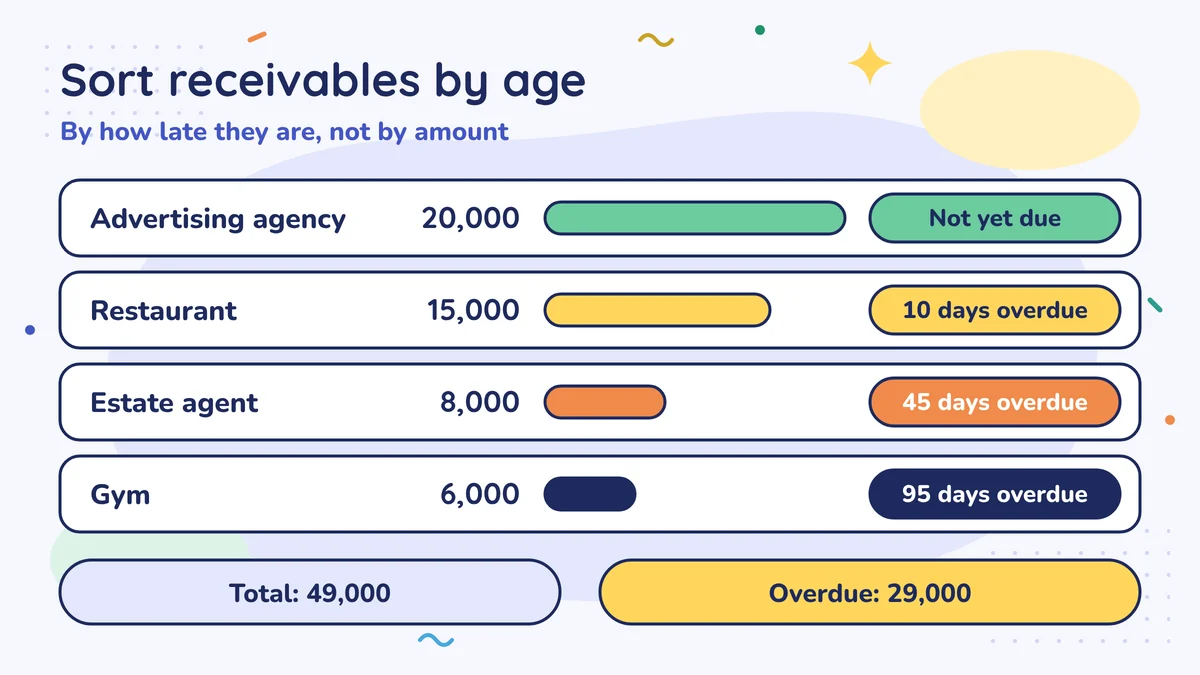
Sort receivables not by amount but by how late they are. In accounting this is called ageing receivables; the logic is like opening the fridge and first looking at what is about to go past its date.
Hülya Hanım's list:
| Customer | Amount | Status |
|---|---|---|
| Advertising agency | 20,000 | Not yet due |
| Restaurant | 15,000 | 10 days overdue |
| Estate agent | 8,000 | 45 days overdue |
| Gym | 6,000 | 95 days overdue |
| Total | 49,000 |
The total looks good. But the overdue part is 29,000 lira, and 6,000 lira of it is now a difficult receivable. The longer a receivable is overdue, the harder it is to collect. Update this list once a week.
Reminders: polite, written, on time
Asking for money bothers nobody, if it is asked for regularly. Set up a calendar:
- 3 days before the due date: a short message. "Hello, I wanted to remind you of our invoice of 15,000 TL due on 15 December. The IBAN is below."
- If payment doesn't arrive on the due date: one more message the next day.
- 7 days after the due date: a phone call. Ask when they will pay and note the date.
- After 30 days: before taking on new work, talk about the old debt. Do the new work for cash in advance or with a partial advance payment.
Making reminders in writing leaves a trace. If there is a dispute later, you will have the date and the amount in hand.
When a payment arrives, record it in the current account the same day. Receiving payment from a firm through the bank is the cleanest. In 2026, collecting more than 30,000 TL from a customer through a bank or PTT is in any case mandatory (VUK General Communiqué No. 459, as amended by No. 575).
The VAT on credit sales doesn't wait
If you are registered for VAT, you put the VAT on the invoice on the return for the month the invoice belongs to, without waiting for the customer to pay. The VAT you paid on purchases that month is deducted from it (VAT Law art. 29, deduction), and you pay the rest, even if the customer's money hasn't arrived. The VAT on the invoices Hülya Hanım issued in September and still hasn't collected was paid in October. So a late receivable holds up not only your profit but also the money in your cash box. If you are under simplified taxation you don't file a VAT return; this part doesn't concern you.
The situation is similar for income tax. On the operating account book or balance sheet basis, an invoice you issued counts as that period's sale even if the money hasn't come in; it goes into provisional tax and the annual return. In self-employed professions (such as lawyers and architects) the rule is different: income arises when the money is received.
A receivable that can't be collected
Sometimes the money doesn't come. Such a receivable doesn't become an expense by itself. The Tax Procedure Law recognises two routes:
- Doubtful receivable (art. 323): For receivables at the lawsuit or enforcement stage, and for receivables too small to be worth a lawsuit that remain unpaid despite a protest or more than one written request, a provision can be set aside and expensed before the receivable is written off. The receivable must have arisen from the business; no provision is set aside for the secured part. In practice this route is for those who keep books on a balance sheet basis.
- Worthless receivable (art. 322): A receivable that a court decision or a conclusive document shows can no longer be collected is written off as a loss.
The conditions and when to apply them are your mali müşavir's job. Written reminders matter here too: for a small receivable, more than one written request is a condition. Ask your mali müşavir which kind of writing (e-mail, KEP (registered electronic mail), a notary's warning) counts as enough. If a large receivable has passed three months, let your mali müşavir know; talk to them before going to a lawyer, too.
Whom do you owe: the payment calendar
Like your receivables, your debts should also have a list: supplier, amount, due date. Put the due dates in your calendar. If you see in advance how much will go out in which week, you are prepared even if a receivable is late. You set up the calendar of money coming in and going out in the lesson Cash flow calendar; the list of receivables and debts feeds that calendar.
If you see that you won't be able to pay, don't wait for the due date. Call the supplier in advance and give a new date. A delay you announce protects the relationship; an unannounced delay leads to being asked for cash in advance on the next purchase.
If there is a difference: compare accounts
With customers and suppliers you do a lot of business with, compare accounts now and then: "Our records show 15,000 TL receivable from you; is that what you have too?" This is called reconciliation (mutabakat). If there is a difference, the reason is usually a forgotten invoice, a wrongly recorded payment or a return. You can find how it is done in the article How to do a current account reconciliation? (in Turkish).
Five minutes at month end
The full month-end check is in the lesson The 30-minute month-end checklist. For receivables and debts, answer three questions there:
- Who is overdue, and on which day will a reminder go to whom?
- Next month, whom will I pay, on which day, and how much?
- Have all the payments received this month been recorded in the current account?
Hülya Hanım's November
Hülya Hanım sorted the list by age and within a week sent three messages and made two phone calls. The restaurant paid the next day. The estate agent paid half and gave a date for the rest. She agreed with the gym to do new work for cash in advance, and got a payment plan for the old debt in writing. The paper supplier was paid on the due date.
Do this this week
Write all your receivables in one list: customer, amount, due date, how many days overdue. This week send a short, polite message to those that are overdue, and phone those more than 30 days overdue. Add your debts to suppliers with their due dates to the same list and put them in your calendar.
Common mistakes
- Giving credit without a due date. "You'll pay at the end of the month" is not a date. Without a written due date you can't tell what is late.
- Feeling relieved by looking at total receivables. 29,000 lira of 49,000 lira of receivables may be overdue. Sort receivables by how long they are overdue.
- Recording a payment received in the current account late. You bother a customer who has already paid with a reminder message; with partial payments it gets confusing which invoice has been closed.
Sources
- Tax Procedure Law No. 213, art. 322 (worthless receivables) and art. 323 (doubtful trade receivables) (mevzuat.gov.tr)
- Doğan Çengel (YMM): doubtful receivables, conditions and the balance sheet basis (Alomaliye)
- Value Added Tax Law No. 3065, art. 29 (deduction) (mevzuat.gov.tr)
- Value Added Tax Law No. 3065, art. 10 (taxable event) (mevzuat.gov.tr)
- VUK General Communiqué No. 459, as amended by No. 575: 30,000 TL limit for collections (Cott summary)
- Turkish Commercial Code No. 6102, art. 21/2 (objecting to an invoice) (mevzuat.gov.tr)
Translated from the Turkish lesson. Last checked against Turkish rules: 12 October 2026. Not yet reviewed by a licensed accountant.
This is general information about Turkish rules, not financial, tax or legal advice. Rules change; check the date and the sources, and ask a licensed accountant (mali müşavir) about your own situation. Disclaimer