The December count: what do stock, cash and bank say on 31 December?
The books tell you what you should have; the count tells you what you really have. On 31 December you count the goods on the shelf at purchase price, record the cash box in a signed note, and compare bank and card statements with the records. With a worked example of how an undercount or overcount shifts profit.
At the end of the year, as of 31 December, the goods on the shelf are counted at purchase price, the cash in the cash box is counted and written into a signed record, and a 31 December statement is obtained for every bank account, card and loan and compared with the records. This list is called the inventory (envanter) (VUK art. 185–186); because the stock figure directly changes the year's profit, a wrong count shifts profit from one year to the next. Under simplified taxation the rules are different; ask your mali müşavir.
Emre Bey the stationer's 31 December
The rules described in this lesson are those of Turkish law.
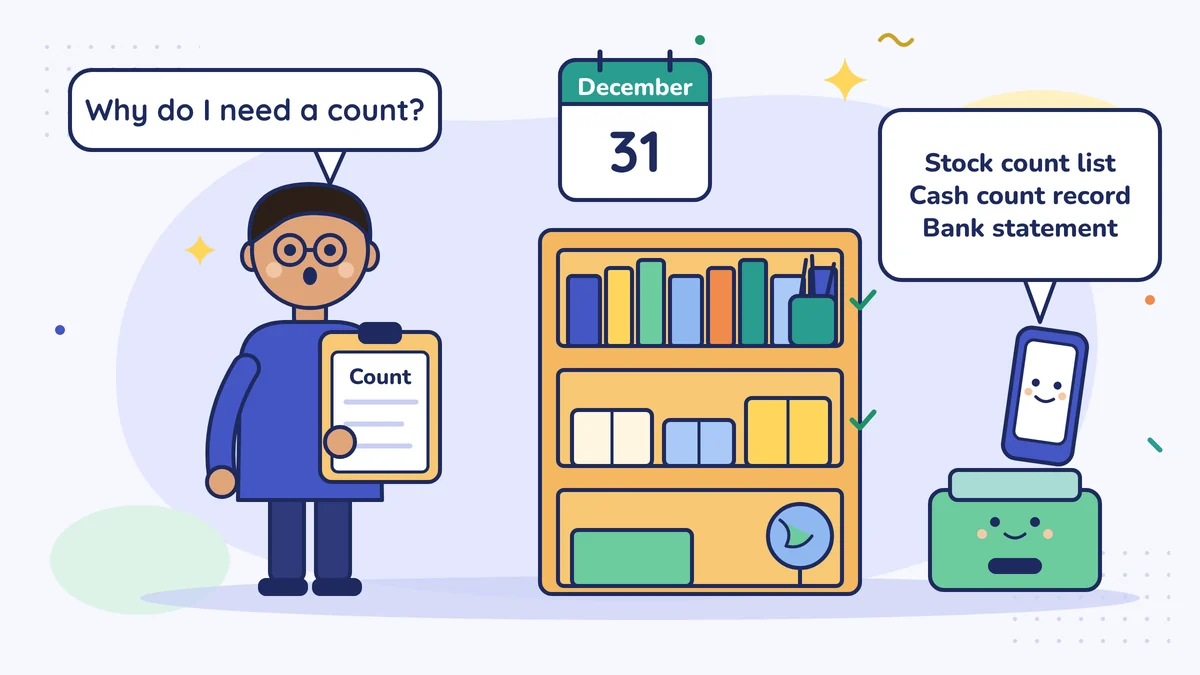
Emre Bey's stationery shop is on the way to the school. In September the shelves empty, in January they fill up again. At the start of December his mali müşavir (accountant) sent him a message: "On the evening of 31 December I'm expecting your stock count list, your cash count record and your bank statements." Emre Bey was surprised: "I already have everything entered in the books. Why do I need a count?"
The books tell you what you should have. The count tells you what you really have. At the end of the year the two are put side by side. It is like a café owner counting the cash box every evening and comparing it with the day's sales; only this time it is once a year, for the whole shop.
Inventory: the year-end photograph
The list of what the business has at the end of the year, what it is owed and by whom, and what it owes and to whom, is called the inventory (envanter) (Tax Procedure Law, Vergi Usul Kanunu, VUK, art. 185–186). On the balance-sheet basis (bilanço esası) this list goes into the inventory book (envanter defteri). If you keep a business book (işletme defteri), the goods left at the end of the year also enter the profit calculation. Under simplified taxation the rules are different; ask your mali müşavir about your situation.
In this lesson we look at three parts of the photograph: the goods on the shelf, the cash in the cash box and the money in the bank. Receivables, payables and fixed assets (demirbaş) are in the next lesson.
The count changes your profit
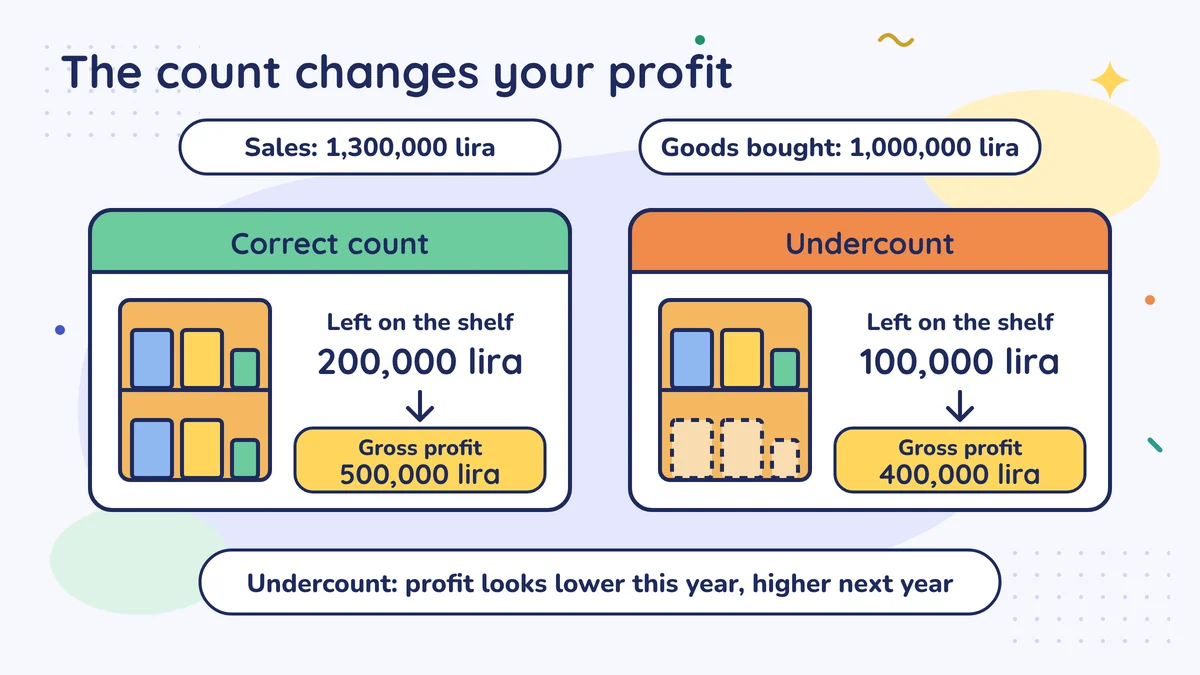
Let's see it in figures. Suppose Emre Bey started the year with empty shelves (in reality, goods left over from last year also enter the calculation; here we keep it simple).
| Item | Correct count | Undercount |
|---|---|---|
| Sales during the year | 1,300,000 | 1,300,000 |
| Goods bought during the year | 1,000,000 | 1,000,000 |
| Goods left on the shelf on 31 December | 200,000 | 100,000 |
| Cost of goods sold (bought − left) | 800,000 | 900,000 |
| Gross profit | 500,000 | 400,000 |
If 100,000 lira of goods are left out of the count, profit looks lower than it really is this year and higher next year. If goods are overcounted, the opposite happens: this year's profit and tax are inflated. A wrong count shifts profit from one year to the next; a correct count keeps both years right.
How is the count done?
The method for the short count you do every month is in the lesson Stock: money waiting on the shelf. A few things are different in the year-end count.
- Fix the day and the time. Thursday 31 December 2026, after the shop closes. If the count is done the next day, the sales in between are added to the list separately.
- Count with two people. One counts, one writes. Then swap places and recount a few shelves.
- Write purchase prices. Merchandise (emtia), that is, goods you bought in order to sell, is as a rule valued at cost (VUK art. 274). Not the sales price on the label, but the purchase price on the invoice.
- List goods that can't be sold separately. Broken, damaged, out-of-fashion or out-of-date goods. There are separate rules for reducing their value; your mali müşavir decides, you just list them separately.
- Separate what isn't yours. Consignment goods on the shelf (left by a supplier on a "sell it, pay me later" basis) are listed separately. Goods you have paid for but that have not yet arrived also get a separate note.
The list has five columns: product, quantity, unit purchase price, amount, note. At the bottom, the people who did the count write the date and sign.
Cash box: do the drawer and the books agree?
On the evening of 31 December, count the cash in the cash box and compare it with the cash balance in the records. Write the result on a dated, signed sheet of paper: this is called a cash count record (kasa sayım tutanağı).
In Emre Bey's records the cash box showed 45,000 lira; there were 6,000 lira in the drawer. Most of the 39,000 lira difference was money he had taken from the cash box during the year and taken home, but never written down anywhere. This difference is not hidden; it is reported to the mali müşavir. In a sole proprietorship the mali müşavir corrects it as money drawn from the business; in a company the situation is different: it is recorded as money the partner took from the company, and interest may have to be calculated on it. The details are in the lesson Business money and pocket money. Money that is in the books but not in the drawer is the easiest error to correct before the year closes.
Bank and card: the 31 December statement
Get the statement dated 31 December for every bank account, credit card and loan. Check whether the balance on the statement is the same as the balance in the records. This is the year-end version of the check you do every month (The 30-minute month-end checklist).
If there is a difference, the reason is usually one of these:
- A bank commission, account maintenance fee or interest has not been recorded.
- A transfer has come in, but who it came from has not been written down.
- A card sale on 31 December will reach the bank in January. This difference is natural; just make a note of it.
If you have a foreign currency account, get its statement in that currency too; your mali müşavir converts the balance into lira at the 31 December exchange rate.
If you have a loan, ask the bank for a written breakdown showing the remaining principal as of 31 December. Your mali müşavir enters the debt on the balance sheet based on this document.
Emre Bey's New Year's Eve
On 31 December Emre Bey closed the shop an hour early. With his son, he counted the shelves in two hours: 3,400 items, 212,000 lira. He listed the broken calculators and last year's diaries separately. He counted the cash box and noted the difference in the record. On the morning of 2 January he sent the four bank statements, the count list and the record to his mali müşavir. The reply was short: "For the first time this year, January will be easy for me."
Do this this week
Today, prepare the template for your year-end count list (columns: product, quantity, unit purchase price, amount, note) and put a two-hour "year-end count" appointment in your calendar for the evening of 31 December 2026.
Common mistakes
- Counting goods at the sales price. A count at the price on the label inflates the stock, and so the profit and the tax. The count is done at the purchase price on the invoice.
- Quietly closing a cash difference. Writing the difference between the records and the drawer in a signed record and telling your mali müşavir is easier than an error carried for years.
- Doing the count in mid-January and not deducting the sales in between. The count must be as of 31 December; if it is done later, the goods sold and received from 1 January to the day of the count are listed separately.
Sources
- Tax Procedure Law No. 213 (Vergi Usul Kanunu), art. 185–186 (inventory), art. 274 (valuation of merchandise) (mevzuat.gov.tr)
- GİB, Tax Return Guide for Taxpayers Earning Commercial Income 2026 (Ticari Kazanç Elde Eden Mükellefler İçin Beyanname Rehberi)
- Alomaliye: Books to be kept in 2026 and their certification
Translated from the Turkish lesson. Last checked against Turkish rules: 12 October 2026. Not yet reviewed by a licensed accountant.
This is general information about Turkish rules, not financial, tax or legal advice. Rules change; check the date and the sources, and ask a licensed accountant (mali müşavir) about your own situation. Disclaimer