For those keeping a business book: the business account summary
If you keep a business book as a sole proprietorship, what you have is not a balance sheet but a one-page business account summary. Using an upholsterer's sample summary, we look at its two sides, how closing stock affects profit, what the summary leaves out and a five-question check before the tax return.
The business account summary (işletme hesabı özeti) is the year-end statement of a sole proprietorship that keeps a business book. On one side are opening stock, purchases during the year and expenses; on the other are sales, other income and the goods left on the shelf at the year-end count; the difference between them is profit or loss. The commercial earnings on the annual income tax return are made up from this summary. Cash, bank, receivables and debts are not in this statement.
Recep Usta's single page
The rules described in this lesson are those of Turkish law.
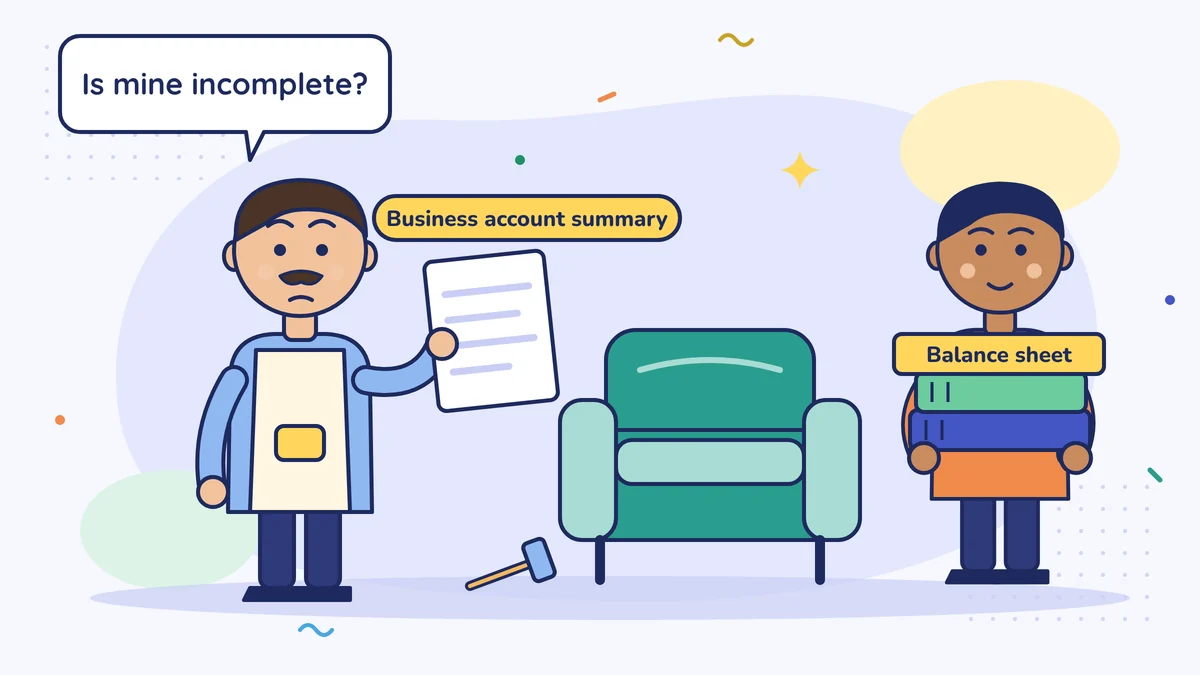
Recep Usta is a furniture upholsterer. He has a sole proprietorship in his own name and keeps a business book (işletme defteri). His neighbour got a thick balance sheet (bilanço) and income statement (gelir tablosu) from his limited company's mali müşavir (accountant). Recep Usta, on the other hand, holds a one-page statement: "Business account summary." He looks at his neighbour and asks: "Is mine incomplete?"
It isn't incomplete. It is the year-end summary of a simpler book. In this lesson we read that page line by line.
Who keeps a business book?
The Tax Procedure Law divides traders into two classes. Sole proprietorships whose purchases, sales or business revenue stay below the limits in the law are second class and keep books on the business account basis (işletme hesabı esası) (Tax Procedure Law art. 177–178). Sole proprietorships above the limits, and limited, joint-stock, general and limited partnership companies, keep books on the balance-sheet basis (Tax Procedure Law art. 177). The limit amounts are updated every year; ask your mali müşavir for the current figure for your business. A second-class trader who wishes can also choose the balance-sheet basis (Tax Procedure Law art. 179).
If you are under simplified taxation (basit usul), none of this concerns you: you do not keep statutory books, your purchase and sales documents are recorded in the Defter-Beyan System, your earnings from this business are exempt from income tax, and you do not file an annual return for these earnings (Simplified taxation or real taxation?).
Two columns, like a corner shop's notebook
Think of an old corner shop notebook: on one page the money going out, on the facing page the money coming in. At the end of the month both sides are added up, and the difference is what is left. The business book works the same way: expenses on one side, revenue on the other. At the end of the year both sides are added up, and the difference is profit or loss.
Recep Usta's summary (sample figures)
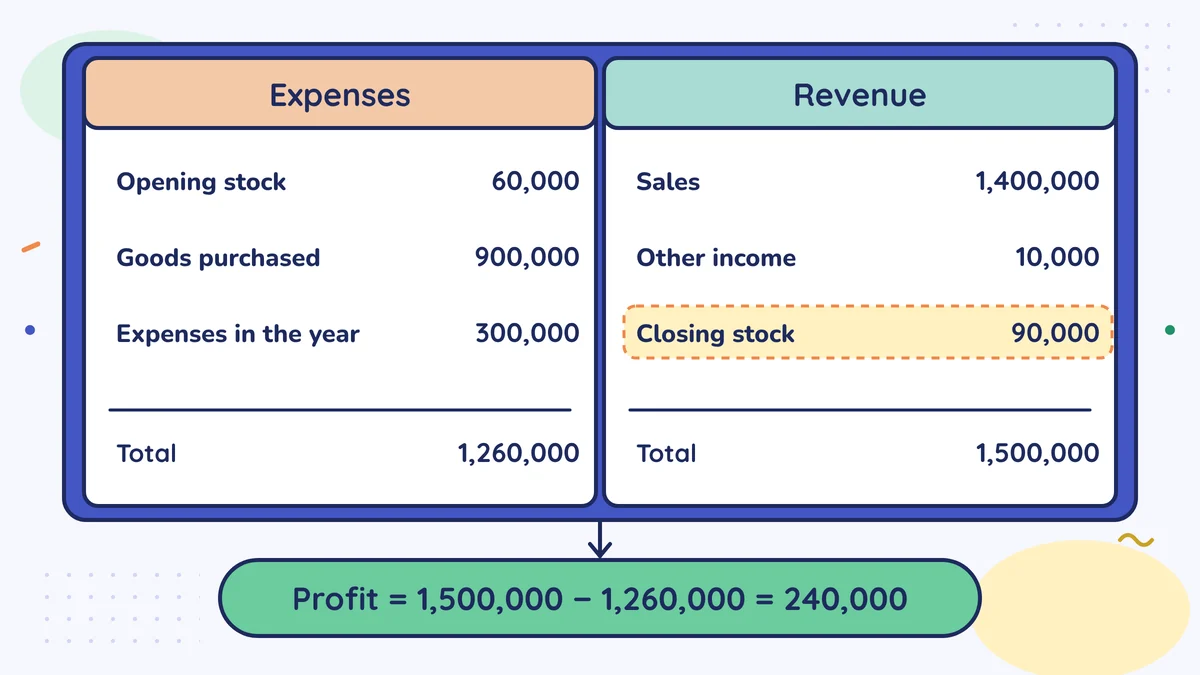
| Expenses side | TL |
|---|---|
| Opening stock (fabric and foam on the shelf on 1 January) | 60,000 |
| Goods purchased during the year | 900,000 |
| Expenses during the year (rent, electricity, employee, depreciation) | 300,000 |
| Total | 1,260,000 |
| Revenue side | TL |
|---|---|
| Sales and business revenue | 1,400,000 |
| Other income | 10,000 |
| Closing stock (31 December count) | 90,000 |
| Total | 1,500,000 |
Profit = 1,500,000 − 1,260,000 = 240,000 lira.
The sales and purchase figures exclude VAT; VAT is tracked separately: if you are a VAT taxpayer, on the VAT return you file every month, the VAT you paid on purchases is deducted from the VAT you collected from customers on sales.
Why is closing stock on the revenue side?
Recep Usta wrote all the fabric he bought during the year on the expenses side. But 90,000 lira worth of it is still on the shelf on 31 December; it has not been sold or used. Writing what is left on the shelf on the other side means saying "the money for these goods has not been used up yet."
The result comes to the same place as "cost of sales" in the income statement: 60,000 + 900,000 − 90,000 = 870,000 lira is the goods actually used during the year.
If the count is wrong, profit shifts. If Recep Usta wrote the goods on the shelf as 40,000, his profit would look like 190,000; if he wrote 140,000, it would look like 290,000. There is also a chain effect: this year's closing stock is next year's opening stock. Goods overcounted this year reduce next year's profit by the same amount. So a counting error does not disappear; it moves between years. You saw how to do the count in the lesson Stock: money waiting on the shelf.
What does not go on the expenses side?
During the year Recep Usta took 15,000 lira home. This money is not written on the expenses side; money the owner takes out of the business is not an expense (Income Tax Law art. 41). Tax is calculated not on the money taken out but on the 240,000 lira profit (Paying yourself a salary). The household bills, the family's phone and personal car costs stay out in the same way. If your workplace is inside your home, ask your mali müşavir how much of the shared bills can be recorded as an expense.
An expensive machine bought this year is not recorded in full as this year's expense either. In 2026, fixed assets (demirbaş) each costing no more than 12,000 TL (excluding VAT) can be recorded directly as an expense; the cost of those above this is spread over the years through depreciation (amortisman) (Tax Procedure Law art. 313; details in the lesson The year-end file for your mali müşavir).
What is not in the summary?
The business account summary tells you the profit; but it does not answer the question "how much is owed to me, and how much do I owe?" Cash, bank, receivables and debt lines are not on this page. The photograph your neighbour on the balance-sheet basis has is not something Recep Usta has.
Close this gap yourself. At the end of the year, write the following on a page:
| Position list (31 December) | TL |
|---|---|
| Cash | 8,000 |
| Bank | 95,000 |
| Amounts owed by customers | 70,000 |
| Goods on the shelf (from the count) | 90,000 |
| Debt to suppliers | 55,000 |
| Loan debt | 40,000 |
| Tax and SGK to be paid in January | 25,000 |
This is not an official balance sheet; but it gives the owner a year-end photograph of the business. What you own totals 263,000, your debts total 120,000; the difference, 143,000 lira, is your share.
Where does the summary go?
The annual income tax return of those keeping a business book contains the business account summary; the commercial earnings table on the return is made up from the information in this summary (GİB Defter-Beyan, annual return guide). So this page is not just information: your tax is calculated from this profit. It is worth checking before the return.
A five-question check
- Do the sales match the total, excluding VAT, of the invoices and cash register receipts I issued during the year?
- Is opening stock the same as last year's closing stock?
- Is closing stock the same as my count list?
- Are there any household or family costs among the expenses?
- Are the machines and fixtures I bought this year on the list?
In one sentence
The business account summary is like the two columns of a corner shop notebook: expenses on one side, revenue and goods left on the shelf on the other; the difference is profit, and your tax is calculated from this profit.
Do this this week
Ask your mali müşavir for last year's business account summary. Compare opening stock with the previous year's closing stock; if they are not the same, ask your mali müşavir.
Common mistakes
- Writing the year-end count as a guess. The goods left on the shelf change profit directly; the error also distorts next year's profit.
- Thinking money taken home is an expense. Money the business owner takes out for themselves is not an expense; it does not reduce profit or tax.
- Thinking the summary is the whole picture of the business. The summary has no cash, bank, receivables or debts; these need to be written on a separate list at the end of the year.
Sources
- Tax Procedure Law (Vergi Usul Kanunu), Law No. 213, art. 177–182 (classes of traders and books), art. 313 (fixtures that can be recorded directly as an expense) (mevzuat.gov.tr)
- Income Tax Law (Gelir Vergisi Kanunu), Law No. 193, art. 41 (non-deductible expenses, money taken out of the business) (mevzuat.gov.tr)
- GİB Defter-Beyan System, Annual Income Tax Return Guide (the commercial earnings table is made up from the business account summary)
- Defter-Beyan: information note for taxpayers under simplified taxation
- TÜRMOB (Union of Chambers of Certified Public Accountants of Turkey)
Translated from the Turkish lesson. Last checked against Turkish rules: 12 October 2026. Not yet reviewed by a licensed accountant.
This is general information about Turkish rules, not financial, tax or legal advice. Rules change; check the date and the sources, and ask a licensed accountant (mali müşavir) about your own situation. Disclaimer