Reading your mali müşavir's statements: a 10-question check
When your mali müşavir sends the year-end statements, ask ten questions before you say "you know best". The short way to compare the statements, from sales to cash and from receivables to equity, with your own invoices, bank statement and count list.
To check the income statement (gelir tablosu) and balance sheet (bilanço) your mali müşavir prepares, you do not need to recalculate every figure. Compare net sales with the total, excluding VAT, of the invoices and cash register sales you issued; cash and bank with the 31 December count and statement; stock with your count list; receivables and debts with customer and supplier balances; and compare gross profit and large expenses with last year. Ask about differences before the tax return.
Ayten Hanım's test results
The rules described in this lesson are those of Turkish law.
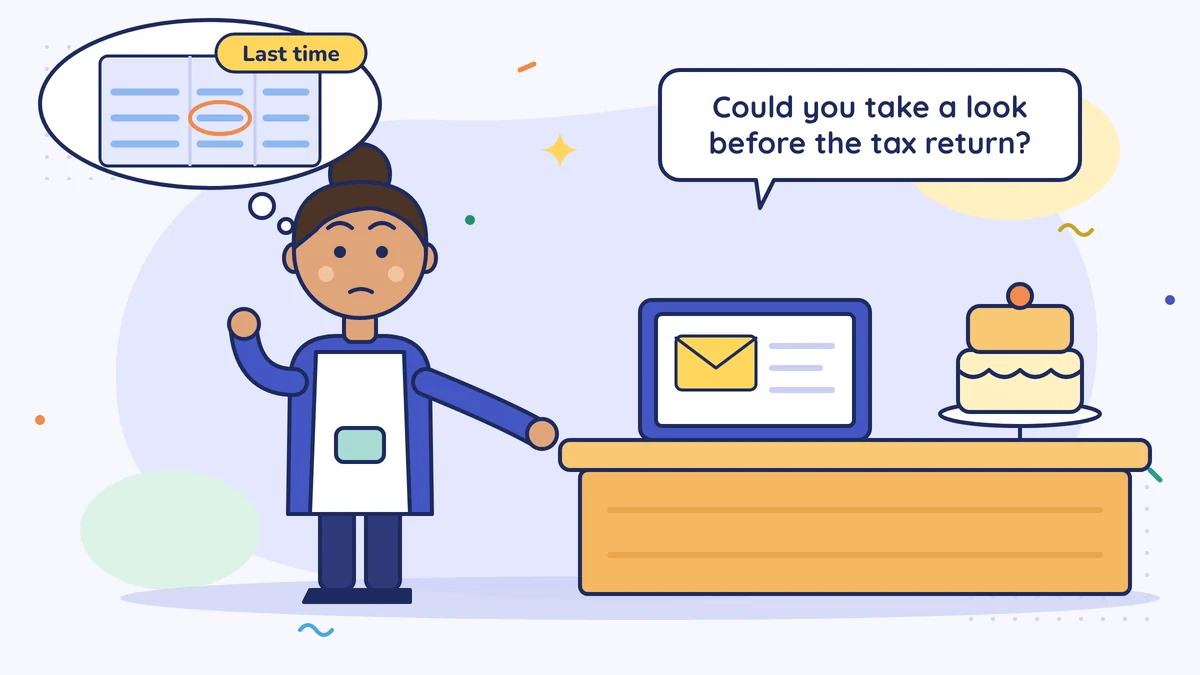
Ayten Hanım's patisserie company is three years old. At the beginning of March her mali müşavir (accountant) e-mailed her last year's statements: "Could you take a look before the tax return?" Ayten Hanım was about to write back: "You know best." Then she remembered the blood test results she had got last month. She was not a doctor, but by looking at the "last time" column next to them she could see which values had moved, and she had asked her doctor about exactly that.
Financial statements are read the same way. You do not need to recalculate every figure. Your mali müşavir's job is to prepare the statements; your job is to say whether the statements match the reality you know. You know better than your mali müşavir what is in the cash box, which customer will not pay and what is left on the shelf. If this check is done before the tax return, corrections are easy.
You saw the income statement line by line and the balance sheet as assets and sources. If you keep a business book, your statement is the business account summary; most of the questions below fit it too.
Before you open the statements
Ask your mali müşavir for two things along with the statements: last year's figures in a column alongside, and a breakdown of the large items (lists of expenses, receivables and debts). Put your own lists next to them: the total of the invoices and cash register sales you issued during the year, the 31 December bank statements, the year-end count list, and customer and supplier balances.
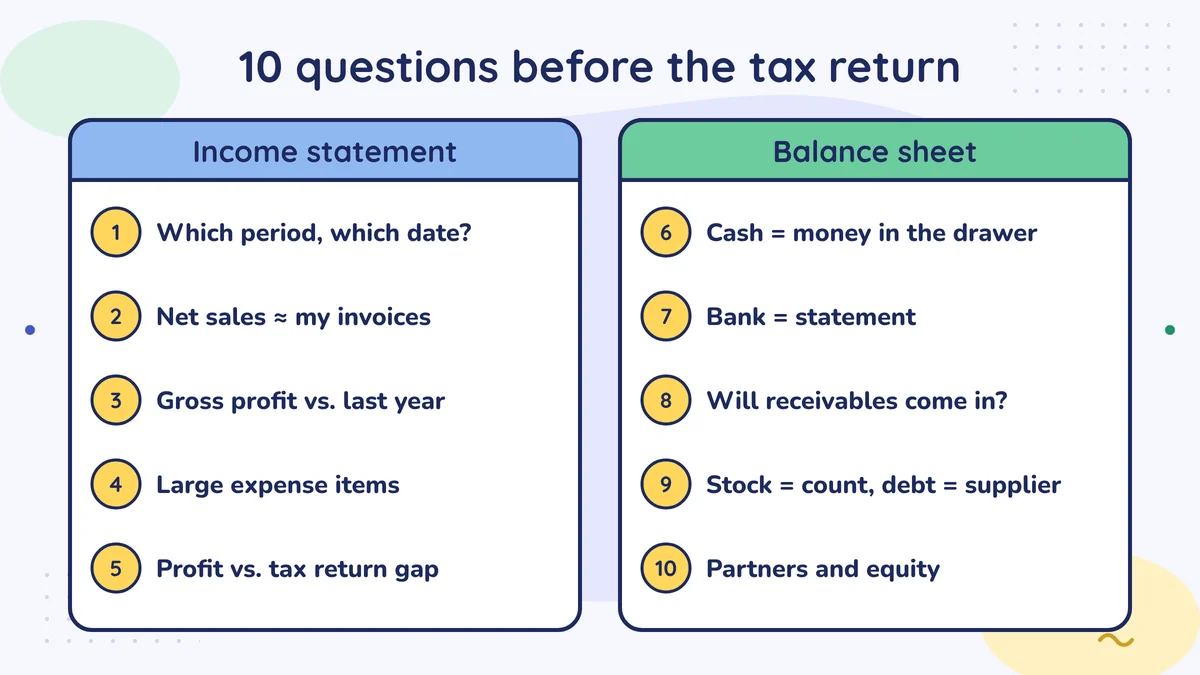
Five questions for the income statement
1. Which period, which date? The income statement should cover the period 1 January–31 December, and the balance sheet the day of 31 December. If last year's column is missing, ask for it; without a comparison, a figure on its own says little.
2. Does net sales match my records? The total, excluding VAT, of the invoices you issued during the year (e-Invoice, e-Archive invoice) and of your cash register sales (end-of-day Z reports), minus returns, should give a figure very close to net sales. Don't count twice the sales where you gave an information receipt from the cash register and also issued an invoice. If there is a big difference, either an invoice has not been entered or a return has been forgotten.
3. Is gross profit similar to last year? Last year, of every 100 lira of Ayten Hanım's sales, 55 lira remained as gross profit; this year, 45 lira. There are three possible reasons: prices have fallen, flour and butter have become more expensive, or the year-end count is wrong. Ask about the reason, not the figure.
4. Is there a large item among the expenses that I don't recognise? Look at the five largest expense items. If there is an amount you don't recognise, or a line that has suddenly grown compared with last year, ask for its breakdown.
5. Why does profit before tax differ from the earnings on the return? Expenses not accepted for tax are added back and exemptions are deducted; that is why the two figures can differ. Your mali müşavir should be able to explain this difference in a few lines.
Five questions for the balance sheet
6. Is the cash really there? The cash on the balance sheet should be the same as the money counted in the drawer on the evening of 31 December. If the statement shows 150,000 and there are 5,000 in the drawer, ask where the difference comes from.
7. Does the bank match the statement? The 31 December balance of each bank account should match the statement to the kuruş. Credit card debt and loan instalments should also appear on the debts side.
8. Will all the receivables really come in? Ask for the list of receivables customer by customer. If there is a customer who has closed down, disappeared or not paid for months, tell your mali müşavir; a receivable that cannot be collected is dealt with separately (The year-end file for your mali müşavir).
9. Does stock match my count, and debts match the suppliers? The stock on the balance sheet should match the total of your year-end count list. Supplier debts should also match the reconciliation (mutabakat) with your large suppliers, that is, the confirmation that both sides have written the same figure.
10. What about the partner lines and equity? If the "receivables from partners" (ortaklardan alacaklar) line is growing, usually a partner has taken money from the company without a payroll or without a profit distribution decision; there are legal limits on this (Turkish Commercial Code art. 358; applied to limited companies too under art. 644; see Paying yourself a salary). If total equity is smaller than the capital, the company is usually carrying accumulated losses; ask your mali müşavir whether it falls into one of the situations in Turkish Commercial Code art. 376 (the same for limited companies under art. 633).
What did Ayten Hanım find?
Ayten Hanım finished the questions in one evening. She stopped at two of them.
The reason for the drop in gross profit was butter: its price had risen during the year, and Ayten Hanım had been late in updating her cake prices. This was not a mistake but a signal; she redid the new year's price list accordingly.
Among the expenses, the "packaging" line had risen by 48,000 lira compared with last year. When the breakdown was requested, it turned out that a 48,000 lira supplier invoice had been entered twice. The mali müşavir corrected the entry, and the return was filed with the corrected figure. Total time: one phone call.
How do you go to the meeting?
- Ask for the statements at least two days before the meeting; write your questions on paper.
- Take your own lists with you; figures cut the discussion short.
- Make a short note next to each answer. Next year the same ten questions will take half the time.
In the Interpreting the figures module we cover how to work out indicators such as profit margin and receivable and stock days from these statements, and which questions to take to the year-end meeting.
In one sentence
You don't need to be an accountant to check your mali müşavir's statements: it is enough to put the figures side by side with your own invoices, your bank statement, your count and last year.
Do this this week
Ask your mali müşavir for last year's income statement and balance sheet, together with last year's column. This week, compare only two of the ten questions (net sales and bank) with your own invoices and statements.
Common mistakes
- Saying "you know best". You know better than your mali müşavir what is in the cash box, which customer will not pay and what is left on the shelf; the statements are verified with this knowledge.
- Looking at a single year. Without last year's column, you cannot tell whether a figure is good or bad.
- Leaving the check until after the tax return. A correction made before the return takes one phone call; afterwards it creates more work.
Sources
- General Communiqué on the Application of the Accounting System No. 1 (1 Sıra No'lu Muhasebe Sistemi Uygulama Genel Tebliği), Official Gazette 26.12.1992 / 21447 repeated (Alomaliye copy)
- Turkish Commercial Code (Türk Ticaret Kanunu), Law No. 6102, art. 358 (partner borrowing from the company), art. 376 (loss of capital), art. 633 and 644 (application to limited companies) (mevzuat.gov.tr)
- TÜRMOB e-library, special circular (05.01.2023): the balance sheet and income statement are the basic financial statements and are attached to the annual return
- GİB Defter-Beyan System, Annual Income Tax Return Guide (the commercial earnings table is made up from the business account summary)
Translated from the Turkish lesson. Last checked against Turkish rules: 12 October 2026. Not yet reviewed by a licensed accountant.
This is general information about Turkish rules, not financial, tax or legal advice. Rules change; check the date and the sources, and ask a licensed accountant (mali müşavir) about your own situation. Disclaimer