Profit margin: what do gross and net tell you?
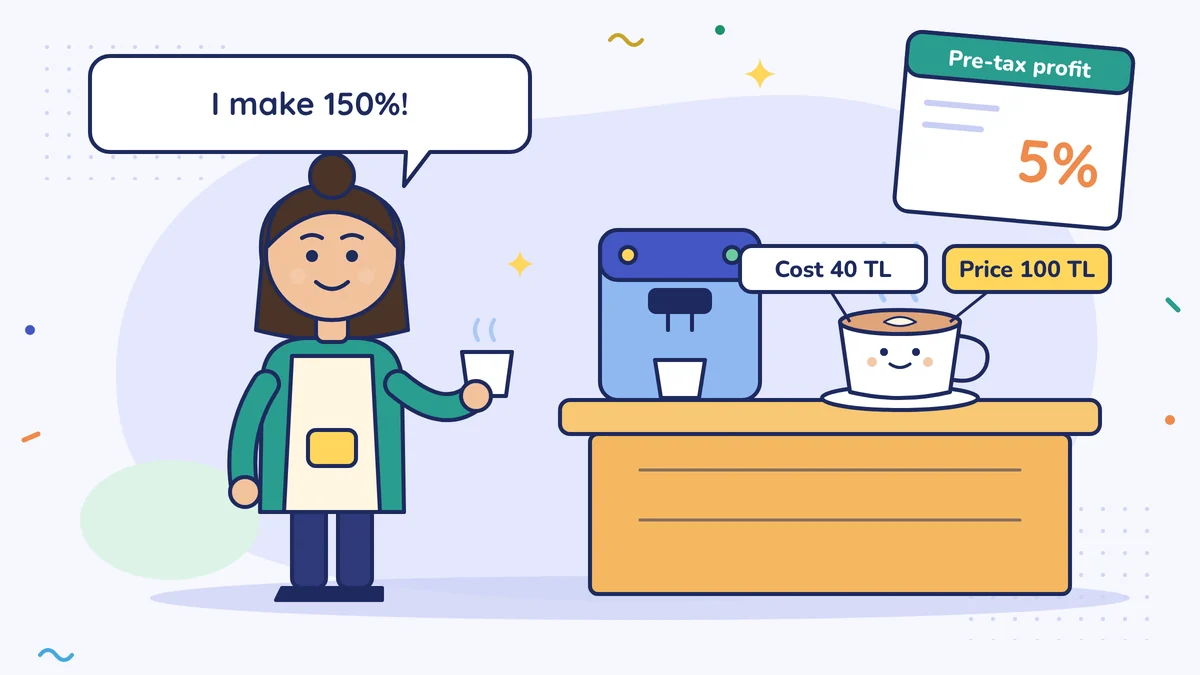
A café owner who says "I make 150% on every latte" is surprised to see a 5% profit at the end of the year. The difference between markup and profit margin, the road from gross profit down to net profit, what each margin tells you, and how a discount affects the margin.
Profit margin is profit divided by sales; it is not the "markup" rate, which is divided by cost. If something costs you 40 lira and you sell it for 100 lira, the markup is 150% and the margin is 60%. Gross margin shows what is left after only the cost of the goods sold is taken out; net margin shows what is left after everything, including rent, staff and tax, is taken out. If gross margin is falling, look at your prices and purchase costs; if net margin is falling, look at your expenses.
Zeynep Hanım the café owner's "150%"
The rules described in this lesson are those of Turkish law.
Zeynep Hanım has run a coffee shop for two years. A cup of latte costs her 40 lira: coffee, milk, cup, lid. The selling price excluding VAT is 100 lira. She tells her friends, "I make 150% on every latte."
But in the 2026 table her mali müşavir (accountant) sent in January, under sales of 2,000,000 lira it says "profit before tax: 100,000 TL". That is 5%. Zeynep Hanım asks: "Where did the 150% go?"
Two separate mix-ups sit on top of each other here. One is in the method of calculation, the other in which profit you are looking at. In this lesson we separate the two.
Markup and profit margin
If something costs you 40 lira and you sell it for 100 lira, 60 lira is left per cup. What you divide this 60 lira by changes the result:
| Divided by | Calculation | Result | Name |
|---|---|---|---|
| Cost | 60 ÷ 40 | 150% | Markup on cost (the tradesperson's "what I put on top") |
| Selling price | 60 ÷ 100 | 60% | Profit margin |
When setting a price, a tradesperson usually adds on top of the cost. Your mali müşavir and the income statement, however, talk about the rate divided by sales, that is, the margin. Every percentage in the table is calculated on sales. When you say "what percent" to your mali müşavir, say which one you mean; otherwise you will both give the same figure two different names.
A tip: however much you put on top, the margin can never reach 100%. If you buy at 40 and sell at 80, the markup is 100% and the margin is 50%.
Gross profit: what is left from the goods themselves
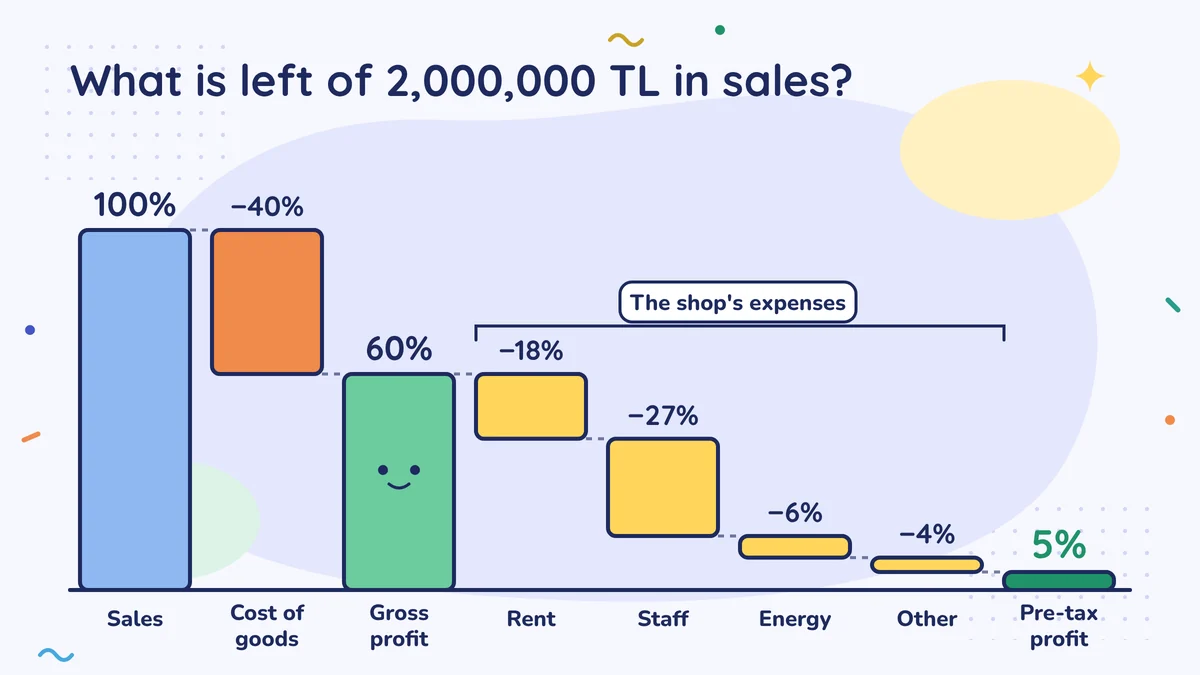
The income statement (in Turkish) is read from top to bottom. Zeynep Hanım's 2026 figures, rounded and excluding VAT:
| Line | Amount (TL) | Share of sales |
|---|---|---|
| Net sales | 2,000,000 | 100% |
| Cost of goods sold (coffee, milk, cake ingredients, cups) | −800,000 | 40% |
| Gross profit | 1,200,000 | 60% |
| Rent | −360,000 | 18% |
| Staff (salaries and SGK) | −540,000 | 27% |
| Electricity, water, natural gas | −120,000 | 6% |
| Other expenses | −80,000 | 4% |
| Profit before tax | 100,000 | 5% |
The gross margin is 60%. Zeynep Hanım's cup calculation was right. But gross profit is the profit before the shop's rent, the employees' salaries and the bills are paid. Once these are taken out, 60% falls to 5%.
In coffee-shop language: gross profit is the profit you see at the counter; net profit is what is left in the drawer in the evening, after the shutter comes down and all the bills are paid.
A note: which expense is written on the "cost" line and which goes into the expenses below can vary with the business and with your mali müşavir's way of working. In a café, the salary of the person working in the kitchen can also be written into cost. That is why the soundest comparison for your own gross margin is with your own past years.
Net profit: after everything is taken out
When tax is taken out of profit before tax, net profit remains. Net margin is net profit divided by net sales. If you are a company, corporate tax is deducted in the company's table. In a sole proprietorship, income tax is your personal tax: it is not recorded as an expense; you pay it out of the profit in the table. Because the amount of tax changes with the type of business and your other income, your mali müşavir calculates it; you look at the pre-tax margin first.
In a sole proprietorship, keep one thing in mind: the table contains nothing for your own labour. You cannot pay yourself a salary, and money you take from the cash box does not count as an expense (Paying yourself a salary). If Zeynep Hanım is a sole proprietor, the 100,000 lira is the reward for a year of her own labour, and her tax also comes out of it. Do not forget this difference when you compare yourself with someone who does the same work through a company and pays themselves a salary.
What does each margin tell you?
- If gross margin is falling, the problem is in the goods or the price: the purchase price went up but the selling price did not follow, wastage increased, or too many discounts were given.
- If gross margin is the same but net margin is falling, the problem is in the shop's costs: rent, staff or energy grew faster than sales.
- If both margins are good but the cash box is empty, the problem is not profit but cash. You saw this in the lesson Profit but no cash. In the next lesson we measure how many days it takes for the money to come back.
How does a discount eat into the margin?
Zeynep Hanım is thinking, "Let me give a 10% discount on lattes, I'll sell more." Let's calculate:
- Today: 100 lira sale, 40 lira cost, 60 lira gross profit per cup.
- With the discount: 90 lira sale, 40 lira cost, 50 lira gross profit per cup.
If she sells 100 cups a day, 6,000 lira of gross profit is left today. To reach the same 6,000 lira with the discount, she needs to sell 120 cups (6,000 ÷ 50). So a 10% discount requires 20% more sales. Before deciding on a campaign, put this calculation down on paper.
Business account books and simplified taxation
In a business that keeps books on the balance-sheet basis (bilanço esası), your mali müşavir prepares this table line by line. On the business account basis (işletme hesabı esası) you will not see a separate "cost of goods sold" line; but the business account summary your mali müşavir prepares shows stock at the start of the year, purchases during the year and stock at the end of the year separately. The calculation is: stock at the start of the year + purchases during the year − stock at the end of the year. Year-end stock comes from the count; if the count is wrong, the margin comes out wrong too (Stock: money waiting on the shelf). If you are under simplified taxation (basit usul), there is no official income statement; you do the same calculation yourself with the purchase and sales documents recorded in the Defter-Beyan System (Defter-Beyan Sistemi). The margin does not care what kind of books you keep.
"Is 5% good?"
There is no single answer. Margins are very different in a café, a hairdresser's and a wholesaler's, and the source of most "sector average" figures going around on the internet is unclear. The soundest measure is your own previous year. We make that comparison two lessons from now.
Do this this week
Pick the three products or services you sell most. For each one, write down what it costs you and its selling price excluding VAT. Divide sales minus cost by the selling price: that is the gross margin of that product. Put the three side by side, and this month take one look at the price of the product with the lowest margin.
Common mistakes
- Mistaking markup for margin. Buying at 40 and selling at 100 is a 150% markup; the margin is 60%. The percentages in the table are divided by sales.
- Thinking gross profit is the money left in your pocket. Rent, salaries, bills and tax have not been taken out yet; in Zeynep Hanım's case 60% falls to 5%.
- Calculating the margin with the VAT-inclusive price. The VAT in the selling price is not yours; it is the state's money held in trust. Calculate the margin with the amount excluding VAT.
Sources
- General Communiqué on the Application of the Accounting System No. 1 (1 Sıra No'lu Muhasebe Sistemi Uygulama Genel Tebliği, Official Gazette 26.12.1992): layout of the income statement (gross sales profit, operating profit, profit for the period), Alomaliye copy
- Income Tax Law No. 193 (Gelir Vergisi Kanunu), art. 41 (money taken by the business owner and a monthly salary paid to themselves cannot be recorded as an expense)
Translated from the Turkish lesson. Last checked against Turkish rules: 12 October 2026. Not yet reviewed by a licensed accountant.
This is general information about Turkish rules, not financial, tax or legal advice. Rules change; check the date and the sources, and ask a licensed accountant (mali müşavir) about your own situation. Disclaimer