The income statement line by line: from sales to net profit
Before you jump to the bottom figure on the income statement your mali müşavir gives you, walk through it from top to bottom. Using a café company's sample statement, we read net sales, cost of sales, gross profit, operating expenses, interest and tax line by line.
The income statement shows the road from sales down to profit over one year: deduct the cost of the goods sold from net sales and you get gross profit; deduct the business's expenses and you get operating profit; after interest and other income and expenses you get profit before tax; deduct the tax and net profit is left. Sales are recorded excluding VAT. For a company, the general corporate tax rate for the 2026 accounting period is 25%; your mali müşavir calculates the amount.
Emre Bey's thick file
The rules described in this lesson are those of Turkish law.
Emre Bey's limited company runs a café. At the beginning of March his mali müşavir (accountant) handed him a file: "Last year's income statement and balance sheet. Take a look, and if you have any questions, let's talk." Emre Bey leafed through the pages, found the "Net profit for the period" line at the very bottom, saw the figure and closed the file.
But the figure at the bottom is the last stop on a long road. In this lesson we walk that road from top to bottom, line by line. You saw what these statements are in the lesson Books and accounts words: the balance sheet (bilanço) is a photograph of one day, the income statement (gelir tablosu) is a film of one year. Now we watch the film.

The statement works like a filter
Think of the filter in a coffee machine. Part of the water poured in at the top stays in the coffee grounds, and less of it reaches the cup. The income statement works the same way: at the top is the amount that came in from sales, on each line one item is taken out, and at the bottom you see the profit left for the business.
The income statement of companies and of those keeping books on the balance-sheet basis (bilanço esası) is written in a set order. This order is laid down in the General Communiqué on the Application of the Accounting System No. 1 (1 Sıra No'lu Muhasebe Sistemi Uygulama Genel Tebliği); that is why the lines sit in the same place whichever mali müşavir it comes from. If you keep a business book (işletme defteri), your statement is different; we explain it in the lesson The business account summary.
Emre Bey's statement (sample figures)
| Line | Amount (TL) |
|---|---|
| Gross sales (brüt satışlar) | 2,050,000 |
| Sales deductions (−) | 50,000 |
| Net sales | 2,000,000 |
| Cost of sales (−) | 800,000 |
| Gross profit on sales | 1,200,000 |
| Operating expenses (−) | 900,000 |
| Operating profit | 300,000 |
| Other ordinary income (+) | 20,000 |
| Finance expenses (−) | 70,000 |
| Profit for the period (before tax) | 250,000 |
| Tax provision (−) | 62,500 |
| Net profit for the period | 187,500 |
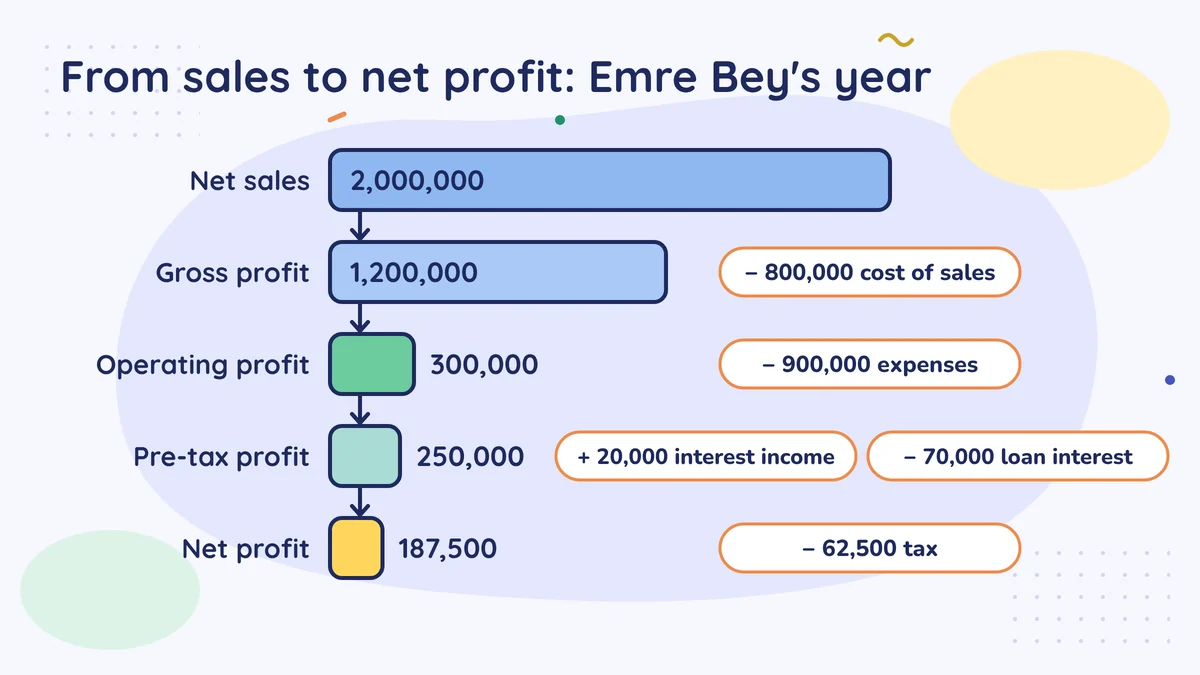
Line by line
Gross sales and sales deductions
This is the total of the sales invoices you issued and the cash register receipts (the end-of-day Z reports) over the year. It is recorded excluding VAT, because the VAT on the invoice is not your sale; it is money you pass on to the state (Calculating VAT line by line). Goods brought back by customers and discounts given afterwards are deducted on the "sales deductions" (satış indirimleri) line. What is left, net sales (net satışlar), is the business's real turnover.
Cost of sales
This is what the goods you sold cost you. In a café: coffee beans, milk, sugar, cake. In a business that buys and sells goods, it is found roughly like this: stock at the start of the year + purchases during the year − stock at the end of the year.
For Emre Bey: 60,000 + 820,000 − 80,000 = 800,000.
That is why the year-end count matters. If the goods on the shelf are undercounted, the cost comes out higher and the profit lower; if they are overcounted, the opposite happens (Stock: money waiting on the shelf).
Gross profit on sales
Net sales minus cost: 2,000,000 − 800,000 = 1,200,000. It answers the question "Before paying the rent and salaries, how much of my sales is left?"
Operating expenses
This is the cost of keeping the business running. For Emre Bey: rent 240,000; his employee's salary and the employer's share of SGK (social security) 520,000; electricity, water and other items 90,000; depreciation 50,000; total 900,000.
Depreciation (amortisman) is the share of the cost of an item used for many years (a coffee machine, a table, an oven) that is spread over those years. It is recorded as an expense even though no money leaves the cash box this year. The Communiqué divides operating expenses into research and development, marketing-sales-distribution, and general administration; you may see these sub-headings in your mali müşavir's statement.
Operating profit
This is the profit of the core business: 1,200,000 − 900,000 = 300,000. Because interest income, loan interest and one-off events have not yet been mixed in, this line shows best how the business itself is doing.
Other income and finance expenses
Regular income from outside the core business is recorded here: interest on deposits, exchange differences, rent from letting part of the workplace. Emre Bey's deposit interest is 20,000. Finance expenses (finansman giderleri) are the interest and charges on loans used. Emre Bey took out a loan for a new branch; its interest is 70,000.
The figure reached up to this point is called "ordinary profit" (olağan kâr) in the statement. After it there is also an "extraordinary income and expenses" (olağan dışı gelir ve giderler) section; occasional events are recorded there, such as the profit from selling an old machine or fire damage paid by the insurer. For Emre Bey this section is empty, so ordinary profit and profit for the period are the same.
Profit for the period and tax
Profit before tax: 300,000 + 20,000 − 70,000 = 250,000.
The company pays corporate tax (kurumlar vergisi) on this profit. For the 2026 accounting period the general corporate tax rate is 25% (Corporate Tax Law art. 32). For banks and finance companies the rate is higher; there are reduced rates for export and manufacturing earnings. Your mali müşavir knows which rate applies to your company. The tax provision (vergi karşılığı) in the statement is the share set aside in the statement for the corporate tax to be paid on this year's profit. In the example we wrote 250,000 × 25% = 62,500. In reality the tax is not calculated one-to-one from the profit in the statement: expenses not accepted for tax are added back, exemptions are deducted, and the domestic minimum corporate tax check is made. Your mali müşavir calculates this line.
In a sole proprietorship, the tax is not the business's debt but the owner's. That is why a sole proprietorship's statement usually ends with profit before tax; the tax is calculated on the annual income tax return.
Net profit for the period
250,000 − 62,500 = 187,500. This is the company's earnings for this year. But it is not the money in the cash box; part of it may be waiting in receivables, part of it on the shelf (Profit but no cash). This figure also passes unchanged into the equity (özkaynak) section of the balance sheet; you will see this in the balance sheet lesson.
Ask yourself as you read
- Is net sales close to the total, excluding VAT, of the invoices I issued and my cash register sales during the year?
- Is gross profit on sales similar to last year? If there is a clear drop, is the reason price, cost or the stock count?
- Is there a large item in operating expenses that I don't recognise?
- How much of operating profit does loan interest take?
Emre Bey asked these four questions. He stopped at the fourth: loan interest was close to a quarter of the profit of the core business. As he was deciding about the new branch, he saw this in figures for the first time.
In one sentence
Read the income statement from top to bottom: cost is deducted from sales, then the business's expenses, then interest and tax; every line tells you where the profit at the bottom comes from.
Do this this week
Ask your mali müşavir for last year's income statement. Underline the gross profit on sales, operating profit and net profit for the period lines; for each one, write on a sheet of paper which items were deducted above it.
Common mistakes
- Looking only at the bottom line. Net profit may look good while operating profit is falling; the profit may be carried by interest income or a one-off sale.
- Thinking sales include VAT. Sales in the income statement exclude VAT; if you compare them with the VAT-inclusive total of your invoices and receipts, you will find a difference.
- Thinking net profit is the money in the cash box. Profit is a calculation for one year; the money may be waiting in receivables, in stock or in loan instalments.
Sources
- General Communiqué on the Application of the Accounting System No. 1 (1 Sıra No'lu Muhasebe Sistemi Uygulama Genel Tebliği), Official Gazette 26.12.1992 / 21447 repeated (Alomaliye copy)
- Muhasebetr (Vedat Erdem): the main groups of the income statement; profit on the sale of fixed assets recorded under extraordinary income (679)
- Corporate Tax Law (Kurumlar Vergisi Kanunu), Law No. 5520, art. 32 (rate) and 32/C (domestic minimum corporate tax) (mevzuat.gov.tr)
- Alomaliye (5 October 2026): the general corporate tax rate is 25%; 12.5% for manufacturers from 2027
- Ekonomi Gazetesi: in 2026 the 5-point reduction for export earnings and the 1-point reduction for manufacturing earnings with an industrial registry certificate continue
- TÜRMOB (Union of Chambers of Certified Public Accountants of Turkey)
Translated from the Turkish lesson. Last checked against Turkish rules: 12 October 2026. Not yet reviewed by a licensed accountant.
This is general information about Turkish rules, not financial, tax or legal advice. Rules change; check the date and the sources, and ask a licensed accountant (mali müşavir) about your own situation. Disclaimer