The balance sheet: assets equal liabilities plus equity
The balance sheet shows what the company owns on the last day of the year, and how much of it is debt and how much is its own money. Using a hardware company's sample balance sheet, we read the cash, bank, receivables, stock, debts, capital and profit lines.
The balance sheet is the statement showing the position of a business on a particular day. On the left are the assets (cash, bank, receivables, stock, vehicles); on the right is where they came from: debts and equity (capital plus profit left in the company). Because every lira came either from borrowing or from the owners' own money, the two sides are always equal. Net profit from the income statement (gelir tablosu) passes into equity on the balance sheet.
Hasan Abi's "where is my money?" question
The rules described in this lesson are those of Turkish law.
Hasan Abi's hardware company closed last year with 120,000 lira of net profit. There are 180,000 lira in the bank and 20,000 lira in the cash box. Hasan Abi is relaxed: "There's profit, and there's money too." Then his mali müşavir (accountant) handed him one more page: "The balance sheet. In January there is 60,000 of tax and SGK (social security), and during the year 300,000 of supplier debt and 150,000 of loan instalments." Hasan Abi's calm turned into a question at once: "So what do I own, and what do I owe?"
The answer to this question is in the balance sheet (bilanço). The income statement tells you what you earned in one year (The income statement line by line). The balance sheet shows what was in the business on the evening of 31 December and whose money paid for it.
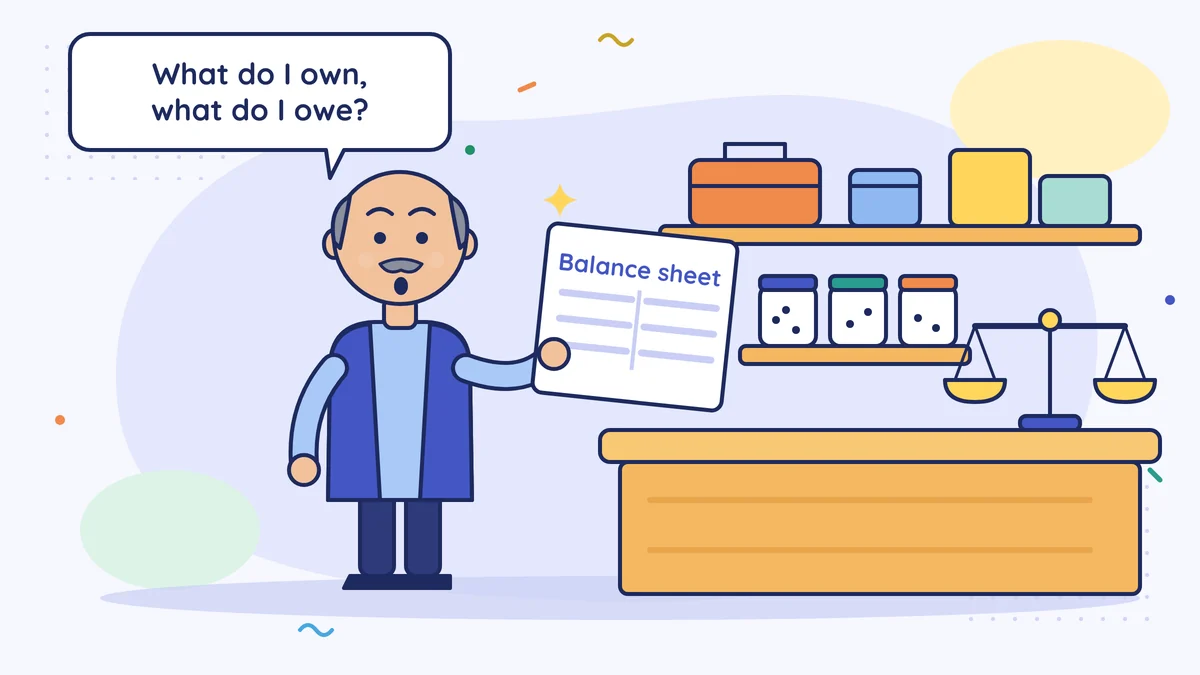
The two pans of the scale
Think of the old scale on the hardware dealer's counter. On the left pan is everything the company owns: the assets (varlıklar; "aktif" in accountants' language). On the right pan is the money these assets were bought with: the sources (kaynaklar; "pasif"). A source either came from someone else, that is, it is a debt (liabilities, yabancı kaynak), or it is the partners' own money plus profit left in the company (equity, özkaynak).
The two pans are always equal, because every lira in the company came either from borrowing or from the owners' own money:
Assets = Liabilities + Equity
Companies and those keeping books on the balance-sheet basis (bilanço esası) draw up a balance sheet. If you keep a business book (işletme defteri), your statement is different (The business account summary).
The groups of the balance sheet and their order are laid down in the General Communiqué on the Application of the Accounting System No. 1 (1 Sıra No'lu Muhasebe Sistemi Uygulama Genel Tebliği): current assets, fixed assets, short-term debts, long-term debts and equity.
Hasan Abi's balance sheet at 31 December (sample figures)
| Assets | TL |
|---|---|
| Cash | 20,000 |
| Bank | 180,000 |
| Trade receivables (amounts owed by customers) | 250,000 |
| Stock (goods for sale) | 400,000 |
| Total current assets | 850,000 |
| Vehicles and fixtures | 300,000 |
| Accumulated depreciation (−) | 100,000 |
| Total fixed assets | 200,000 |
| Total assets | 1,050,000 |
| Sources | TL |
|---|---|
| Bank loan (part payable within one year) | 150,000 |
| Trade payables (debts to suppliers) | 300,000 |
| Tax and SGK payable | 60,000 |
| Total short-term debts | 510,000 |
| Bank loan (part payable after one year) | 140,000 |
| Total long-term debts | 140,000 |
| Capital | 100,000 |
| Retained earnings | 180,000 |
| Net profit for the period | 120,000 |
| Total equity | 400,000 |
| Total sources | 1,050,000 |
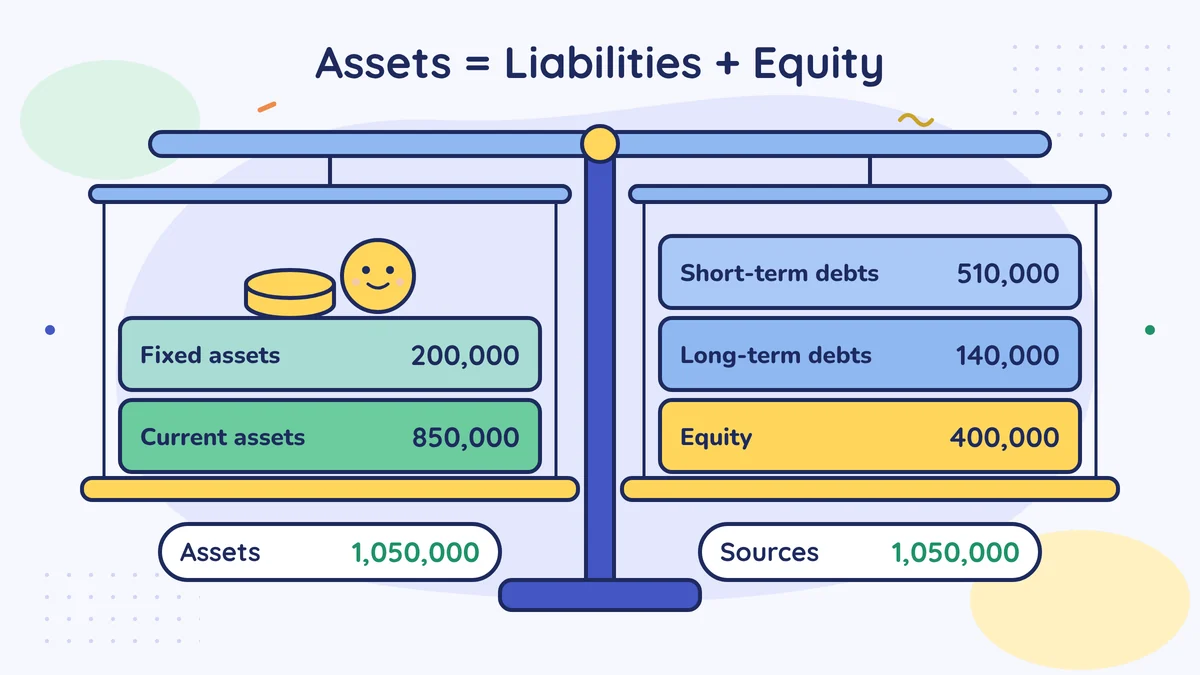
The left side: what do you have?
Current assets (dönen varlıklar) are those expected to turn into money within one year, and they are listed from closest to money to furthest.
- Cash: The money actually in the drawer on 31 December. If the cash on the balance sheet differs from the money in the drawer, ask your mali müşavir; usually the reason is an unrecorded payment or money taken out.
- Bank: The balance of each account on 31 December. It should match the bank statement to the kuruş. If you have a foreign currency account, its value converted into lira at the 31 December rate is shown.
- Trade receivables: Sales not yet collected, that is, sales on credit (Credit sales and payments). If there is a receivable you think you cannot collect, tell your mali müşavir; it is dealt with separately (The year-end file for your mali müşavir).
- Stock: The purchase value of the goods on the shelves and in the storeroom at the year-end count.
Fixed assets (duran varlıklar) are things used for many years: a van, shelving, a computer. Right below them, accumulated depreciation (birikmiş amortisman) is the wear and tear recorded as an expense so far. The items Hasan Abi bought for 300,000 lira now have a book value of 200,000. This is the value in the books, not the price they would fetch if sold on the market.
The right side: whose money?
- Short-term debts: Those to be paid within one year. Supplier debt, this year's loan instalments, and the VAT, withholding tax (muhtasar) and SGK to be paid in January.
- Long-term debts: Those to be paid after one year; usually the part of the loan left for later years.
- Equity: The capital (sermaye) the partners put in, the retained earnings (geçmiş yıllar kârları), that is, profit not distributed in earlier years but left in the company, and this year's net profit for the period. The last line of the income statement enters the balance sheet here; the two statements are linked by this line.
The answer to Hasan Abi's question
Hasan Abi has 200,000 lira of cash on hand. The debt he will pay within one year is 510,000. At first glance the debt looks bigger; but when you look at the whole statement, the picture changes: 250,000 lira of receivables will be collected and 400,000 lira of goods will be sold. Assets that will turn into money within one year are 850,000; debts to be paid within one year are 510,000.
So the company looks sound; but this comfort depends on the stock being sold and the receivables coming in. We cover how to read these ratios separately in the last module of this level, Interpreting the figures (The cash conversion cycle).
Two lines to keep your eye on
- Receivables from partners (ortaklardan alacaklar): In a limited company, if a partner took money out of the company without a payroll or without a profit distribution decision, it appears on this line. It is a debt the company has given to the partner. There are legal limits (Turkish Commercial Code art. 358; applied to limited companies too under art. 644); for tax there may also be consequences such as interest being calculated (Paying yourself a salary). If it grows from year to year, talk to your mali müşavir.
- Equity: In years with a loss, equity shrinks. In a company, if the lost capital exceeds a certain proportion, there are steps the law requires (Turkish Commercial Code art. 376; applied to limited companies too under art. 633). If total equity looks smaller than the capital, ask your mali müşavir.
Inflation adjustment lines
In the balance sheets for the end of 2023 and for 2024 you may have seen new lines called "inflation adjustment" (enflasyon düzeltmesi). Law No. 7571 (Official Gazette 25.12.2025) added provisional article 37 to the Tax Procedure Law: in the 2025, 2026 and 2027 accounting periods, including the provisional tax (geçici vergi) periods, no inflation adjustment is made in tax records. The only exception is those engaged solely in buying, selling and manufacturing worked gold and silver (Tax Procedure Law repeated art. 298/A-9); if you are a jeweller, ask your mali müşavir. Adjustment differences carried over from earlier years may continue to appear in equity; ask your mali müşavir what they mean.
In one sentence
The balance sheet is a photograph of the evening of 31 December: on the left what you have, on the right how much of it is debt and how much is yours; the two sides are always equal.
Do this this week
Open last year's balance sheet. Compare the cash and bank lines with the actual cash count and the bank statements of 31 December; note any line that does not match and ask your mali müşavir.
Common mistakes
- Thinking the money in the bank is the company's wealth. The short-term debts on the right side are waiting for that money within one year.
- Thinking the book value of a fixed asset is its market price. The amount after accumulated depreciation is deducted is an accounting value; it is not a sale price.
- Ignoring the receivables from partners line. In a limited company, money the partner takes from the company is a debt; as it grows, it can run into legal limits and further tax consequences.
Sources
- General Communiqué on the Application of the Accounting System No. 1 (1 Sıra No'lu Muhasebe Sistemi Uygulama Genel Tebliği), Official Gazette 26.12.1992 / 21447 repeated (Alomaliye copy)
- Turkish Commercial Code (Türk Ticaret Kanunu), Law No. 6102, art. 358 (partner borrowing from the company), art. 376 (loss of capital), art. 633 and 644 (application to limited companies) (mevzuat.gov.tr)
- PwC Tax Bulletin 2025/40: Law No. 7571 postponing inflation adjustment (Official Gazette 25.12.2025), Tax Procedure Law (Vergi Usul Kanunu) provisional art. 37
- KPMG: inflation adjustment will not be applied in 2025, 2026 and 2027
- Andersen Turkey: Law No. 7571, provisional art. 37 also applies to banks; taxpayers under 298/A-9 (gold and silver) excluded
- Tax Procedure Law (Vergi Usul Kanunu), Law No. 213, art. 177–182 (classes of traders and books) (mevzuat.gov.tr)
- TÜRMOB (Union of Chambers of Certified Public Accountants of Turkey)
Translated from the Turkish lesson. Last checked against Turkish rules: 12 October 2026. Not yet reviewed by a licensed accountant.
This is general information about Turkish rules, not financial, tax or legal advice. Rules change; check the date and the sources, and ask a licensed accountant (mali müşavir) about your own situation. Disclaimer