Cash conversion cycle: how many days until receivables and stock turn into cash?
Profit is good but money is always tight. The reason is often how long the money takes to make its round trip. We calculate receivable days, stock days and supplier payable days with three simple divisions, and see how much cash a few days' improvement leaves in the till.
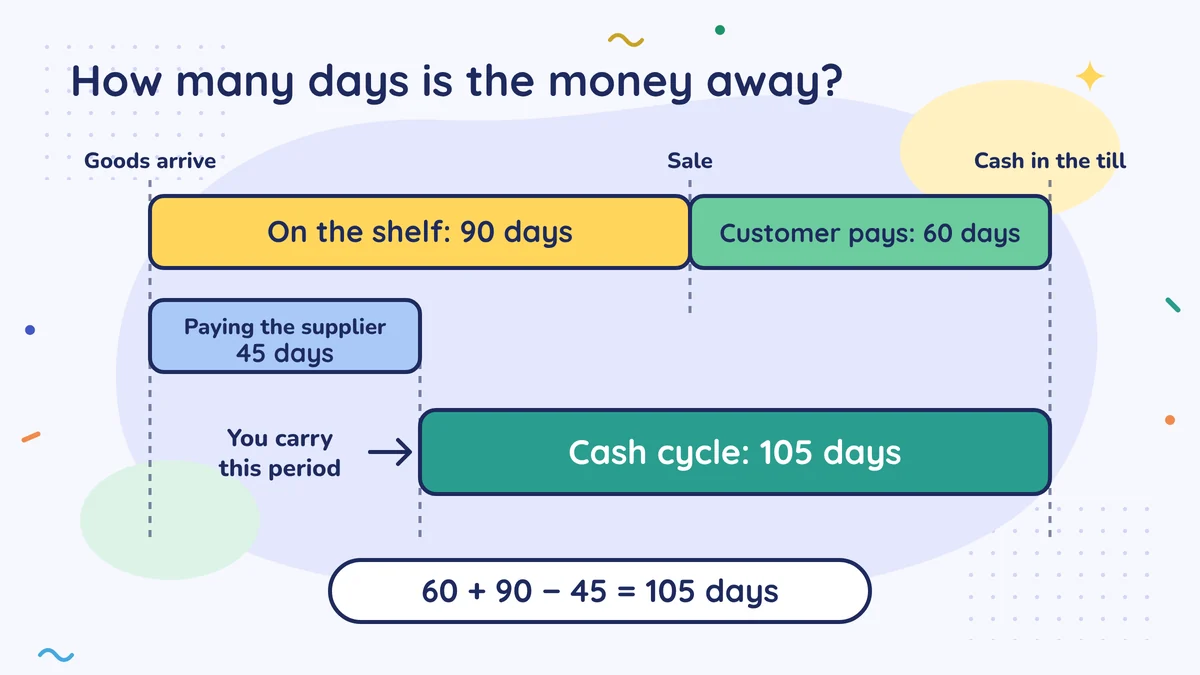
Receivable days show how many days on average the customer takes to pay; stock days show how many days on average the goods wait on the shelf; payable days show how many days on average you take to pay your supplier. Add receivable days and stock days and subtract payable days, and you get the cash conversion cycle: the number of days you carry with your own money or with a loan until the money goes round the business and comes back to the till. The shorter this period, the more cash stays in the till with the same sales.
Emre Bey the wholesaler's profitable but tight year
The rules described in this lesson are those of Turkish law.
Emre Bey is a hardware wholesaler. He sells goods on credit terms to hardware shops and tradespeople, and he also buys on credit terms from his suppliers. He will close 2026 well: 3,650,000 lira of sales excluding VAT and 280,000 lira of profit before tax. But all year, at every month end, the same rush: cheque day is coming, and there is no money in the till.
You saw the "profit but no cash" situation in the lesson Profit but no cash: the money waits with the customer, on the shelf, or in the state's share. In this lesson we go one step further and measure this: how many days does the money wait there?

The money's round trip
Think of a haulier's lorry. The lorry leaves the depot, delivers the load and comes back empty. The longer the trip, the less work the same lorry does in a year.
Money also goes on a trip. Emre Bey pays the supplier, the goods go onto the shelf, wait on the shelf, are sold to a customer on credit terms, the customer pays, and the money comes back to the till. Three numbers determine the length of this trip.
Three numbers, three divisions
| Number | What it asks | Calculation |
|---|---|---|
| Receivable days | How many days on average does the customer take to pay? | Average receivables ÷ annual sales × 365 |
| Stock days | How many days on average do the goods wait on the shelf? | Average stock ÷ annual cost of goods sold × 365 |
| Payable days | How many days on average do you take to pay the supplier? | Average supplier payables ÷ annual purchases × 365 |
The easiest way to get the "average": add the amount at the start of the year and the amount at the end of the year and divide by two. If your business is seasonal (school opening, religious holidays, construction season), the average of the amounts at the end of each month gives a more accurate result. Some sources use 360 instead of 365; the difference is a few days, just use the same one every year.
One point of care: receivables are recorded at the VAT-inclusive amount of the invoice. To keep the example simple, we have left VAT out here. In your own calculation, if you divide receivables by VAT-inclusive sales, you compare like with like. The same goes for supplier payables: the payable is recorded including VAT, so divide by VAT-inclusive purchases. Stock, on the other hand, is recorded at the purchase amount excluding VAT if you can deduct the VAT on purchases; divide it by cost excluding VAT as well.
Emre Bey's calculation
Emre Bey's annual figures (excluding VAT):
- Sales 3,650,000 lira, that is, 10,000 lira a day.
- Cost of goods sold 2,920,000 lira, that is, 8,000 lira a day. Because stock stayed roughly the same all year, annual purchases are the same amount.
- Average receivables 600,000, average stock 720,000, average supplier payables 360,000 lira.
| Number | Calculation | Result |
|---|---|---|
| Receivable days | 600,000 ÷ 10,000 | 60 days |
| Stock days | 720,000 ÷ 8,000 | 90 days |
| Payable days | 360,000 ÷ 8,000 | 45 days |
| Cash conversion cycle | 60 + 90 − 45 | 105 days |
How to read it: the goods Emre Bey puts on the shelf wait 90 days on average, and after they are sold the money arrives in 60 days. The supplier gives him 45 days. Emre Bey carries the 105 days in between with his own money or the bank's money.
The money tied up during this time can also be calculated: receivables + stock − supplier payables = 600,000 + 720,000 − 360,000 = 960,000 lira. More than three times Emre Bey's annual profit is going round inside the business.
What difference do a few days make?
Emre Bey sets two targets:
- Receivables from 60 days to 45 days. Average receivables fall to 450,000 lira; 150,000 lira is freed up in the till.
- Stock from 90 days to 75 days. Average stock falls to 600,000 lira; 120,000 lira is freed up.
A total of 270,000 lira. Same sales, same profit; but almost a year's profit in extra money sits in the till. The cure for the month-end rush is often not more sales but a shorter trip.
How do you shorten it?
The receivables side. Write a due date on every sale, sort receivables by days overdue, send a reminder before the due date. We set up this system in the lesson Credit sales and payments. The number of days is the report card that measures once a year whether that system is working.
The stock side. Find goods that have not been touched for three months, think about clearing them with a discount, and place new orders according to how fast things sell (Stock: money waiting on the shelf). A single overall stock-days figure mixes fast-moving and slow-moving goods. If you calculate it separately by product group, you find the problem shelf.
The payables side. Paying your supplier late lengthens the number of days but shakes trust, and can lead to late-payment interest and price differences. The right way is to agree on the payment terms in advance. The opposite can also be true: with a supplier that gives a discount for paying in cash (iskonto), paying early can turn out more profitable than a short trip. Do the calculation, then decide.
What do you compare the number with?
On its own, "60 days" is neither good nor bad. These numbers are very different for a wholesaler, a building-materials seller and a café; a café has almost no receivables. The meaningful comparison is with your own previous year and with the payment terms you give your own customers. If your terms are 30 days and your receivable days are 60, your customers are paying twice as late on average.
You can get these three numbers from your mali müşavir's (accountant's) year-end table, and also from your own current account (cari hesap) and stock-count records. If you keep business account books or are under simplified taxation, these lines may not be in the table; your list of current accounts and your year-end count do the same job. To follow cash flow monthly, use the table in the lesson Cash flow calendar; the numbers of days give you the big picture of the year.
Do this this week
Find three figures: the total receivables you are waiting for from customers today, total sales for the last 12 months (including VAT; from the invoices you issued or from your mali müşavir), and the payment terms you give your three biggest customers. Divide receivables by sales and multiply by 365. Compare the number of days with your payment terms; if the difference is more than 15 days, call the two customers who pay latest this week.
Common mistakes
- Dividing receivables by sales excluding VAT. Receivables are recorded including VAT; if you divide by sales excluding VAT, the number of days comes out longer than it really is. Put both on the same basis.
- Being satisfied with a single stock-days figure. Fast-moving goods hide slow-moving ones; calculate separately by product group.
- Trying to shorten the number of days by paying suppliers late. It looks better on paper, but you lose trust, payment terms and price; agree on terms in advance.
Sources
- Emre Yıldırım (Tax Inspector), The Importance and Interpretation of Financial Statements -2- (stock and receivables turnover) (Mali Tabloların Önemi ve Yorumlanması), Muhasebetr
- General Communiqué on the Application of the Accounting System No. 1 (1 Sıra No'lu Muhasebe Sistemi Uygulama Genel Tebliği): chart of accounts (customers, trade goods, suppliers), Alomaliye copy
Translated from the Turkish lesson. Last checked against Turkish rules: 12 October 2026. Not yet reviewed by a licensed accountant.
This is general information about Turkish rules, not financial, tax or legal advice. Rules change; check the date and the sources, and ask a licensed accountant (mali müşavir) about your own situation. Disclaimer