Year-end meeting with your mali müşavir: the questions to take with you
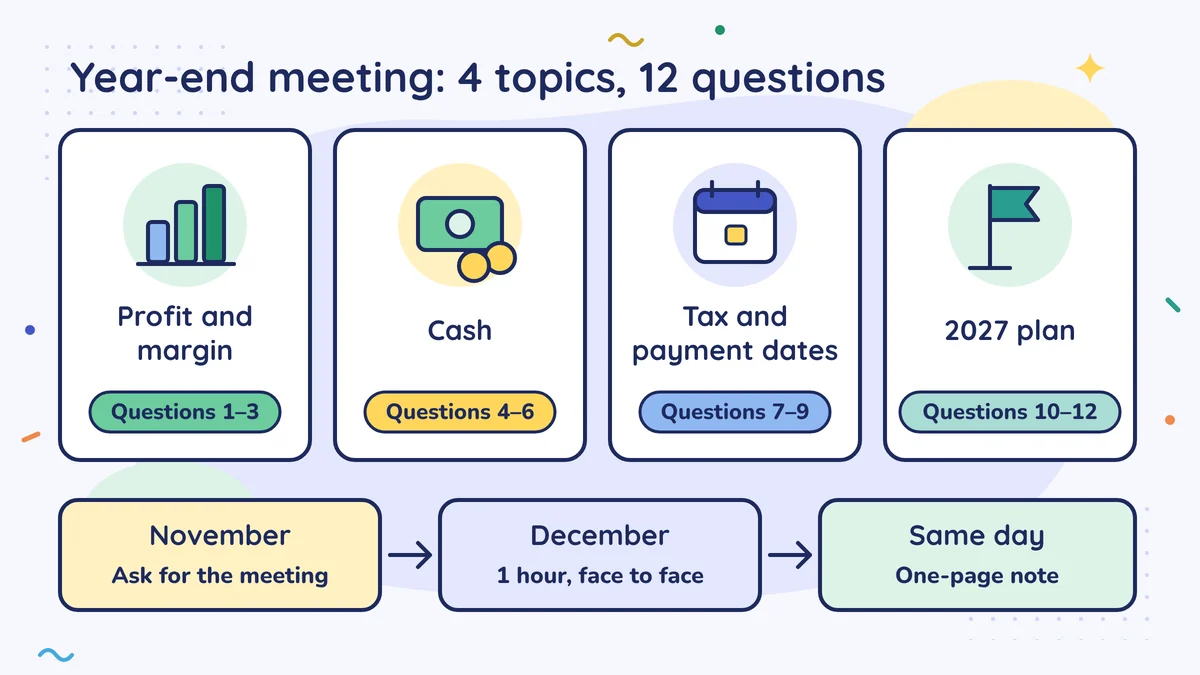
Instead of a ten-minute phone call at the end of January, a one-hour meeting in the first half of December. What to take with you, the 12 questions to ask your mali müşavir about profit, cash, tax and the 2027 plan, and a one-page note after the meeting.
Hold the year-end meeting with your mali müşavir before the year ends, in the first half of December, because the stock count, reconciliation and some decisions are only useful before 31 December. Take with you the January–September table, the same period of last year, your list of receivables and your own notes. Group your questions under four headings: profit and margin, cash, tax and payment dates, and next year's plan.
Leyla Hanım the stationer's ten minutes
The rules described in this lesson are those of Turkish law.
Leyla Hanım has a stationery shop with two branches. Last year her year-end conversation with her mali müşavir (accountant) took place in the last week of January, on the phone, and lasted ten minutes. The mali müşavir said, "Profit is this much, tax is this much, you pay in March," and Leyla Hanım said, "Fine." In March the tax came in higher than she expected. They had never talked about why it was high or what she could have done differently during the year.
This year she will do it differently: in the second week of December, for one hour, face to face, and with a list in her hand.

Why before the year ends?
Before you take your car for its inspection, you check the tyres and the lights; a fault noticed on inspection day is not fixed that day. The year end is like that. Things such as the day of the stock count, comparing balances with customers and suppliers (reconciliation, mutabakat) and the status of receivables that have become hard to collect are planned before 31 December. If you talk in January, you only learn the result. If you talk in December, you also do the things that will affect the result in time. We cover the year-end tasks themselves separately in this level's year-end module (Year-end checklist); in this lesson we focus on the meeting itself.
Your mali müşavir's December is busy. Ask for the meeting in November and set the date together.
What do you take with you?
- The January–September 2026 table. Your mali müşavir is already preparing it for the provisional tax (geçici vergi) return in November; ask for a copy. If you are under simplified taxation (basit usul), there is no provisional tax, so this table does not exist; take your own purchase and sales records.
- The same period of last year. Make the comparison as in the lesson Comparing with last year.
- Your list of receivables. Customer by customer, sorted by days overdue.
- Your own numbers. Your gross margin, your receivable and stock days (Cash conversion cycle), the number of units you sold or of customers.
- This list of questions. If you send the questions by e-mail in advance, your mali müşavir comes prepared.
Profit and margin
- What happened to my gross margin compared with the same period last year, and why? If it fell, was it price, purchase cost or wastage?
- Which expense increased most as a share of sales? For Leyla Hanım, the answer turned out to be the rent of the second branch.
- What is our estimate of profit before tax for the whole year? Ask for a rough figure that also takes October–December into account.
Cash
- Where is the difference between profit and the money in the bank waiting? In receivables, in stock, or in tax to be paid?
- Are there receivables that have become hard to collect, and what is done about them at the year end? Your mali müşavir will tell you under what conditions and with which documents.
- On which day, and how, will we do the stock count? Who will do the count, and when will the result go to the mali müşavir?
Tax and payment dates
- Roughly how much will my 2026 annual tax be, and how much of it do the provisional taxes I paid cover? For 2026, under the rules the last days are: October–December provisional tax 17 February 2027; for a sole proprietorship, the annual income tax return and first instalment 31 March 2027, second instalment 2 August 2027 (31 July falls on a Saturday); for a company, corporate tax return and payment 30 April 2027. These dates become final when GİB (Revenue Administration) publishes its 2027 calendar. If you are under simplified taxation, there is no provisional tax; your earnings from this business are exempt from income tax, and you do not file an annual return for these earnings.
- How much should I set aside each month in the coming months? Set the amount together with your mali müşavir; we built the habit of setting money aside in the lesson Setting money aside for tax.
- Is there a change in my type of books, my tax method or my invoicing in 2027? For example, those under simplified taxation and those keeping business account books can issue paper invoices of up to 3,000 lira including taxes in 2026; under the current rule (VUK General Communiqué No. 509, amendment of 31.12.2025), from 1 January 2027 they will issue e-Archive invoices whatever the amount. Ask in December whether a new postponement has come out.
The 2027 plan
- What will happen to my staff costs in 2027? The 2027 minimum wage (asgari ücret) is usually announced in December; work out the cost with your mali müşavir together with your number of employees and your salary plan.
- If you are a manufacturer: is the discount on the SGK employer premium changing? The Treasury discount (Hazine indirimi), which is 5 points for manufacturing in 2026, ends on 31 December 2026. The President can extend this period until 31 December 2027; if it is not extended, in 2027 manufacturing will also fall to 2 points like other businesses. Ask about the latest situation in December. If you are a manufacturing company, ask one more thing: under Law No. 7582, from the 2027 accounting period, 12.5% corporate tax will apply only to the earnings from production of companies that hold an industrial registry certificate (sanayi sicil belgesi) and actually produce; your mali müşavir will tell you whether you meet the conditions.
- Which documents do you need from me in January, and by what date? Get the list in writing.
What came out of Leyla Hanım's meeting?
When Leyla Hanım asked the first two questions, the picture became clear. January–September sales were up 28% on the same period last year; close to inflation, so she was standing still. Her gross margin had fallen from 32% to 31%, which was acceptable. But the rent of the second branch had gone up from 6% of sales to 9%. Almost all of the fall in the pre-tax profit margin came from here.
The cash question brought up something else: some of the notebooks and bags bought in August for the school season were still in the storeroom. Stock days had been 70 last year and were 95 this year. Her mali müşavir suggested putting the count day in the calendar now and listing the goods in the storeroom separately in the count; that way, in January it would be clear at a glance which goods were moving slowly.
On the tax question, last year's surprise was not repeated: her mali müşavir gave a rough range for the annual tax, and Leyla Hanım set the monthly amount she will put aside that same day.
After the meeting
On the same day, write a one-page note: the figures discussed, the decisions made, who will do what by which date. Send the note to your mali müşavir too and ask, "Have I understood correctly?" Leyla Hanım's note had three decisions: renegotiate the second branch's lease in March, clear the stock left over from the school season with a discount in January, and transfer a fixed amount to the tax jar on the 20th of every month.
The purpose of the meeting is not to put your mali müşavir through an exam, but to look at the same figures together. An employer who asks questions also makes the mali müşavir's job easier.
Do this this week
This week, write a short message to your mali müşavir and ask for a one-hour year-end meeting within the first two weeks of December. Add the five of this lesson's 12 questions that concern you most, and ask for a copy of the January–September 2026 table.
Common mistakes
- Leaving the meeting until January. The stock count, reconciliation and some decisions are useful before 31 December; in January you only learn the result.
- Going without figures in hand. A question asked without knowing your own margin and your receivable and stock days stays general, and so does the answer.
- Not writing down what was discussed. Without a one-page note, the decisions are forgotten by March; send the note to your mali müşavir too.
Sources
- Alomaliye: 2025 income tax return 1–31 March 2026, payment 31 March and 31 July 2026
- TRT Haber: Last day for corporate tax return and payment is 30 April
- Income Tax Law No. 193 (Gelir Vergisi Kanunu) (art. 92: paying annual tax in two instalments; additional art. 120: provisional tax)
- PwC Tax Bulletin: Tax provisions of Law No. 7566 (fourth provisional tax period brought back)
- Ekonomi Gazetesi: Amendment to VUK General Communiqué No. 509 (509 Sıra No'lu VUK Genel Tebliği, Official Gazette 31.12.2025), paper invoices up to 3,000 TL under simplified taxation and business account books until 1.1.2027
- Cott: Law No. 7582 (Official Gazette 04.06.2026), 12.5% corporate tax on production earnings with an industrial registry certificate from 2027
- Alomaliye: SGK Circular 2026/1 (SGK Genelgesi; Treasury discount: manufacturing 5 points until 31.12.2026, the President can extend until 31.12.2027; other businesses 2 points)
- KPMG Vergi: No inflation adjustment in 2025–2027 (Tax Procedure Law (Vergi Usul Kanunu) provisional art. 37)
Translated from the Turkish lesson. Last checked against Turkish rules: 12 October 2026. Not yet reviewed by a licensed accountant.
This is general information about Turkish rules, not financial, tax or legal advice. Rules change; check the date and the sources, and ask a licensed accountant (mali müşavir) about your own situation. Disclaimer