A partner taking money out of the company: receivables from partners, interest and TTK 358
In two years Emre Bey took 300,000 lira from the company on top of his salary and profit shares. How the receivables from partners account grows, when the law prohibits this debt, why interest is calculated, what happens if it is not, and how this balance is closed.
In a limited or joint-stock company, money a partner takes from the company other than salary and profit shares (kâr payı) is the partner's debt to the company and sits on the 'receivables from partners' line of the balance sheet (bilanço). A partner who has not paid a due capital debt, or a partner of a company whose profit and free reserves do not cover past years' losses, cannot borrow from the company (TTK art. 358). Even where it is allowed, the company is expected to calculate interest at a market rate on this receivable; if it does not, it may be treated in a tax audit (vergi incelemesi) as disguised profit distribution (Corporate Tax Law art. 13).
Emre Bey's growing line
The rules described in this lesson are those of Turkish law.
Emre Bey's haulage company is a limited company, and he is the only partner. He works in the company as its manager and has a salary on the payroll. But every now and then he transfers money from the company account to his own: the house instalment, the children's school, a holiday. In two years the total reached 300,000 lira.
At the end of the year his mali müşavir (accountant) showed him the balance sheet: "There are 300,000 lira on the receivables from partners line. This is your debt to the company. It has three consequences: a legal limit, interest, and a plan to close it."
We explained the ways a partner can take money from the company, that is, the difference between a salary, a profit share and a loan, in the lesson Paying yourself a salary, and the day-to-day routine in the lesson Business money and pocket money. In this lesson we look at what happens when the line grows. In a sole proprietorship these rules do not work this way; money you take out of the business is tracked separately as the owner's drawings.

The neighbour in the credit book
Think of the corner shop's credit book (veresiye defteri). A neighbour buys a little every week and it is written in the book. One day the figure in the book passes the shop's monthly turnover. The shopkeeper no longer remembers what he lent, but the book does.
Receivables from partners are the company's credit book. The only difference is that the debtor is the owner of the shop. That is why the law and the tax administration take a separate look at this book.
The legal limit: TTK 358
Turkish Commercial Code art. 358 prohibits a partner from borrowing from the company in two cases:
- If the partner has not paid a due debt arising from his capital commitment.
- If the company's profit and free reserves do not cover past years' losses.
This article also applies to limited companies (TTK art. 644). For a company executive who lends to a partner in breach of the rule, the law provides for a judicial fine of at least 300 days (TTK art. 562). In other words, the prohibition is addressed to the manager who runs the company; in a single-partner company that is usually Emre Bey himself again.
Emre Bey's capital has been paid in full and the company has no past-year losses. So his borrowing is not prohibited by law. But not being prohibited does not mean there are no consequences.
Interest: why is it calculated?
If a company lends to its partner without interest, it gives the partner a benefit. Corporate Tax Law art. 13 treats this as a transaction with a related person that is not at arm's length. That is why mali müşavirs calculate interest on this receivable at the end of the period; in practice this is called the adat calculation (adat hesabı). The company issues an invoice to the partner for this interest; according to the prevailing view, VAT is also added on top of the interest. As for the rate, in practice the interest rate on the company's own loans or the rates announced by the Central Bank are usually taken as the basis; the reasoning for the rate chosen should be kept on file.
The logic of the calculation is simple: amount of debt × number of days × annual rate ÷ 365. To make the example easy to see, let us assume an annual rate of 40%; this is only an example, and your mali müşavir decides which rate to use:
| Item | Amount |
|---|---|
| Receivables from partners outstanding all year (assumption) | 300,000 |
| Example annual rate | 40% |
| Annual interest (300,000 × 40%) | 120,000 |
These 120,000 lira are interest income for the company and an interest debt for Emre Bey; according to the prevailing view, VAT is added on top in the invoice. So the money Emre Bey took creates a new debt every year. As the balance grows, this amount grows too.
If interest is not calculated
In a tax audit, uncalculated interest may be treated as disguised profit distribution through transfer pricing (örtülü kazanç dağıtımı) (Corporate Tax Law art. 13). In that case:
- The uncalculated interest is added to the company's income, and corporate tax (and the VAT on the interest) is claimed.
- This amount is treated as a profit share distributed to the partner; profit share withholding tax (stopaj) comes into play (Profit share distribution).
- Penalties and late payment interest may be added on top.
In short, not calculating interest is not a saving; it is a postponed burden.
How is the line closed?
Emre Bey discussed four ways with his mali müşavir:
- Repayment: Paying the money back into the company from his own account. The simplest way.
- Offsetting against a profit share (mahsup, that is, deducting one from the other): If the company distributes profit, the profit share due to Emre Bey can be counted against this receivable. A general meeting (genel kurul) decision is needed and withholding tax is still deducted.
- Offsetting against payables to partners: If Emre Bey has money he put into the company at another time, sitting on the 'payables to partners' line, the two can be set against each other.
- Tying a regular amount to the salary: For the future. Money taken in the past cannot later be counted as salary; a salary is paid through the payroll with income tax deducted. Because a partner who is a manager is insured under Bağ-Kur (the social security scheme for the self-employed), SGK premiums are generally not deducted from his payroll; ask your mali müşavir about your own situation.
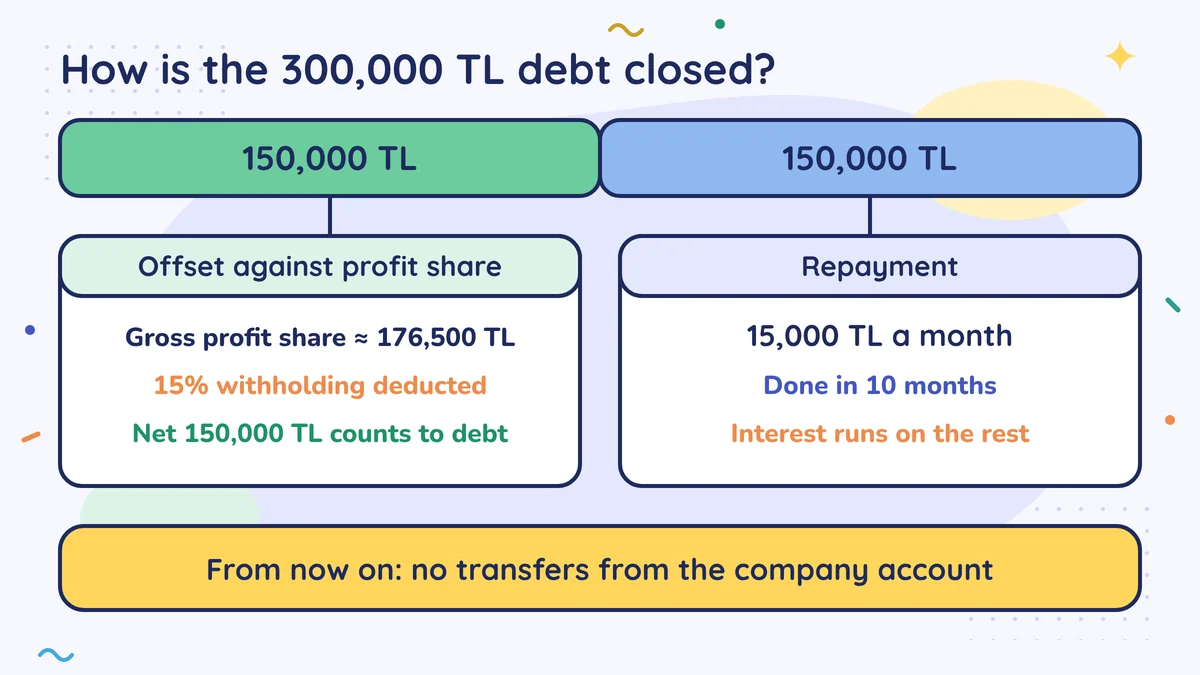
Emre Bey made a plan: he will close half the debt with the 150,000 lira left from this year's profit share after withholding tax is deducted. For this, a profit share of about 176,500 lira gross is needed, because 15% withholding tax is deducted (150,000 ÷ 0.85). He will pay off the remaining 150,000 lira over ten months with repayments of 15,000 lira a month; during this time interest will continue to be calculated on the remaining debt. From now on he will not transfer money from the company account to his own; he will plan his needs around his salary.
Make every money transaction with a partner through the bank, whatever the amount, and write in the description what it is. At the end of the period, this line is one of the first you should ask your mali müşavir about (The year-end meeting with your mali müşavir).
Ask your mali müşavir
- "At what rate and for which periods do we calculate interest on the receivables from partners account?"
- "Does the company have past-year losses or unpaid capital debt; in other words, where do we stand under TTK 358?"
- "If we offset this balance against a profit share, what happens in terms of withholding tax and cash?"
Ask for the answers in writing, and look at this line again at the end of every year.
In one sentence
Money you take from the company without a payroll and without a profit share decision is your debt to the company; it has a legal limit (TTK 358) and interest, and you need a plan to close it before it grows.
Do this this week
On your latest balance sheet or trial balance, find the amount on the 'receivables from partners' line and compare it with last year's. If it is growing, ask your mali müşavir two questions: 'Are we calculating interest on this receivable?' and 'How can we close it this year?'
Common mistakes
- Using the company account as if it were your own. Every lira taken outside the payroll and a profit share decision is your debt to the company and builds up on the balance sheet.
- Thinking that not calculating interest is a saving. In an audit, uncalculated interest may be treated as disguised profit distribution; tax, withholding tax and penalties can come together.
- Trying to have past withdrawals recorded as salary afterwards. A salary is paid through the payroll and on time; money taken in the past does not turn into salary later.
Sources
- Turkish Commercial Code No. 6102 (6102 sayılı Türk Ticaret Kanunu), art. 358 (partner borrowing from the company), art. 562 (penalty), art. 644 (application to limited companies) (mevzuat.gov.tr)
- Erdem & Erdem: The prohibition on borrowing from the company under the Turkish Commercial Code
- Ekrem Öncü (YMM), partners borrowing from the company: the conditions of TTK 358, the judicial fine, Corporate Tax Law art. 13 and the VAT on interest (MuhasebeTR)
- Mehmet Maç (YMM), the tax consequences of lending to a partner without interest: Corporate Tax Law art. 13, arm's length interest, VAT (MuhasebeTR)
- Corporate Tax Law No. 5520 (5520 sayılı Kurumlar Vergisi Kanunu), art. 13 (disguised profit distribution through transfer pricing) (mevzuat.gov.tr)
- TÜRMOB
Translated from the Turkish lesson. Last checked against Turkish rules: 12 October 2026. Not yet reviewed by a licensed accountant.
This is general information about Turkish rules, not financial, tax or legal advice. Rules change; check the date and the sources, and ask a licensed accountant (mali müşavir) about your own situation. Disclaimer