Accounts that look risky: cash, ongoing losses, VAT refunds and the risk of fake documents
Some lines on the balance sheet draw attention: cash swelling in the records, growing receivables from partners, losses that have gone on for years, VAT refunds and a suspicious supplier's invoice. None of them is an offence on its own, but the explanation should be ready. For each line we see why it stands out and how to fix it.
Cash that looks high in the records but is not in the drawer can be treated as the partner's debt to the company and have interest charged on it. Losses that go on for years and VAT refund claims lead to documents being checked more closely. A document not based on a real purchase is a fake document; knowing your supplier, paying through the bank and documenting delivery protect you.
Erdal Bey the wholesaler's yellow pen
The rules described in this lesson are those of Turkish law.
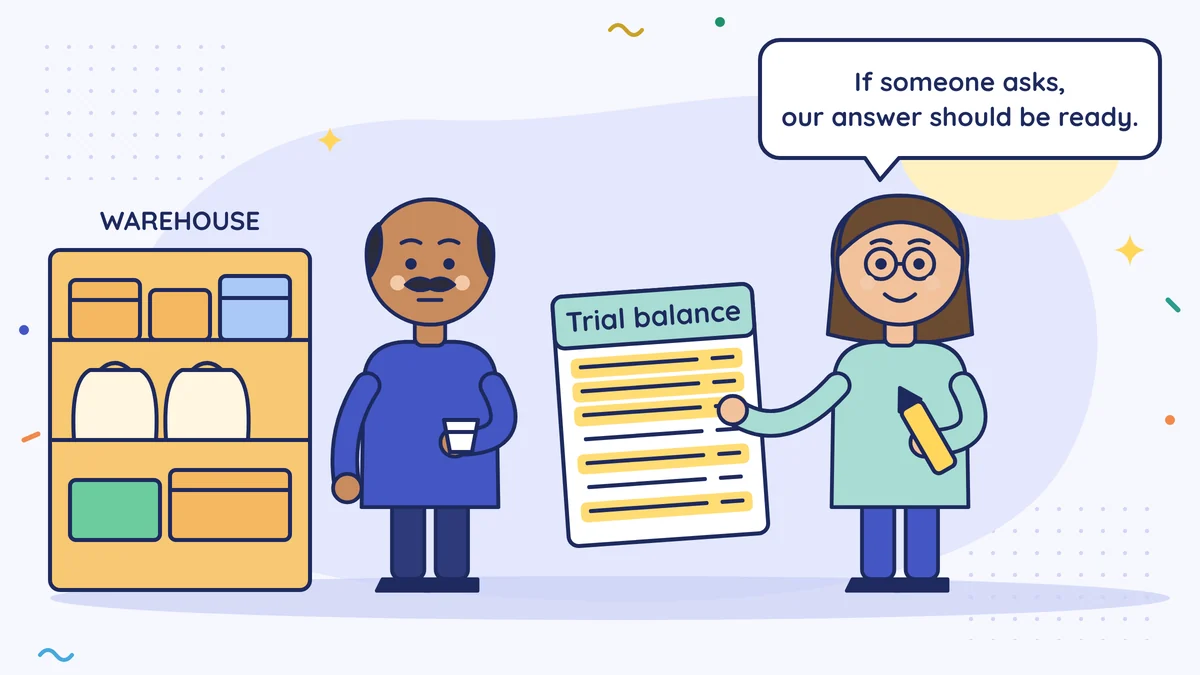
Erdal Bey's food wholesale business is a limited company. In June his mali müşavir (accountant) brought the six-month trial balance (mizan), that is, the combined list of all the accounts. He had marked five lines with a yellow pen. "These are not offences," he said, "but if someone asks, our answer should be ready."
Think of a blood test. On the results sheet some lines have a star next to them. The star does not mean "you are ill"; it means "let's take a look at this too". The lines that draw the tax administration's attention are like that.
Does this apply to you? This lesson is for businesses that keep books on the balance-sheet basis (bilanço esası); all companies do. If you keep a business book (işletme defteri), your books have no cash line and no receivables from partners line, but the sections on losses, VAT refunds and fake documents apply to you too. In a sole proprietorship, the money you withdraw from the business is tracked separately instead of receivables from partners, and the interest issue does not work as it does in a company; ask your mali müşavir how to close a swollen cash balance.
1. Cash swelling in the records
In Erdal Bey's records the cash account showed 900,000 TL. There was 40,000 TL in the drawer. Over the years the difference had built up from money taken from the till and not written down, and from small payments that were never recorded.
Why does it stand out? It is not normal for a wholesaler to keep this much cash in the till. The auditor may think this money was in fact given to the partner interest-free, and may calculate interest. Some Council of State (Danıştay) decisions also say that high cash on its own is not enough and that concrete findings are needed; but the one who has to give the explanation is still you. A cash account going negative is an even more serious sign: it suggests collections that were not recorded.
Fix it like this. Count the cash and write a dated, signed count report. Find the reason for the difference with your mali müşavir. If it turns out to be money the partner took, it is the partner's debt to the company and interest is calculated on it; how to close it is in the lesson A partner taking money out of the company. The steps of the year-end count are in the lesson The December count. From now on, make large collections and payments through the bank; in 2026 business-related collections and payments of more than 30,000 TL already have to be made through a bank or PTT (the Turkish post office), whether the other party is a business, your partner or a customer.
2. Growing receivables from partners
The second yellow line was this one: 250,000 TL. When the part of the cash difference that went to the partner is added here, the line will grow even bigger. We covered in which situations the law prohibits this debt, its interest and the repayment plan in the lesson linked above; we won't repeat it here. Just one note: this line is one of the first lines to ask your mali müşavir about at the end of every year.
3. Losses that have gone on for years
Erdal Bey's company had been reporting a loss, if a small one, for three years. Yet the business was growing and the number of employees was rising.
Why does it stand out? How a business that makes a loss for a long time stays on its feet is a natural question. Is the partner putting in money, is there a loan, or is part of the sales not being recorded?
Fix it like this. Put the real reason for the loss in writing. It could be a new warehouse investment, depreciation (amortisman), or a product group whose price is below its cost. If the loss is real, your file is ready; if it isn't, you find the mistake early. Calculate your cost product by product as in the lesson Fixed costs, variable costs and unit cost. If the partner put money in, make sure it was done through the bank and recorded.
4. Asking for a VAT refund
Once Erdal Bey started exporting, he was going to ask for a VAT refund.
Why does it stand out? A refund means money going out of the state's coffers to you. So before it is paid, the list of your purchase documents is checked through the system. Depending on the type and amount, a sworn mali müşavir (yeminli mali müşavir) report, a tax audit report or a guarantee may be requested. If something is found missing, a period is given to fix it; if it is not fixed, the claim may be sent for audit.
Fix it like this. Before asking for a refund, go over the purchases of the period the refund relates to with your mali müşavir. A purchase with a weak document can hold up the whole refund. We saw which documents' VAT can be deducted in the lesson Deductible VAT.
5. The risk of fake documents
The last yellow line was a supplier: a firm they started working with last year, whose invoices are in order but whose address is unclear.
A document issued as if a real purchase or job existed when it did not is a fake document (sahte belge). A document that shows a real purchase as different in amount or nature is a misleading document (içeriği yanıltıcı belge) (VUK art. 359). Both have serious consequences. But as the buyer, your problem is usually this: if your supplier is later identified as an issuer of fake documents, a letter comes to you. If you cannot prove that the purchase was real, its VAT may be removed from your deductions and its amount from your expenses.
On 1 October 2025 the Ministry of Treasury and Finance (Hazine ve Maliye Bakanlığı), through the Tax Inspection Board (Vergi Denetim Kurulu), brought in an analysis system called KURGAN. The system assesses purchase transactions by looking at the supplier's risk; for a purchase seen as risky, a letter requesting information comes to the buyer. This letter does not mean an audit has begun. The deadline for answering is written in the letter (in practice 15 days); if it is not answered on time, a special irregularity penalty (özel usulsüzlük cezası, the penalty for not giving information) may be imposed, and a letter left unanswered may also turn into an audit.
Protect yourself like this. Before working with a new supplier, do a short check:
| Check | How |
|---|---|
| Is the firm real | Tax certificate (vergi levhası), address, landline; if possible, see the workplace |
| Do the goods it sells fit its business | If a shoe seller is selling you flour, ask |
| Who is the payment going to | To the firm's own bank account named on the invoice; no cash in hand |
| Did the goods really arrive | Delivery note (irsaliye), delivery report, the vehicle's number plate |
| Is the price reasonable | If it is far below the market, ask why |
Put these documents next to the invoice. If a letter comes, answer it on time, together with your mali müşavir and with your documents.
Erdal Bey's plan
| Line | Amount | Plan |
|---|---|---|
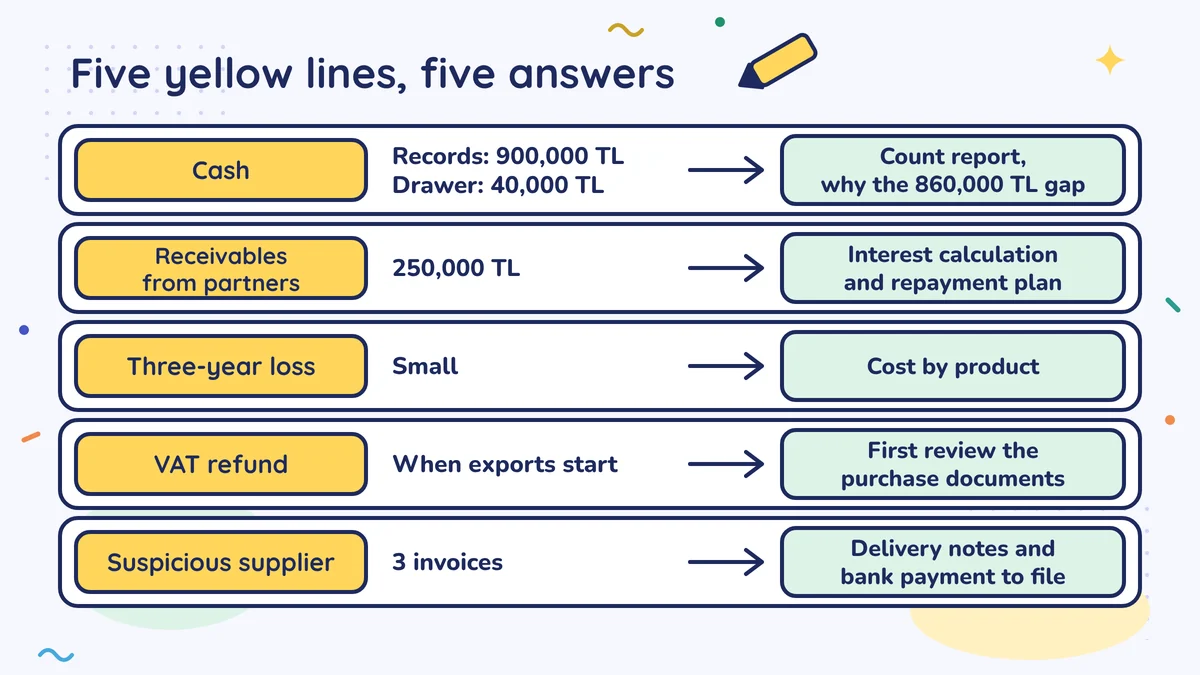
| Cash | 900,000 TL in the records, 40,000 TL in the drawer | Count report; the reason for the 860,000 TL difference, line by line with the mali müşavir |
| Receivables from partners | 250,000 TL | The part from cash to be added; interest calculation and repayment plan |
| Three years of losses | Small | Cost by product; the price of the loss-making group to be updated |
| VAT refund | When exports start | Purchase documents to be reviewed before the refund |
| Suspicious supplier | 3 invoices | Delivery notes and bank payment into the file; no new purchases |
His mali müşavir looked at the list: "Now if someone asks, all five lines have an answer."
Do this this week
Ask your mali müşavir for the latest trial balance and look at four lines: cash, receivables from partners, the result for the period (profit or loss), and the suppliers you have worked with for the first time in the last six months. Compare the amount on the cash line with the money you count in the drawer today; if there is a difference, write to your mali müşavir.
Common mistakes
- Never comparing the cash in the records with the money in the drawer. The difference builds up over years; a difference found early is easily explained with a count report.
- Paying a new supplier in cash or into someone else's account. The strongest way to prove a purchase was real is a bank payment into the own account of the firm named on the invoice.
- Brushing off a loss because "no tax comes out of it anyway". Not being able to explain in writing the reason for a long-running loss also hides a wrong entry for years.
Sources
- Tax Procedure Law No. 213, art. 359 (fake and misleading documents) (Vergi Usul Kanunu) (mevzuat.gov.tr)
- Corporate Tax Law No. 5520, art. 13 (disguised profit distribution through transfer pricing) (Kurumlar Vergisi Kanunu) (mevzuat.gov.tr)
- Av. Dr. Fatih Aras: Swollen cash accounts and tax risk, Council of State decisions
- Ekonomi Gazetesi, Ezgi Türkmen and Yeşim Dikici Orhan: KURGAN, intent and supplier acceptance
- Alomaliye: Strategy for Combating Fake Documents and the KURGAN Guide for Taxpayers and Professionals (October 2025)
- MuhasebeTR, Fuat Tekgül (SMMM): The referral-to-audit process in VAT refund claims
- VUK General Communiqué No. 459, as amended by No. 575: the 30,000 TL limit for collections and payments (Ekonomi Gazetesi)
- Andersen: the obligation to make payments through the bank (non-taxpayers also covered under Communiqué No. 572; limit 30,000 TL under No. 575)
- Ekonomi Gazetesi, Ramazan Kök (YMM): A KURGAN letter has come, what should I do?
Translated from the Turkish lesson. Last checked against Turkish rules: 13 October 2026. Not yet reviewed by a licensed accountant.
This is general information about Turkish rules, not financial, tax or legal advice. Rules change; check the date and the sources, and ask a licensed accountant (mali müşavir) about your own situation. Disclaimer