What is depreciation? Useful life, rate and the 12,000 lira limit
Sinan Bey the dry cleaner bought a 375,000 lira machine, but this year's expense came to 75,000 lira. What depreciation is, which amount is spread over the years, the 2026 limit of 12,000 lira, how useful life and the rate are read from the Ministry of Finance's list, and what happens to a fixed asset bought in the middle of the year.
Depreciation is recording as an expense the cost of things used in the business for more than one year, such as machines, vehicles and furniture, by spreading it over the years they will be used (VUK art. 313). As a rule, the number of years is set by the Ministry of Finance's useful life list; the rate is 100 divided by the number of years, for example 20% for 5 years. In 2026, a fixed asset costing no more than 12,000 lira per item (excluding VAT) can be recorded directly as an expense.
Sinan Bey the dry cleaner's new machine
The rules described in this lesson are those of Turkish law.
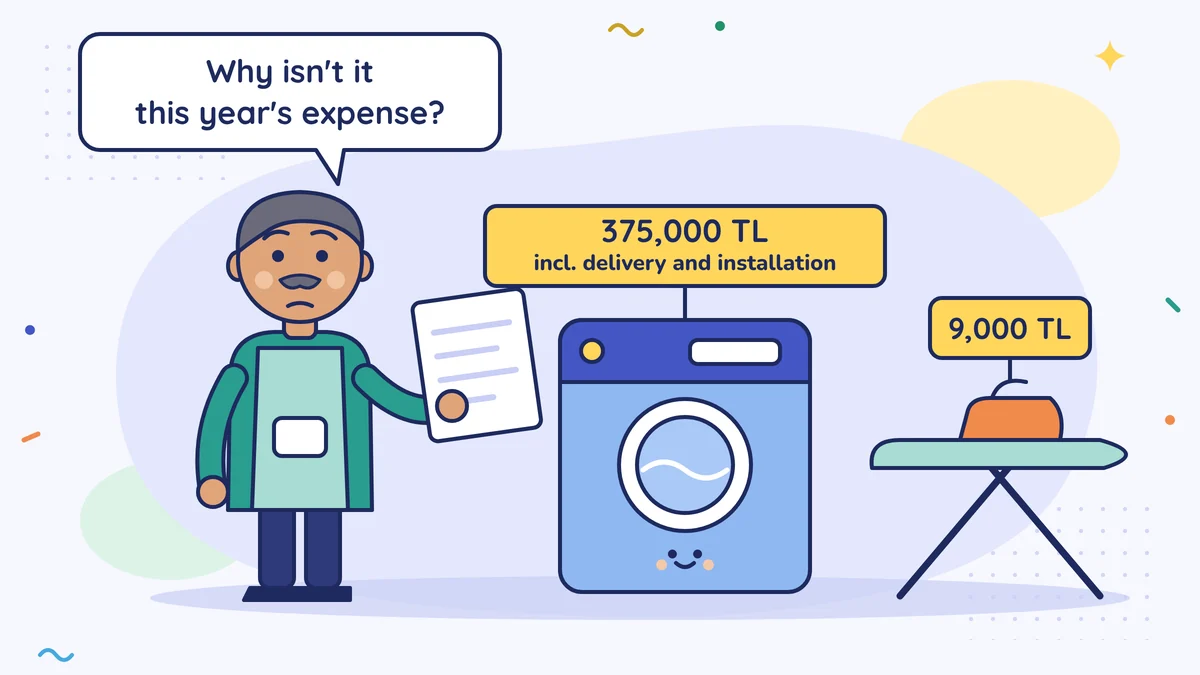
Sinan Bey's dry-cleaning shop has been on the same corner for ten years. In October 2026 the old washing machine could no longer be repaired. He bought a new one for 360,000 lira (excluding VAT) and paid another 15,000 lira for delivery and installation. The same week he also bought a new ironing table for 9,000 lira.
Towards the end of the year his mali müşavir (accountant) sent him the preliminary calculation. Sinan Bey looked at the table: the machine had not all been recorded as an expense. "The money went out, and this year too. Why isn't it this year's expense?"
Think of a tea maker who runs a tea stand. If he records the big samovar he will brew tea in for ten years as an expense on the day he buys it, that day shows a big loss, and for the next ten years the samovar looks as if it were free. The right way is to share the samovar's cost over the years it will be used. In accounting this is called depreciation (amortisman).
What does depreciation mean?
The cost of something that is used in the business for more than one year and wears out, ages or loses value over time is recorded as an expense by spreading it over the years it will be used (Tax Procedure Law, Vergi Usul Kanunu, VUK, art. 313). Buildings, machines, vehicles, furniture, computers and the shop counter belong to this group. In short, these are called fixed assets (demirbaş, duran varlık).
Two things do not belong to this group:
- Land and plots. They do not wear out; no depreciation is set aside. If you bought a building together with its plot, depreciation is set aside for the building's share, not for the plot's share.
- Goods you bought in order to sell. That is stock; when it is sold, its cost becomes an expense. The value of stock is in the third lesson of this module.
The amount that is spread: cost
The figure spread over the years is not only the price on the invoice. Payments made to buy the thing and make it ready for use are added too: delivery, installation, customs and so on (VUK art. 262, 269 and 270). The cost (maliyet bedeli) of Sinan Bey's machine is 360,000 + 15,000 = 375,000 lira.
If you are a VAT taxpayer, you deduct the VAT on the invoice from the VAT you collect on sales; that is why VAT does not go into the cost. If you cannot deduct the VAT, the VAT-inclusive amount is recorded as the cost.
The 12,000 lira limit
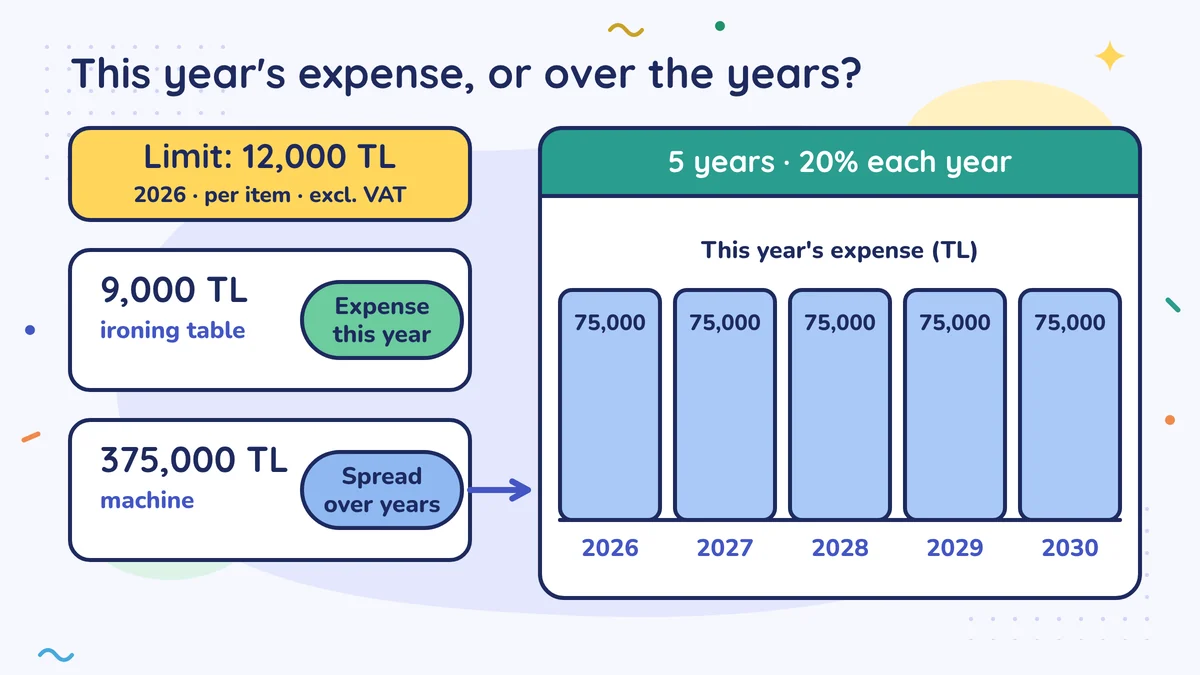
In 2026, a fixed asset costing no more than 12,000 lira per item can be recorded directly as an expense (VUK art. 313; VUK General Communiqué No. 588, 588 Sıra No'lu VUK Genel Tebliği). If you are a VAT taxpayer, this limit is checked against the price excluding VAT. For parts that work together as a single whole (such as the case, screen and keyboard of a desktop computer), the total amount is what counts; splitting the same purchase into two invoices does not change the result. You also saw this rule in the lesson The year-end file for your mali müşavir.
Sinan Bey's 9,000 lira ironing table is below the limit; it can be recorded as this year's expense. The 375,000 lira machine, however, is spread over the years.
Useful life and rate: over how many years?
You cannot choose the number of years as you please. For every type of fixed asset the Ministry of Finance announces a useful life (faydalı ömür), that is, how many years it is normally used, and a rate based on it (VUK art. 315). The list is published with VUK General Communiqué No. 333 (333 Sıra No'lu VUK Genel Tebliği) and its later amendments; your mali müşavir looks at this list. Since 2021, anyone who wishes may also choose a longer period, provided it is not shorter than the period in the list and does not exceed twice that period or 50 years (an option introduced by Law No. 7338); a period shorter than the one in the list cannot be chosen.
The rate is 100 divided by the number of years:
| Useful life in the list | Annual rate |
|---|---|
| 4 years | 25% |
| 5 years | 20% |
| 10 years | 10% |
For example, if the list says 5 years for this machine, Sinan Bey's table looks like this:
| Year | This year's expense | Set aside so far | Value remaining in the books |
|---|---|---|---|
| 2026 | 75,000 | 75,000 | 300,000 |
| 2027 | 75,000 | 150,000 | 225,000 |
| 2028 | 75,000 | 225,000 | 150,000 |
| 2029 | 75,000 | 300,000 | 75,000 |
| 2030 | 75,000 | 375,000 | 0 |
If an item is not clearly in the list, your mali müşavir chooses the closest item; if there is serious doubt, a written opinion (a private ruling, özelge) can be requested from the Revenue Administration (Gelir İdaresi).
A full year for a machine bought in October?
As a rule, depreciation starts in the year the thing enters the business and is set aside year by year; even if you buy it in October, that year's full share is set aside. Under Law No. 7338, for fixed assets newly added to the business after 26 October 2021, anyone who wishes may also set aside the share on a daily basis from the day it is ready for use (VUK art. 320); whoever chooses this route cannot later go back on it. Ask your mali müşavir whether you can use this option with your type of books and which one suits you. For a passenger car (binek otomobil), however (except for those whose business is renting out or operating passenger cars), in the year of purchase depreciation is set aside only for the remaining months; the part that cannot be set aside is left to the last year. A passenger car also has an upper limit: for a car bought in 2026, depreciation can be recorded as an expense on at most 1,380,000 lira excluding special consumption tax (ÖTV) and VAT; if ÖTV and VAT have been added to the car's cost, this limit is 2,600,000 lira. Depreciation on the part above the limit cannot be recorded as an expense (Income Tax Law, Gelir Vergisi Kanunu, art. 40; Income Tax General Communiqué Serial No. 332, 332 Sıra No'lu GV Genel Tebliği). Before buying a car in the business's name, discuss this limit with your mali müşavir.
One more thing to know: a year's share goes into that year's calculation. If you forget to set it aside one year, the period does not get longer; that share cannot be added to the following year (VUK art. 320). So send the invoice for every new fixed asset to your mali müşavir in the same month.
Where does it appear in the statements?
Each year's share appears as an expense in the income statement and lowers profit. The total set aside so far stands in the balance sheet (bilanço) on the accumulated depreciation (birikmiş amortisman) line, as a minus below the fixed asset (The balance sheet: assets equal liabilities plus equity). If you keep a business book (işletme defteri), depreciation is also set aside; the form of the record is different. Under simplified taxation (basit usul) the earnings are exempt from tax, so the situation is different; ask your mali müşavir.
On the cash side, the money went out on the day of purchase. You saw in the lesson How many months does an investment take to pay for itself? that depreciation takes nothing out of the cash box but lowers profit.
Sinan Bey's list
Sinan Bey talked with his mali müşavir for ten minutes and added two columns to his list of fixed assets: useful life and annual share. Now, at the start of every year, he knows how much of that year's profit will be set aside for the machines. "The machine is bought once, but it turns out I need to think as if I were paying for it over five years," he said.
Do this this week
Add two columns to your list of fixed assets: useful life and annual share. Find the invoice for every fixed asset you bought this year; ask your mali müşavir "Over how many years are these spread, and how much is recorded as an expense this year?" and write the answers in the columns.
Common mistakes
- Thinking the whole cost of an expensive fixed asset is an expense of the year it was bought. In 2026 an item over 12,000 lira is spread over the years; this year's profit, and its tax, comes out higher than you expected. Splitting the invoice into parts does not change this.
- Recording delivery and installation as a separate expense. Payments made to make the machine ready for use are added to its cost and spread over the years together with it.
- Sending the invoice to your mali müşavir late. A year's share goes into that year's calculation; a share not set aside cannot be added to the following year, and the period does not get longer.
Sources
- Tax Procedure Law No. 213 (213 sayılı Vergi Usul Kanunu), art. 262 (cost), art. 313 (depreciation and direct expense), art. 315 (rates), art. 320 (depreciation period) (mevzuat.gov.tr)
- TÜRMOB: VUK General Communiqué No. 588 (588 Sıra No'lu VUK Genel Tebliği), 2026 amounts (12,000 lira for art. 313)
- VUK General Communiqué No. 333 (333 Sıra No'lu VUK Genel Tebliği): useful lives of assets subject to depreciation (Alomaliye copy)
- Alomaliye: Current depreciation list, useful lives and rates
- Muhasebetr, Mehmet Maç: depreciation not set aside and why the period cannot be extended (VUK art. 320)
- Muhasebetr, Emine Koçakerim: the option of daily-basis depreciation introduced by Law No. 7338
- Muhasebetr, Sedat Öngel: partial-year depreciation for passenger cars and daily-basis depreciation (VUK art. 320)
- Yöntem YMM: 2026 amounts for the passenger car expense restriction (depreciation limit 1,380,000 lira excluding ÖTV and VAT, 2,600,000 lira if added to cost; Income Tax General Communiqué Serial No. 332, 332 Sıra No'lu GV Genel Tebliği, Official Gazette 31.12.2025)
- PwC Türkiye: 2026 limits on passenger car expenses and depreciation (1,380,000 lira / 2,600,000 lira)
- Muhasebetr, Sefa Topçu: the option, introduced by Law No. 7338, of choosing a period longer than the useful life
Translated from the Turkish lesson. Last checked against Turkish rules: 13 October 2026. Not yet reviewed by a licensed accountant.
This is general information about Turkish rules, not financial, tax or legal advice. Rules change; check the date and the sources, and ask a licensed accountant (mali müşavir) about your own situation. Disclaimer