A new employee or a second branch? Extra cost, extra sales, break-even
In a growth decision you look not at the whole business but at the figures that will change after the decision. Using the example of Hasan Abi the pide maker, we calculate the extra cost of a new employee and of a second branch, the extra sales each must bring in, and the money that will leave the cash box in the first months.
Count only the figures that will change after the decision: divide the extra fixed cost by the contribution margin ratio (the share left after variable costs are taken out of sales, divided by sales); the result is the monthly extra sales the decision needs to pay for itself. In 2026, an employee on the minimum wage costs the employer 40,874.63 TL a month without incentives. For a second branch, rent, energy, set-up money and the shortfall of the first months are added to this; so test the branch decision with cash first.
Hasan Abi the pide maker's two ideas
The rules described in this lesson are those of Turkish law.
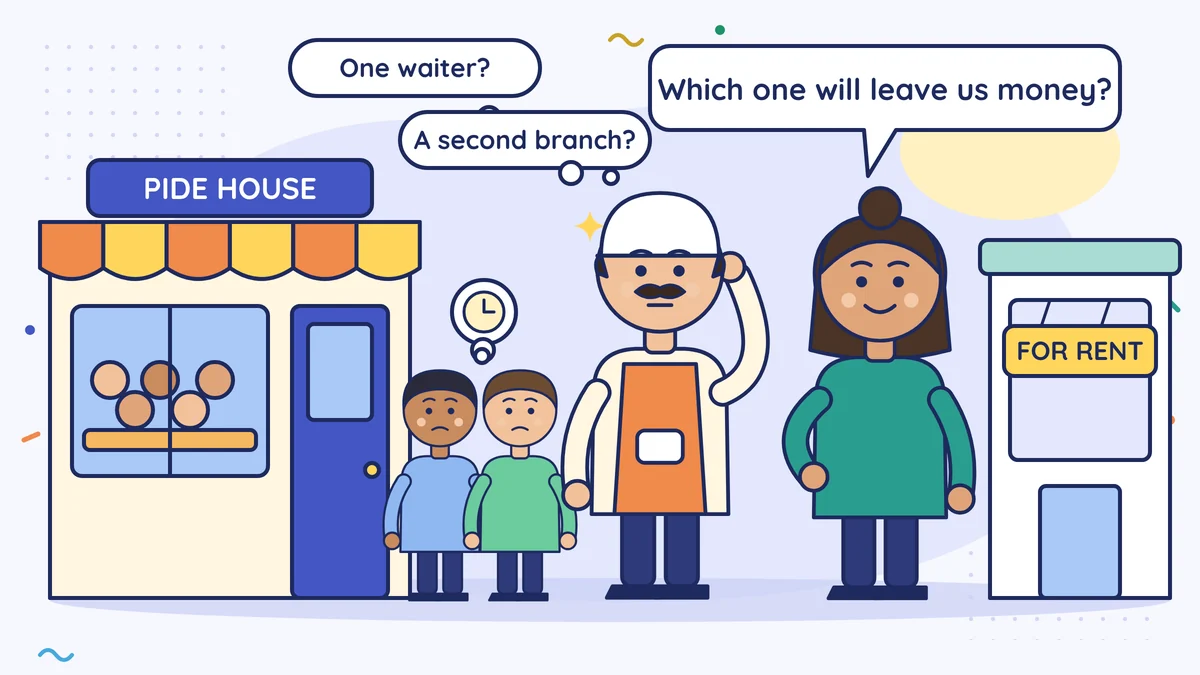
At lunchtime Hasan Abi's pide restaurant is packed. Customers waiting at the door give up after a while and go into the restaurant across the street. In the evenings, though, half the room is empty. Hasan Abi has two ideas in his head: take on one more waiter, or rent the empty shop two streets away and open a second branch.
His wife asks: "Which one will leave us money?" Hasan Abi's answer is honest: "They both look good."
To weigh the two ideas on the same scale, three figures are enough: how much extra cost the decision brings you, how much extra sales it brings, and at what point the extra sales cover the extra cost.
Look only at the figures that will change
In a growth decision you don't look at the whole business. Today's rent, today's master cook and today's electricity are already being paid; they will be paid whether or not you take on a waiter. Only the figures that will change after the decision go into the calculation: the new cost that comes in and the new sales that come in. Let's call this the "extra calculation".
Contribution margin: what is left from each sale
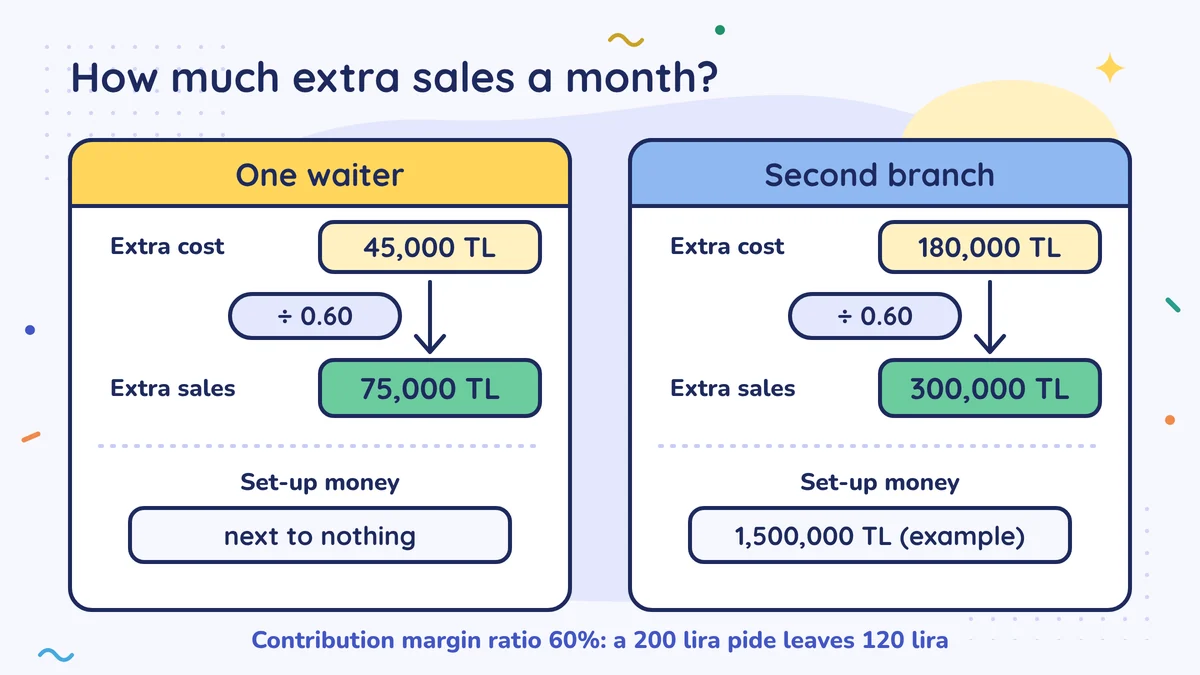
One of Hasan Abi's pides is 200 lira excluding VAT. The dough, minced meat, cheese, firewood and packaging come to 80 lira. Once these variable costs are taken out of the sale, 120 lira is left. This is called the contribution margin (katkı payı), that is, the share each sale sets aside to cover the rent, the salaries and the profit. As a rate, 120 ÷ 200 = 60%; this is called the contribution margin ratio (katkı oranı).
We saw how the break-even point (başabaş noktası) is found in the Cost and pricing module (Break-even point: how many sales until you stop making a loss?). Here we apply the same calculation to a single question: how much extra sales are needed to cover the extra cost?
Formula: extra fixed cost ÷ contribution margin ratio = extra break-even sales.
The figures are written excluding VAT. The VAT on sales is not yours; it is money held in trust for the state. If you are under simplified taxation, you do not add VAT to your sales; the VAT you pay on purchases also becomes part of your cost, so write variable costs including VAT.
Option 1: one more waiter
For 2026, the monthly cost to the employer of an employee on the minimum wage, without incentives, is 40,874.63 TL: gross 33,030 TL, plus the 21.75% employer SGK (Social Security Institution) share and the 2% unemployment share. The steps of the calculation are in the lesson What an employee really costs you. Hasan Abi also adds work clothes and lunch and writes down a round 45,000 TL. If an incentive comes, he counts it as a bonus; he builds the calculation without incentives. The waiter must be notified to SGK at least one day before starting work (The SGK employment start notification).
Extra break-even: 45,000 ÷ 0.60 = 75,000 TL of extra sales a month. The restaurant is open 26 days a month; that is about 2,900 TL a day, or 15 extra pides a day.
The real question is this: do the customers turned away at the door come to more than 15 pides a day? For a week Hasan Abi counts the people turned away at the door at lunchtime: 40 people a day on average. He can't keep them all; if he keeps half of them, that makes 20 pides a day.
| Item (monthly, excl. VAT) | Amount (TL) |
|---|---|
| Extra sales (20 pides × 200 × 26 days) | 104,000 |
| Variable costs (40%) | −41,600 |
| Extra contribution margin | 62,400 |
| The waiter's cost | −45,000 |
| Extra profit (before tax) | 17,400 |
It is above break-even, but the margin is not wide. If he can keep only 15 of the 40 people turned away at the door, the waiter only just pays for himself.
Option 2: a second branch
The extra fixed costs of the second branch, monthly:
| Item | Amount (TL) |
|---|---|
| Rent | 60,000 |
| Two employees (2 × 45,000) | 90,000 |
| Electricity, water, natural gas | 20,000 |
| Other (cleaning, extra accounting fee, maintenance) | 10,000 |
| Total | 180,000 |
The rent in the table is the gross amount. If the shop belongs to a person and you are under real taxation or a company, in 2026 you deduct 20% of the gross rent as withholding tax (stopaj) and pay it to the tax office; 48,000 TL reaches the landlord's hands. If the contract says "60,000 in my hand", the gross rent becomes 75,000 TL and the branch's cost goes up by 15,000 TL (Withholding tax and the muhtasar return). Before opening the branch you need to notify the tax office and get a licence (ruhsat) from the municipality; a separate workplace file at SGK may also be needed for the employees. Draw up the list with your mali müşavir (accountant).
Extra break-even: 180,000 ÷ 0.60 = 300,000 TL of sales a month; about 11,500 TL a day, or 58 pides a day. This is only to cover the costs; profit starts above it.
Three more things go into the calculation:
- Set-up money. For example 1,500,000 TL for renovation, an oven, tables and chairs, and the deposit. This money is not inside the monthly break-even; it comes back through the extra profit once the branch passes break-even. We calculate in how many months it comes back in the next lesson.
- The first months. A new branch doesn't fill up from day one. If it makes 150,000 TL of sales a month for the first three months: 150,000 × 0.60 − 180,000 = −90,000 TL. You need to cover 270,000 TL from the cash box over three months. We calculated how much money should stay in the cash box while growing in the lesson Working capital.
- Your time. Hasan Abi can't be in two shops at once. If sales fall in the main restaurant, that fall is also written into the extra calculation as a minus.
The two options side by side
| Waiter | Second branch | |
|---|---|---|
| Extra fixed cost (monthly) | 45,000 | 180,000 |
| Extra break-even sales (monthly) | 75,000 | 300,000 |
| Set-up money | next to nothing | 1,500,000 (example) |
| Cash going out in the first months | one salary | monthly shortfall + set-up |
| Turning back if you got it wrong | under the contract and notice rules | the rental contract and the investment don't come back |
The waiter is a step you can turn back from; the second branch is a long-term step. If the second turns out to be wrong, turning back is expensive.
Test the decision with cash
Even if the profit calculation comes out positive, the money leaves the cash box on different days. In most workplaces the salary is paid at the end of the month, and the SGK premium at the end of the following month (If you have employees: the second half of the month). The branch's rent and deposit, however, go out up front. When an employee leaves after completing one year, severance pay (kıdem tazminatı) may arise if the conditions are met (When an employee leaves); add this to the long-term cost too.
What did Hasan Abi do?
He took on the waiter first. For three months he noted the number of pides at lunchtime. Once the extra sales comfortably pass 75,000 TL a month, he will put the second branch back on the table. Until then he is saving the set-up money and the three months' shortfall in a separate account.
Do this this week
For a week, count the customers turned away at the door, or who leave because they can't wait, at your busiest hour, and write them on a piece of paper. At the end of the week, assume you can keep half of the daily average; multiply this by your average sale amount (excluding VAT), your contribution margin ratio and the number of days you are open in a month. Compare the monthly figure you get with the 2026 cost of a new employee (at least 40,874.63 TL without incentives).
Common mistakes
- Looking at the whole business. Today's rent and salaries are paid whatever the decision; only the costs and sales that change after the decision go into the calculation.
- Taking the cost of an employee for the net salary. In 2026 an employee on the minimum wage takes home 28,075.50 TL, but their cost to the employer without incentives is 40,874.63 TL.
- Forgetting the branch's first months. A new branch doesn't fill up from day one; put aside the shortfall of the first months and the set-up money in advance.
Sources
Translated from the Turkish lesson. Last checked against Turkish rules: 12 October 2026. Not yet reviewed by a licensed accountant.
This is general information about Turkish rules, not financial, tax or legal advice. Rules change; check the date and the sources, and ask a licensed accountant (mali müşavir) about your own situation. Disclaimer