When an employee leaves: notice, severance pay, the SGK notification, the final settlement
The employee may resign, or you may decide to part ways. How many weeks' notice is given, when does severance pay arise, what is notified to SGK, what goes on the last payroll, and what is a release (ibraname) for?
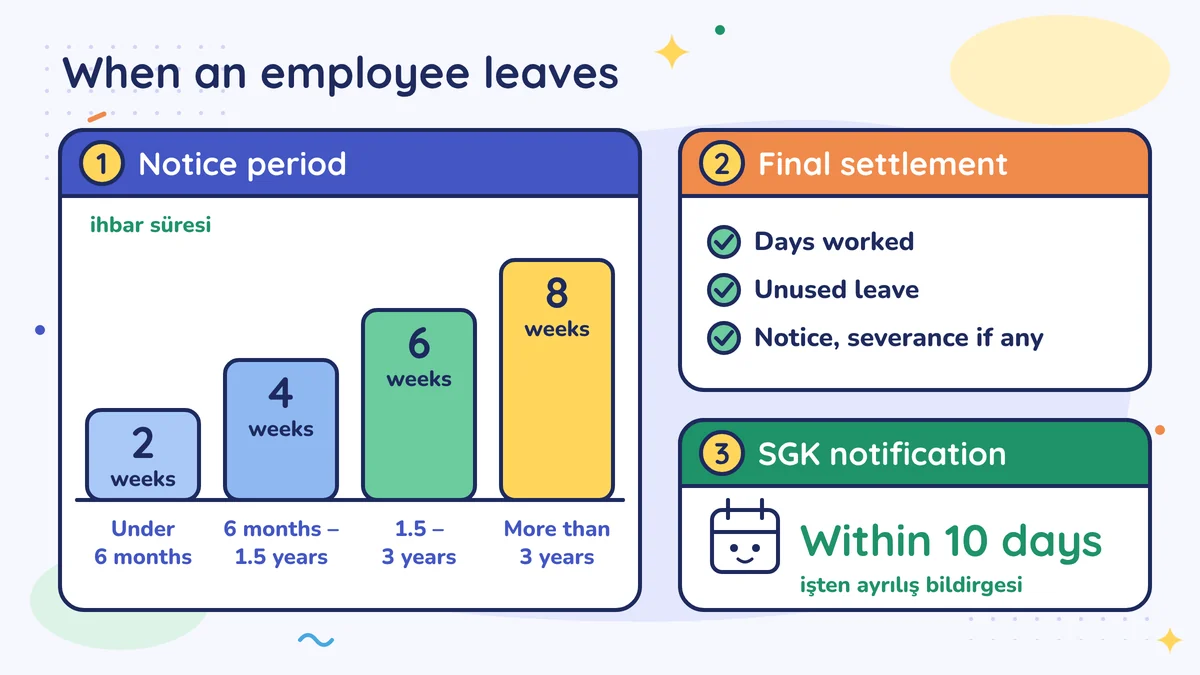
In an open-ended contract, notice of 2, 4, 6 or 8 weeks is given before leaving, depending on length of service. A person who has worked at least one year is paid severance pay equal to 30 days' gross wage for each full year when the employer lets them go (except letting them go because of conduct against morality and good faith, such as theft or absenteeism) and in some other cases the law lists; as a rule, it is not paid on resignation. The employment termination notification is given to SGK within 10 days from leaving. Always consult your mali müşavir (accountant) or an employment lawyer on whether severance pay will be paid.
Recep Abi the greengrocer's hard conversation
Serkan has been at the till and in the storeroom of Recep Abi's greengrocer's shop for three and a half years. When winter came, Recep Abi decided to make the shop smaller; he will carry on with one person. For days he thought about how to tell Serkan. His real question, though, was this: "What will this parting cost me, and which papers are needed?"

When a tenant moves out
Think of a tenant moving out of a flat. The meters are read, the last bills are paid, the deposit is calculated, the keys are handed over, and both sides sign to say "our account is closed". When an employee leaves, the same round is made: the notice period, the final settlement, the SGK (Social Security Institution) notification and the papers.
Who is ending it, and how does it end?
| Situation | What happens |
|---|---|
| During the probation period | Either side can end it without waiting for notice and without compensation; the rights for the days worked are paid |
| The term of a fixed-term contract has ended | The contract ends on its own, no notice is needed; whether severance pay arises is disputed, ask your mali müşavir (accountant) |
| The employee resigned | The employee also follows the notice period |
| The employer ends an open-ended contract | The notice period is followed, or notice pay is paid in advance |
| Termination for just cause (art. 24 and 25) | It can be ended without waiting for the notice period |
The same rules apply to a part-time employee; the calculation is made on their wage. Whoever ends it, put the decision in writing: take a resignation as a signed letter; if you are letting someone go, give notice with the reason written down and have it signed. If the employee won't sign, write a report (tutanak) with two witnesses or send it through a notary. In a later argument of the "I didn't resign, I was let go" kind, this paper is the strongest evidence in your hands.
At workplaces with 30 or more employees, for someone who has worked for at least six months on an open-ended contract, job security rules also apply: the employer must show a valid reason (art. 18). In a dispute over wages, compensation or reinstatement, applying to a mediator before filing a lawsuit is compulsory; this rule applies to both the employee and the employer (Labour Courts Law (İş Mahkemeleri Kanunu) No. 7036, art. 3).
Notice periods
Under Labour Law art. 17, in an open-ended contract, the side ending the contract gives notice in advance:
| Length of employment | Notice period |
|---|---|
| Less than 6 months | 2 weeks |
| From 6 months up to 1.5 years | 4 weeks |
| From 1.5 years up to 3 years | 6 weeks |
| More than 3 years | 8 weeks |
The employer can also end the contract at once by paying the wage for this period in advance. During the notice period, the employee is given at least 2 hours of paid leave a day to look for a job (art. 27). The notice period and annual leave cannot be made to overlap (art. 59). "Count your last two weeks as leave" doesn't work.
An employee who resigns also follows these periods. If they don't, this time the notice pay is owed to the employer. Ask your mali müşavir before deducting this amount from the last salary on your own.
Severance pay
Severance pay (kıdem tazminatı) is still paid under article 14 of the old Labour Law No. 1475. The main framework:
- The employee must have worked for the same employer for at least 1 year.
- 30 days' gross wage is paid for each full year. The time beyond full years is also added in proportion.
- In the calculation, payments that can be measured in money and are given regularly, such as meals and travel, are also added to the gross. This is called the "dressed" gross wage (giydirilmiş brüt).
- The amount to be paid for one year has a ceiling (tavan). The ceiling changes twice a year, in January and July. Ask your mali müşavir for the current ceiling based on the leaving date.
Example: Serkan's dressed gross wage is 45,000 lira, he worked for 3 years 6 months, and his wage is below the ceiling. For three full years, 3 × 45,000 = 135,000 lira; for the extra six months, 45,000 × 6/12 = 22,500 lira; the severance pay comes to 157,500 lira gross. Your mali müşavir calculates its deductions.
Cases where, as a rule, it is paid: The employer letting the employee go (including letting them go because of the employee's illness or a compelling reason; excluding only the case of conduct against morality and good faith below), the employee leaving for just cause (for example, their salary not being paid), military service, retirement, or leaving after completing the conditions for retirement other than age, a female employee leaving of her own will within one year after getting married, and the death of the employee.
Cases where, as a rule, it is not paid: The employee resigning of their own will without relying on a just cause, and the employer ending the contract because of the employee's conduct against morality and good faith (such as theft or absenteeism) (art. 25/II).
These rules have many exceptions and aspects shaped by court decisions. Don't decide on your own whether severance pay will be paid; always consult your mali müşavir or an employment lawyer.
The SGK notification and the exit code
The employment termination notification (işten ayrılış bildirgesi) is given to SGK within 10 days from the date the employee leaves (Law No. 5510 art. 9). Your mali müşavir usually does this on e-SGK. If the deadline has passed, have it given on the day you notice; an administrative fine applies to a notification given late.
In the notification, a termination code (işten çıkış kodu) is chosen. For example, a resignation is shown with code 03, and the employer letting someone go without showing a just cause is shown with code 04. This code looks like a small detail, but it decides whether the employee can receive unemployment benefit. As a rule, someone who resigns cannot receive unemployment benefit. A code that does not reflect the truth wrongs the employee unfairly, and comes back to you as a sanction too. Have the code chosen according to what really happened.
The final settlement and the papers
The last payroll includes:
- The wage for the days worked in the month they leave
- The pay for the annual leave days they did not use, based on the last wage (Annual paid leave)
- Notice pay and severance pay, if any
Make the payment through the bank, and write the items in the description. Give the employee a certificate of employment (çalışma belgesi) showing the type and length of the work (art. 28).
A release (ibraname) is a written document that says "I have received what I was owed". Under the Turkish Code of Obligations (Türk Borçlar Kanunu) art. 420, for it to be valid, it must be made at least one month after the contract ends, the items owed and their amounts must be written one by one, and the payment must have been made in full through the bank. A general "I have no claims" paper signed on the day of leaving often counts only as a receipt.
Recep Abi first called his mali müşavir, then sat down with Serkan. He gave the eight-week period in writing and allowed two hours of leave every day to look for a job. On the evening of the last day, Serkan's settlement went into the bank with a sheet listing it item by item.
Do this this week
Look at each employee's start date and note today's notice period and whether their service has passed one year. Count the unused leave days from the leave record. Keep these three pieces of information on one page; if a parting comes up, you will talk to your mali müşavir from this page.
Common mistakes
- Filling the notice period with annual leave. The notice period and annual leave cannot be made to overlap; unused leave is paid separately.
- Choosing the exit code "to keep it easy". The code decides the employee's unemployment benefit; a code that does not reflect the truth causes problems for both sides.
- Having a general release signed on the day of leaving. A release is valid when it is made at least one month after the contract ends, with the items and amounts written, and with payment made through the bank.
Sources
- Labour Law (İş Kanunu), Law No. 4857, art. 17, 18, 24, 25, 27, 28, 59 (Ministry of Labour and Social Security PDF)
- Labour Law No. 1475, art. 14 (severance pay, still in force)
- Alomaliye: Types of termination where severance pay must be paid (Law No. 1475 art. 14, Court of Cassation 9th Civil Chamber; secondary source)
- Labour Courts Law No. 7036, art. 3 (compulsory mediation)
- Law No. 5510, art. 9 (employment termination notification)
- Turkish Code of Obligations No. 6098, art. 420 (release agreement)
- Kadim Hukuk: Notice periods (art. 17; secondary source)
- Muhasebetr: Termination codes and unemployment benefit (secondary source)
- Kulaçoğlu Hukuk: Conditions for the validity of release agreements (secondary source)
Translated from the Turkish lesson. Last checked against Turkish rules: 9 October 2026. Not yet reviewed by a licensed accountant.
This is general information about Turkish rules, not financial, tax or legal advice. Rules change; check the date and the sources, and ask a licensed accountant (mali müşavir) about your own situation. Disclaimer