Break-even point: how many sales until you stop making a loss?
How many cars does Kemal Bey the car wash owner have to wash a month to avoid a loss? We calculate the break-even point in units and in lira, add a target profit and the margin of safety, and see how changes such as a rent increase or a new employee shift the break-even point.
The break-even point is the level of sales at which the money from sales covers all fixed and variable costs. It is found by dividing fixed costs by the contribution margin per product or service (price minus variable cost). Below this number you make a loss, above it you make a profit; if you want a target profit, you add it to fixed costs and do the same division.
Kemal Bey the car wash owner's question
The rules described in this lesson are those of Turkish law.
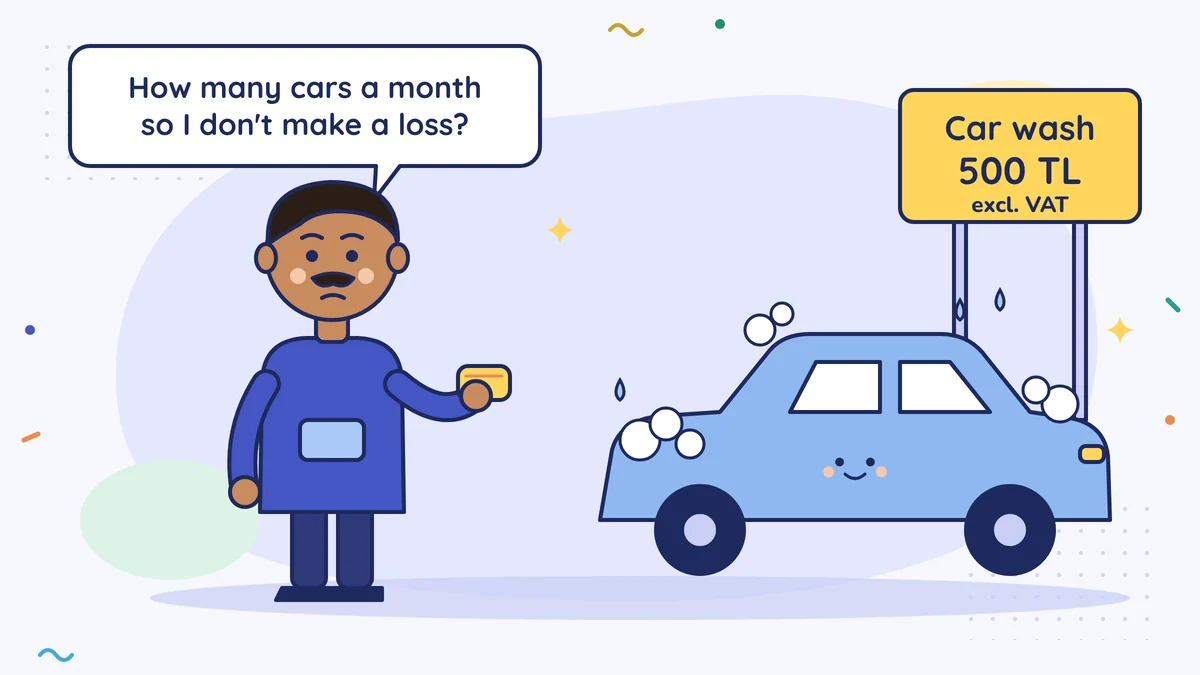
Kemal Bey runs a car wash at the entrance to the industrial estate. A car wash costs 500 lira excluding VAT. Some days there is a queue; on others only the odd car turns up. The question on Kemal Bey's mind is simple: "How many cars do I have to wash a month so I don't make a loss?"
This question has a name: the break-even point (başabaş noktası). The level of sales at which income covers all costs. Below it, a loss; above it, a profit.
The dolmuş driver's sum
A dolmuş (shared minibus) driver knows how many passengers have to get on before the day's diesel, the minibus instalment and the rank fee are covered. Every passenger after that number is earnings. The break-even point is the business's "which passenger".
For the calculation you need the two pieces from the previous lesson: fixed costs and the contribution margin (Fixed costs, variable costs and unit cost).
Kemal Bey's figures
Monthly fixed costs, rounded and excluding VAT:
| Cost | Monthly (TL) |
|---|---|
| Rent | 50,000 |
| One employee (salary and employer's SGK share) | 41,000 |
| Fixed part of electricity and water, compressor maintenance | 12,000 |
| Mali müşavir's (accountant's) fee | 6,000 |
| Insurance, internet, other | 11,000 |
| Total fixed costs | 120,000 |
The employee line is the rounded figure of 40,874.63 TL, the employer's cost without incentives of an employee on the minimum wage in 2026.
Variable cost per car: shampoo and wax 50, water and electricity used in the wash 30, card commission 20; 100 lira in total.
Contribution margin (katkı payı) = 500 − 100 = 400 lira. Each car contributes 400 lira towards fixed costs.
The break-even point
Break-even units = fixed costs ÷ contribution margin per car
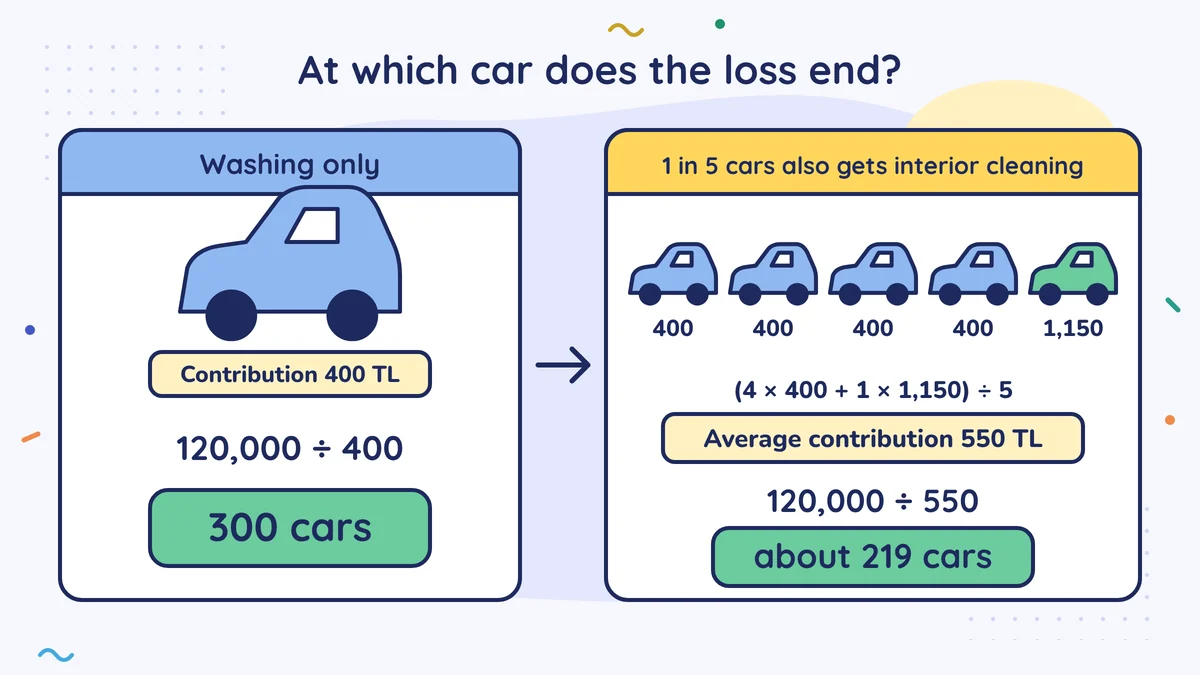
120,000 ÷ 400 = 300 cars.
Kemal Bey is open 25 days a month. 300 ÷ 25 = 12 cars a day. A month that stays below 12 cars a day is a loss; a month that goes above it is a profit.
Let's check:
| Line | Amount (TL) |
|---|---|
| Sales (300 × 500) | 150,000 |
| Variable costs (300 × 100) | −30,000 |
| Total contribution | 120,000 |
| Fixed costs | −120,000 |
| Profit | 0 |
You can also find the same point in lira. The contribution margin is 80% of the price (400 ÷ 500). Break-even sales revenue = fixed costs ÷ contribution margin ratio = 120,000 ÷ 0.80 = 150,000 lira. For a business that sells more than one service and finds it hard to count units, this route is more practical.
Target profit
Break-even means "zero profit". Kemal Bey is a sole proprietorship; in return for his own labour he wants 60,000 lira a month of profit before tax. Income tax and his own Bağ-Kur premium (Bağ-Kur is the social security scheme for the self-employed) will also come out of this money; what he takes home will be less. Add the target profit to fixed costs:
(120,000 + 60,000) ÷ 400 = 450 cars, that is, 18 cars a day.
Today he washes 375 cars a month on average: above break-even but below the target. At these sales his profit is 375 × 400 − 120,000 = 30,000 lira.
Margin of safety: how big a drop can you take?
Margin of safety ratio = (current sales − break-even) ÷ current sales
(375 − 300) ÷ 375 = 20%. So if Kemal Bey's sales fall by 20%, profit drops to zero; if they fall further, losses begin. A rainy month, roadworks outside, a new car wash opening in the next street: a business with a low ratio feels every shock more.
"What if…?"
The break-even point is not a one-off calculation; it is a decision tool. When something changes, recalculate:
| Change | New calculation | Break-even |
|---|---|---|
| Today | 120,000 ÷ 400 | 300 cars |
| If rent goes up by 10,000 lira | 130,000 ÷ 400 | 325 cars |
| If shampoo and wax go up by 20 lira | 120,000 ÷ 380 | about 316 cars |
| If the price goes up to 550 lira | 120,000 ÷ 450 | about 267 cars |
| If a second employee is hired (+41,000) | 161,000 ÷ 400 | about 403 cars |
Note the last line. If Kemal Bey hires a second employee, break-even rises to 403 cars; with today's 375 cars he would slip into a loss. A second employee only makes sense if they will clearly increase the number of cars washed. We look at this decision separately in the lesson A new employee or a second branch?.
If there is more than one service
Kemal Bey also does interior cleaning: price 900 lira, variable cost 150 lira, contribution 750 lira. If one in five of the cars that come in also wants interior cleaning on top of the wash, those cars leave 400 + 750 = 1,150 lira of contribution. The average contribution per car is found like this: (4 × 400 + 1 × 1,150) ÷ 5 = 550 lira. Break-even falls to 120,000 ÷ 550 = about 219 cars. If the sales mix changes, the average contribution changes too; recalculate every quarter.
Remember
- This calculation is before tax. Income tax or corporate tax comes out of profit separately.
- Profit break-even is not cash break-even. The principal part of a loan instalment is not an expense, but it leaves the cash box; a machine's depreciation (amortisman), on the other hand, is an expense, but no money leaves the cash box this month. You see separately in your cash plan when the cash box will get tight (Profit but no cash, The 13-week cash plan).
- The figures are estimates. Take fixed and variable costs from the average of the last three months; if you see a large deviation, recalculate.
Do this this week
Calculate your own break-even point: divide the average monthly fixed costs of the last three months by the contribution margin of your best-selling product or service. Divide the number you get by the number of days you are open a month, write it down as "how many a day" and pin it up next to the till.
Common mistakes
- Confusing break-even with turnover. Saying "I sell 150,000 lira a month, I'm fine" is not enough; look at how far your sales are above break-even sales revenue.
- Not factoring in your own labour. In a sole proprietorship the break-even point means "zero profit"; add the profit you need to live on as a target profit.
- Doing the calculation once and leaving it. When rent, prices, ingredients or the number of employees change, break-even shifts too; recalculate with every major change.
Sources
- Dr. Uğur Demir, Cost–Volume–Profit Relationships and Profit Planning (Maliyet Hacim Kâr İlişkileri ve Kâr Planlaması, Ankara University lecture notes): break-even sales volume, break-even sales revenue, margin of safety
- Bilgen Özkan (SMMM), Reaching Profit in Businesses: Break-Even Point Analysis, Muhasebetr
- Alomaliye: Cost and Profit Analysis Scenarios and Growth Strategies
- Alomaliye: 2026 minimum wage briefing (employer cost without incentives 40,874.63 TL)
Translated from the Turkish lesson. Last checked against Turkish rules: 12 October 2026. Not yet reviewed by a licensed accountant.
This is general information about Turkish rules, not financial, tax or legal advice. Rules change; check the date and the sources, and ask a licensed accountant (mali müşavir) about your own situation. Disclaimer