How many months does an investment take to pay for itself? The payback period
A new machine or a renovation takes money out of the cash box in one go, then puts a little back every month. Using the example of Ayşe Hanım the dry cleaner, we calculate the payback period, see how depreciation and VAT enter this calculation, and how to test it with three scenarios.
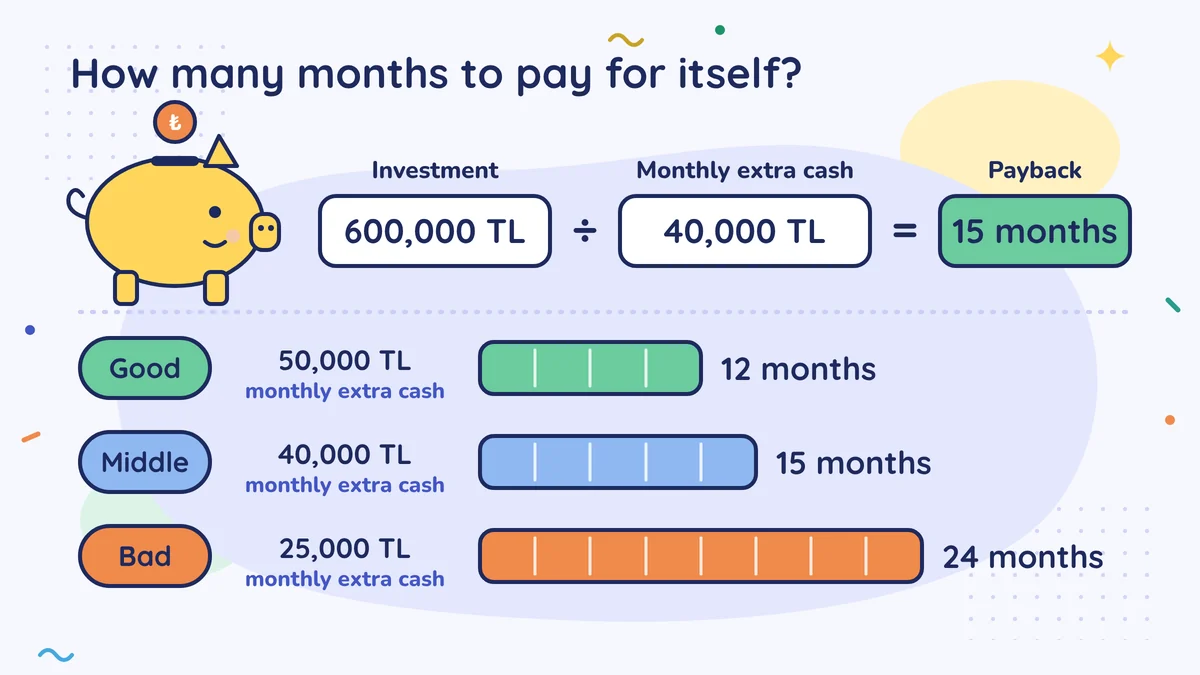
The payback period is found by dividing the investment amount by the monthly extra cash the investment brings in: if a 600,000 TL machine brings in 40,000 TL of extra cash a month, it pays for itself in 15 months. The calculation is done on cash, not on the income statement; depreciation affects the income statement but takes no money out of the cash box. Do the estimate three times, as a good, a middle and a bad scenario; if in the bad scenario the period gets close to the machine's life, think again.
Ayşe Hanım the dry cleaner's new machine
The rules described in this lesson are those of Turkish law.
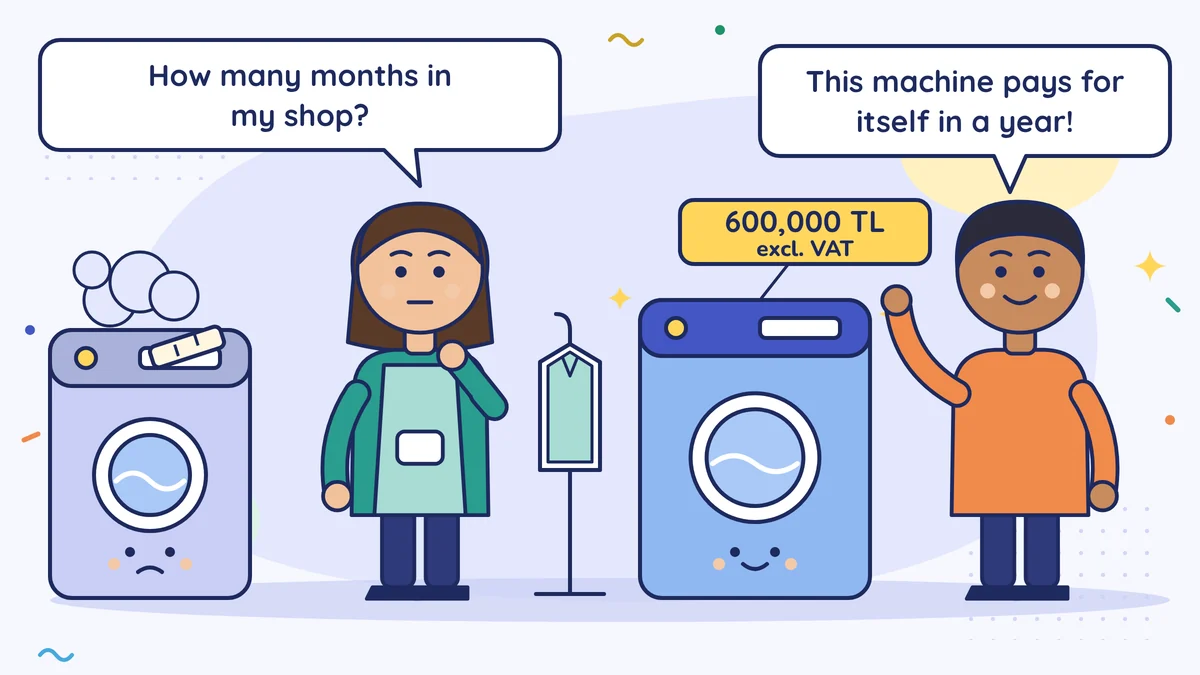
The machine in Ayşe Hanım's dry-cleaning shop is twelve years old. It breaks down every month, burns a lot of electricity and takes only a small load at a time. The dealer gave her a quote for a new machine: 600,000 TL excluding VAT. The seller says, "This machine pays for itself in a year."
Ayşe Hanım's question is a fair one: "Who calculated that? In how many months does it pay for itself in my shop?"
Think of a piggy bank
An investment is money that leaves the cash box in one go. Every month the machine puts a little money back into the cash box: either by bringing in extra work or by cutting costs. Think of it as a piggy bank. When the money saved in the piggy bank reaches the price of the machine, the machine has paid for itself. This period is called the payback period (geri ödeme süresi).
Formula: investment amount ÷ monthly extra cash brought in by the investment = payback period (months).
Find the monthly extra cash
As in the previous lesson, we look only at the figures that will change (A new employee or a second branch?). The changes Ayşe Hanım expects with the new machine, monthly and excluding VAT:
| Item | Amount (TL) |
|---|---|
| Extra work: bulk laundry from hotels and restaurants | 40,000 sales |
| Variable cost of the extra work (detergent, water, electricity, 25%) | −10,000 |
| Left from the extra work | 30,000 |
| Electricity saving | 6,000 |
| Repair and maintenance cost of the old machine | 4,000 |
| Monthly extra cash | 40,000 |
Payback period: 600,000 ÷ 40,000 = 15 months. With Ayşe Hanım's figures, the seller's "one year" comes out as 15 months. It is not a bad result; but once the details are written into the calculation, the promise changes.
Not profit, but cash
The payback calculation is done on cash, not on the income statement. The difference has a name: depreciation (amortisman), that is, the price of the machine being recorded as an expense not in a single year but spread over the years it will be used (Tax Procedure Law art. 313–315). In the year the machine is bought for 600,000 TL, only part of the price appears as an expense on the income statement. But the whole 600,000 TL left the cash box on the day of purchase. Your mali müşavir (accountant) decides over how many years it is spread by looking at the depreciation list published by the Ministry of Finance.
Depreciation also goes into the tax calculation: because it is recorded as an expense, it reduces tax. So first calculate the payback period before tax, then ask your mali müşavir "what changes after tax?" The difference comes out differently in a sole proprietorship and in a company. If you are under simplified taxation, your income is exempt from income tax, so there is no such tax effect.
What about VAT?
On the machine's invoice, 20% VAT, that is, 120,000 TL, comes on top of the 600,000 TL. Because Ayşe Hanım is a VAT taxpayer, she can deduct this VAT from the VAT she collects on her sales. But she pays the 120,000 TL on the day of purchase; if the VAT on sales is not enough that month, the rest carries forward to the following months (Calculating VAT line by line). So the VAT comes back in the end, but it may not come back straight away. If you are under simplified taxation, or not a VAT taxpayer for some other reason, you have no VAT deduction; then the VAT also becomes part of the machine's cost, and you write the investment amount including VAT in the calculation.
Write three scenarios
The estimate of extra work is the most unpredictable figure. Don't look at a single figure; look at three:
| Scenario | Monthly extra cash | Payback |
|---|---|---|
| Good: all the work expected from the hotels comes in | 50,000 | 12 months |
| Middle: Ayşe Hanım's estimate | 40,000 | 15 months |
| Bad: half of the bulk work comes in | 25,000 | 24 months |
Even in the bad scenario, 24 months. Since the machine's life is over ten years, even the bad scenario looks acceptable. In your own calculation, if the payback period in the bad scenario gets close to the machine's life, stop and think again.
What this calculation can't see
The payback period is a simple measure, and it has limits.
- Money waiting has a cost. If the 600,000 TL hadn't gone into the machine, it could have earned interest in the bank. If the machine is bought on credit, the interest and charges are also deducted from the monthly extra cash. The longer the period, the bigger this gap. A note for readers who know accounting: the methods that close this gap are the discounted payback period and net present value; your mali müşavir can calculate these too.
- The years after it has paid for itself. The payback period tells you the day the piggy bank is full; it doesn't tell you what comes after. A machine that pays for itself in 15 months and works for ten years is a better investment than a machine that pays for itself in 12 months and breaks down two years later.
- Prices change. In a period of inflation both your prices and your costs go up. Do the calculation with today's prices and update it every six months (Updating prices under inflation).
What did Ayşe Hanım do?
She talked to two hotels and a restaurant and got the monthly amount of laundry as a written offer; the estimate stopped being just talk. Finding even the bad scenario acceptable, she bought the machine. She left three months' fixed costs in the cash box as a cash reserve (kenar parası) (The bad-month scenario and the cash reserve), and asked her mali müşavir over how many months the 120,000 TL of VAT would be deducted from the VAT on sales. Whether to find the money from her own cash box, with a loan or through leasing, we compare in the next lesson.
Do this this week
For a machine, vehicle or renovation you are thinking of buying, make a one-page table: the investment amount, what is left from the monthly extra sales, the monthly saving and the total monthly extra cash. Fill in this table three times, for the good, middle and bad scenarios, and write the three payback periods side by side.
Common mistakes
- Taking the seller's calculation for your own. Recalculate the promise "it pays for itself in a year" with your sales and your costs.
- Mixing up profit and cash. The machine's price is recorded as an expense spread over the years through depreciation, but the money leaves the cash box on the day of purchase; calculate the payback on cash.
- Deciding on a single figure. The estimate of extra work is the most unpredictable figure; write the bad scenario too and see that you can live with it.
Sources
- Tax Procedure Law No. 213, art. 313–315 (depreciation) (Vergi Usul Kanunu)
- Value Added Tax Law No. 3065, art. 29 (deduction) (Katma Değer Vergisi Kanunu)
- Muhasebetr (Vedat Erdem), Tax Procedure Law art. 313 and 315: depreciation rates are announced by the Ministry of Finance
- TÜİK (Turkish Statistical Institute), Consumer Price Index bulletins
Translated from the Turkish lesson. Last checked against Turkish rules: 12 October 2026. Not yet reviewed by a licensed accountant.
This is general information about Turkish rules, not financial, tax or legal advice. Rules change; check the date and the sources, and ask a licensed accountant (mali müşavir) about your own situation. Disclaimer