What an employee really costs you
Saying "I'll hire on the minimum wage" doesn't tell you the cost. Gross, net and the employer's share are three different figures for the same employee. Let's see, with 2026 figures, how much an employee takes out of the till and how incentives fit into this calculation.
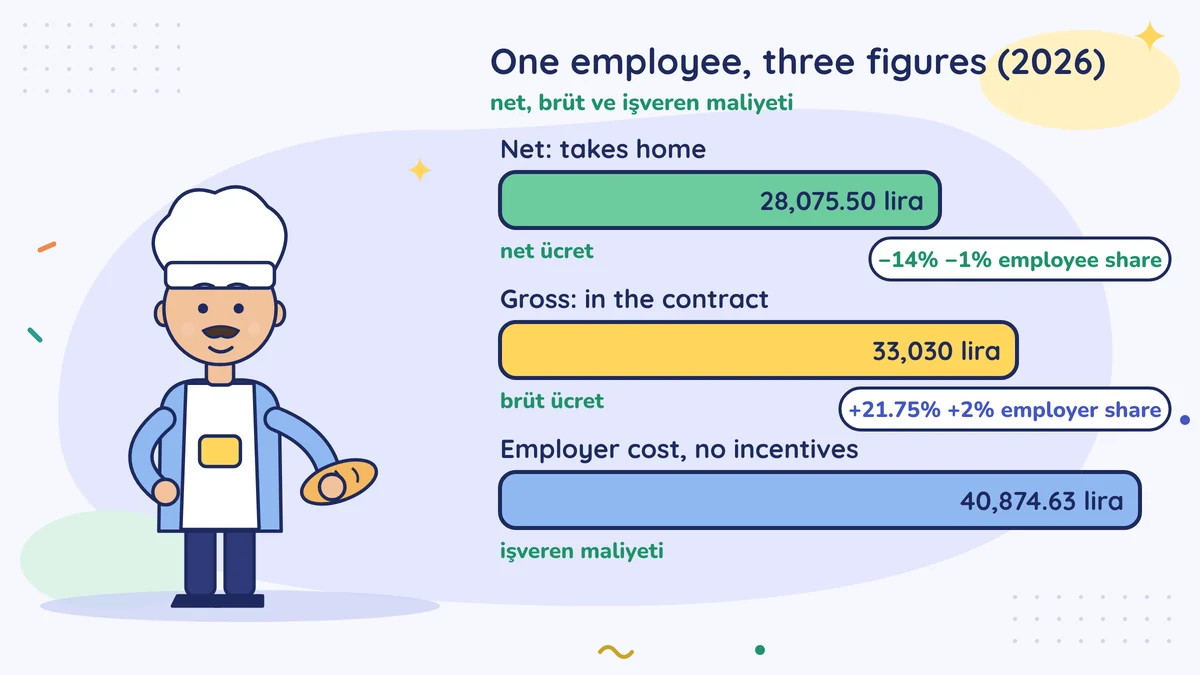
For 2026 the minimum wage is 33,030 lira gross, and the net amount the employee takes home is 28,075.50 lira. On top of this, as the employer you add a 21.75% SGK share and a 2% unemployment share; without incentives, a minimum wage employee costs you 40,874.63 lira a month. If the conditions are met, the Treasury reduction (Hazine indirimi) and minimum wage support (asgari ücret desteği) lower this amount a little.
Hasan Abi the baker's bread calculation
Ask Hasan Abi the cost of a loaf and he counts the flour, the yeast, the salt, the firewood and the electricity one by one. He knows that a baker who prices bread on "just the cost of the flour" will go under by the end of the month. But when he decided to hire a dough maker, his first sentence was: "I'll pay the minimum wage, 28 thousand." This is where he forgot the flour.
There are three different figures for an employee:
- Gross wage (brüt): The wage written in the contract, before deductions.
- Net wage (net): The amount the employee takes home.
- Employer cost (işveren maliyeti): The total that leaves your till once the premiums you pay are added to the gross.
When you talk with the employee, make clear which figure you are saying. If you say "I'll pay 28 thousand", the employee hears net, while you may be thinking gross; at the end of the month you will both be surprised.
Step by step with the 2026 minimum wage
For 2026 the minimum wage is 33,030 lira gross (1 January – 31 December 2026). These deductions are made from the employee's wage:
| Item | Rate | Amount (lira) |
|---|---|---|
| Gross wage | 33,030.00 | |
| SGK employee share | 14% | -4,624.20 |
| Unemployment insurance employee share | 1% | -330.30 |
| Income tax and stamp duty | exempt on the minimum wage | 0.00 |
| Net (what the employee takes home) | 28,075.50 |
The part equal to the minimum wage is exempt from income tax and stamp duty; that is why the tax deduction is zero for a minimum wage employee. If the wage is above the minimum wage, the excess is taxed and the calculation changes.
Now your side. For 2026, with the general rates, the employer's share is:
| Item | Rate | Amount (lira) |
|---|---|---|
| Gross wage | 33,030.00 | |
| SGK employer share | 21.75% | 7,184.03 |
| Unemployment insurance employer share | 2% | 660.60 |
| Employer cost without incentives | 40,874.63 |
So the dough maker Hasan Abi called "28 thousand" takes about 40,900 lira out of the till when there is no incentive. Part of the difference is the employee's own deduction, part is the employer's share. You pay both to SGK, because setting aside the employee's deduction from the wage and paying it in is also the employer's job.
An example above the minimum wage: if you pay 40,000 lira gross, the employer's share without incentives is 40,000 × 23.75% = 9,500 lira, and the total cost is 49,500 lira. To see the net, you need a tax calculation; the gross-to-net calculator (in Turkish) does this. If you promised the employee a net figure, use the net-to-gross calculator (in Turkish), and for the total cost use the employer cost calculator (in Turkish).
On what day does the money leave the till?
The cost is not paid in one go; it is spread over the month. For a minimum wage employee, a month without incentives flows like this:
| When | What is paid | Amount (lira) |
|---|---|---|
| Payday | Net wage to the employee | 28,075.50 |
| By the end of the following month | Employee and employer premiums to SGK (including unemployment) | 12,799.13 |
| Total | 40,874.63 |
Because the tax deduction is zero for a minimum wage employee, no payment goes to the tax office for this employee. If the wage is above the minimum wage, the income tax and stamp duty withheld from the wage are also paid in the same period as the withholding and premium service return (muhtasar ve prim hizmet beyannamesi). What surprises people most in the first month is this: a few weeks after you pay the wage, a second payment comes. Setting this second payment aside together with the wage makes your job easier.
Incentives: how do they fit into the calculation?
Under certain conditions, the state reduces the employer's premium burden. The general picture is this:
- Treasury reduction (Hazine indirimi): For an employer who gives the notifications and pays the premiums on time and has no overdue debt to SGK, the SGK employer share drops by a few points. For 2026 it is 2 points for work outside manufacturing; for a minimum wage employee, the total cost drops to 40,214.03 lira.
- Minimum wage support (asgari ücret desteği): In 2026, if the conditions are met, private-sector employers get support of 42.33 lira per insured employee per day, that is, 1,269.90 lira for someone working 30 days, and it is deducted from the SGK premium debt (Law No. 5510 provisional art. 112, SGK Circular 2026/8). This support is not available for employees notified with the social security support premium (sosyal güvenlik destek primi), such as retired employees. In a workplace that notified employees in 2025, the support cannot exceed the number of days notified in the same month of 2025 with earnings up to 1,300 lira a day; that is why, if you had employees last year, support may not come for the person you newly hire in 2026.
- Incentives tied to the person or the region: The situation of the person you hire, or the location of the workplace, can open the door to other incentives. Their conditions change often, and they may not combine with each other.
Don't build the incentive into the cost calculation from the start. First set your budget on the figure without incentives; if the incentive comes, count it as profit. Ask your mali müşavir (accountant) before hiring which incentive you can benefit from; for some incentives there are conditions checked at the moment of hiring, such as the person being registered with İŞKUR (the Turkish Employment Agency) before starting work.
What stays outside the wage
The figure on the payroll is not the only expense. Meals, transport, work clothes, the occupational health and safety service, your mali müşavir's payroll fee, and who will run the shop during annual leave also go into the calculation. Don't forget the severance and notice pay (kıdem ve ihbar tazminatı) that may arise if the employee leaves in the future. Setting a little of these aside every month prevents a cash squeeze at the end of the month (the article Profit, but no money (in Turkish)).
This calculation depends on the year. The figures above are for 2026; when the minimum wage or the employee's wage changes, do the calculation again. Sending your mali müşavir the employee's days and wage information on time every month is also part of getting the cost right (What to send your mali müşavir every month).
One more thing, the payment method: since 1 July 2025, employers with 3 or more employees, counting all their workplaces together, must pay wages through a bank (the change to the regulation on making wage, premium and similar payments through banks, Official Gazette 04.06.2025, No. 32920). The tax rules also have a separate bank requirement tied to the amount; ask your mali müşavir whether it applies to you even if you have few employees. Even with a single employee, paying through the bank is the easiest way to prove who received what.
Hasan Abi did the calculation again: around 41 thousand without incentives, plus meals and transport. He still hired the dough maker; but he reviewed the price of bread according to this calculation.
Do this this week
Open the employer cost calculator and enter the gross wage of the employee you are thinking of hiring. Multiply the total by twelve, and write extra costs such as meals and transport next to it. Compare this yearly figure with the extra sales you expect that employee to bring.
Common mistakes
- Mixing up net and gross. If you don't put in writing whether you were talking net or gross when you said "28 thousand" to the employee, a dispute will arise at the first wage.
- Counting the incentive as certain income from the start. The Treasury reduction and minimum wage support are conditional; one month of late payment or an SGK debt can lose you the support.
- Paying part of the wage by hand, outside the payroll. This arrangement, made to show the premium as lower, comes back as missing premiums, late payment charges and an administrative fine when the employee goes to court or in an SGK inspection. The real wage is written on the payroll.
Sources
- SGK: The employer's obligations (deducting and paying premiums) (İşverenin Yükümlülükleri)
- SGK Circular 2026/2, earnings subject to premium (İSMMMO copy)
- SGK Circular 2026/8, minimum wage support (Alomaliye copy)
- Cott: 2026 minimum wage support circular (Law No. 5510 provisional art. 112; the 1,300 lira limit in the same month of 2025)
- Alomaliye: SGK premiums guide 2026
- KPMG: Law No. 7566 (Treasury reduction)
- EY: 2026 minimum wage
- EY: The threshold for paying wages through a bank dropped to 3 employees (Official Gazette 04.06.2025, No. 32920; in force 01.07.2025)
- KPMG: SGK premium rates 2026
- More detailed table: the article How much does an employee cost me? (in Turkish)
Translated from the Turkish lesson. Last checked against Turkish rules: 9 October 2026. Not yet reviewed by a licensed accountant.
This is general information about Turkish rules, not financial, tax or legal advice. Rules change; check the date and the sources, and ask a licensed accountant (mali müşavir) about your own situation. Disclaimer