Withholding tax and the muhtasar return: deducting and paying in someone else's tax
When you pay rent, your mali müşavir's fee or an employee's salary, you deduct part of the other party's tax and pay it to the state. Following a tailor through one month, we calculate withholding tax on rent and on self-employment fees at 2026 rates, and see the tax deducted from salaries and how all of it is paid in with the muhtasar return.
Withholding tax (stopaj) means deducting part of the other party's income tax when you make a payment and paying it to the state on their behalf. For 2026, on the rent of a workplace rented from a person and on self-employment payments (such as a mali müşavir or a lawyer), the rate is 20% of the gross amount; the tax deducted from an employee's salary is shown by the payroll. The taxes deducted are declared and paid by the 26th of the following month with the withholding tax and premium service return (muhtasar ve prim hizmet beyannamesi); those under simplified taxation do not deduct withholding tax on rent and self-employment payments.
Rıza Usta the tailor's first muhtasar
Rıza Usta's tailor shop is under real taxation. The shop belongs to a retired teacher; for the rent they agreed "16,000 lira a month in my hand". Two journeymen work with him. He also has a mali müşavir (accountant).
At the end of the first month his mali müşavir asked: "Did you pay exactly 16,000 for the rent? Then you have another 4,000 lira of withholding tax, by the 26th." The first question that came to Rıza Usta's mind was: "I'm the tenant, why does the landlord's tax concern me?"

The miller's share
In the old days, when a villager took his wheat to the mill, the miller set aside his own share before handing over the flour. The share was taken at the source, before the flour reached the villager's hands.
Withholding tax (stopaj) is like that. The word means deducting at the source. On some payments the state takes its tax before the money reaches the other party's hands. But this time it isn't the miller who sets the share aside; it's you, the one making the payment: when you pay the rent, a fee or a salary, you deduct the tax and pay it in on the other party's behalf.
If you forget to deduct it, the tax does not disappear. The tax office asks you for that tax as the one who made the payment, and late payment interest and a penalty may come on top. That's why withholding tax is not something to skip because "it isn't my tax".
You briefly saw what withholding tax is in the lesson What is tax?. Here we move on to its calculation and its calendar.
Rent: if you rent from a person
If you are under real taxation or you are a company, under Income Tax Law art. 94 you deduct withholding tax from the rent of a workplace you rent from a person. For 2026 the rate is 20% of the gross rent (Council of Ministers Decision No. 2009/14592).
The gross rent is the amount before tax is deducted; the net rent is what reaches the landlord's hands. Because Rıza Usta agreed "16,000 in my hand", 16,000 lira is the net rent. To find the gross, the net amount is divided by 0.80:
| Item | Amount |
|---|---|
| Paid to the landlord (net) | 16,000 |
| Gross rent (16,000 / 0.80) | 20,000 |
| Withholding tax (20,000 × 20%) | 4,000 |
Rıza Usta's real monthly outflow for rent is 20,000 lira: 16,000 lira to the landlord and 4,000 lira to the tax office. When signing the contract, pay attention to whether the amount written is gross or net; the difference is 20% every month. Also pay the rent not by hand but through a bank or PTT: for workplace rent this is mandatory whatever the amount (Income Tax General Communiqué Serial No. 328), and paying by hand carries a separate penalty.
If you rent the shop from a company, the situation is different: the company issues you an invoice with VAT, and you do not deduct withholding tax. If the person renting it to you is a business owner themselves, ask your mali müşavir about the situation.
Self-employment: mali müşavir, lawyer, architect
When you make payments to self-employed professionals such as a mali müşavir, a lawyer or an architect, you also deduct withholding tax. For 2026 the rate is 20% of the gross fee. These people issue you a self-employment receipt (serbest meslek makbuzu), most of them electronically today.
The monthly fee Rıza Usta pays his mali müşavir:
| Item | Amount |
|---|---|
| Gross fee | 5,000 |
| Withholding tax (20%), deducted by Rıza Usta | −1,000 |
| VAT (20%) | +1,000 |
| Paid to the mali müşavir | 5,000 |
The VAT on the receipt becomes deductible VAT if you are a VAT taxpayer. The 1,000 lira of withholding tax you deducted is paid in with the muhtasar. If your mali müşavir works as a company and issues you an invoice, no withholding tax is deducted. You saw how a mali müşavir's fee is set in the lesson Mali müşavir fees and the contract.
Tax deducted from salaries
You also deduct income tax and stamp duty from an employee's salary. These are calculated with the payroll, not with a rate. In 2026 the part equal to the minimum wage is exempt from income tax and stamp duty. That's why these taxes are not deducted from the salary of a journeyman working for the minimum wage; for a journeyman paid above the minimum wage there is a deduction, and the amount can change from month to month during the year. The payroll tells you the amount; the steps of the calculation are in the lesson The first payroll.
Muhtasar: all in one return
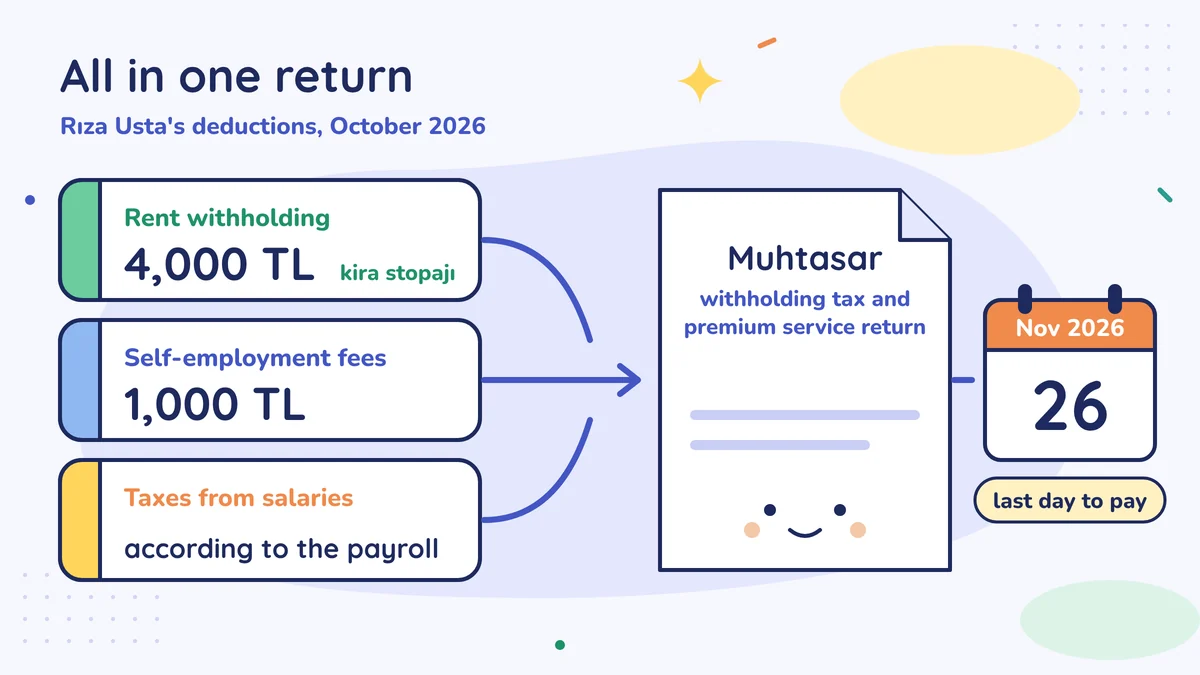
All the withholding taxes you deducted during the month, that is, the deductions from rent, self-employment fees and salaries, are declared by the 26th of the following month with the withholding tax and premium service return (muhtasar ve prim hizmet beyannamesi); the tax is also paid by the same date. The last payment day for the SGK premium declared on the same return, however, is the end of the following month. Muhtasar means "summary": the tax deducted from many people is gathered in a single form. Your mali müşavir files the return; you pay the money.
Rıza Usta's October 2026 muhtasar:
| Item | Amount |
|---|---|
| Withholding tax on rent | 4,000 |
| Withholding tax on self-employment fees | 1,000 |
| Income tax and stamp duty deducted from salaries | according to the payroll |
The taxes on the October muhtasar are paid on 26 November 2026 at the latest. If you have no employees and the conditions are met, there is also the option of filing this return once every three months. All the days are in the lesson A month's calendar.
If you are under simplified taxation
Income Tax Law art. 94 keeps those whose profit is determined under simplified taxation outside the withholding tax obligation. If you are under simplified taxation, you do not deduct withholding tax on rent and self-employment payments; you pay the rent and the fee in full. If you have employees, the withholding tax and premium service return is still filed and the SGK premium is still paid; ask your mali müşavir whether tax is deducted from salaries.
Rıza Usta's routine
Rıza Usta talked to his landlord and had the contract say "gross 20,000 lira, withholding tax paid in by the tenant". Now every month on rent day he puts the 4,000 lira aside separately. When the 26th comes, the money for the muhtasar is ready.
Do this this week
List the payments you make regularly every month: rent, mali müşavir, lawyer, employees' salaries. Next to each one write "withholding tax?". Check whether the amount in your rental contract is gross or net, then ask your mali müşavir for the payment slip of the last muhtasar (the tax assessment slip, tahakkuk fişi) and compare its items with this list.
Common mistakes
- Taking net rent for gross. If "16,000 in my hand" was agreed, the gross rent is 20,000 lira and you pay in the 4,000 lira of withholding tax. Make clear from the start which one is written in the contract.
- Forgetting to deduct withholding tax. The tax does not disappear; the tax office asks you for it as the one who made the payment, and late payment interest and a penalty may come on top.
- Deducting withholding tax on a shop rented from a company. If the landlord is a company, it issues an invoice with VAT, and you do not deduct withholding tax. The rule changes depending on who the landlord is.
Sources
- Income Tax Law No. 193, art. 94 (tax withholding), art. 98 (muhtasar return) (mevzuat.gov.tr)
- Alomaliye: Council of Ministers Decision No. 2009/14592, Income Tax Law art. 94 withholding rates
- TÜRMOB table: the reduced rate for rent withholding ended on 31 July 2021, 20% from 1 August 2021 (Alomaliye copy, PDF)
- Av. Bilal Alyar: Withholding tax (tevkifat), application of Income Tax Law art. 94 in 2026
- SGK: Employer's obligations (withholding tax and premium service return)
- Muhasebetr: 2026 tax calendar
- Income Tax General Communiqué Serial No. 328 (Official Gazette 17.10.2024, 32695): rent collections and payments to be made through a bank or PTT (Cott summary)
- Fatih Aras: The obligation to pay workplace and residential rent through a bank or PTT (secondary source)
Translated from the Turkish lesson. Last checked against Turkish rules: 12 October 2026. Not yet reviewed by a licensed accountant.
This is general information about Turkish rules, not financial, tax or legal advice. Rules change; check the date and the sources, and ask a licensed accountant (mali müşavir) about your own situation. Disclaimer