Working capital: how much cash do you need as you grow?
When sales double, the money tied up inside the business can grow two and a half times. Using Filiz Hanım the textile maker's big order on 90-day terms, we work out tied-up money the short way, the share of VAT, the ways to close the gap, and the two questions to ask before saying yes to an order.
The working capital you need is the money tied up in receivables and stock, minus the credit period your supplier gives you. For a new piece of business it is found roughly by multiplying daily cash spending by the cash conversion cycle; on credit sales, the VAT paid before the money is collected is added to this. The longer the customer's credit period, the more money you need, even if sales stay the same.
Filiz Hanım's big order
The rules described in this lesson are those of Turkish law.
Filiz Hanım's textile workshop runs steadily. Every month it turns out 540,000 lira of work excluding VAT; fabric, labour, rent and other costs come to 450,000 lira a month. That leaves 90,000 lira of profit a month.
A clothing chain has brought an offer: 540,000 lira of extra work every month, paid on 90-day terms. The sums look easy: "Profit will double."
Profit really may double. But for the first three months not a single kuruş comes into the cash box from this customer, while the costs start on day one. In this lesson we measure the money in between. In accounting, working capital (işletme sermayesi) is a broad idea related to the current assets on the balance sheet (bilanço); the meaning we use in this lesson is narrower: the money tied up in receivables and stock to keep the business turning, which is not covered by your supplier's credit period.

The haulier's second lorry
When a haulier buys a second lorry, he works out the price of the lorry. What he often forgets is the second lorry's diesel, motorway tolls and the driver's salary. These are paid before every trip; the freight charge comes in only when the customer pays. A second lorry also needs a second diesel kitty.
Working capital is this diesel kitty. It is not a permanent investment like a machine or a shop. It is the money that stays inside the business all the time as long as the business keeps turning.
The short way to work out tied-up money
In the lesson Cash conversion cycle you worked out the cash conversion cycle: the customer's payment days, plus the days goods wait, minus the days your supplier gives you. You also saw tied-up money there: receivables, plus stock, minus what you owe suppliers.
For a new piece of business, the short way is this:
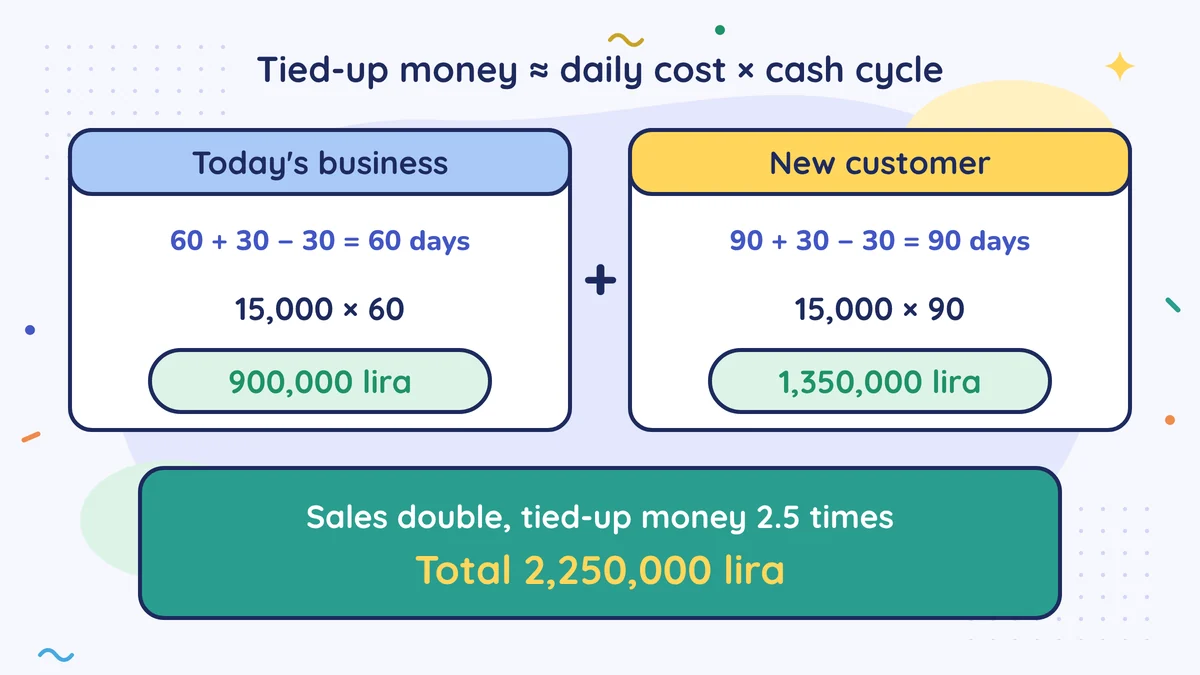
Tied-up money ≈ daily cash spending × cash conversion cycle
Filiz Hanım's current business:
| Item | Value |
|---|---|
| Monthly costs | 450,000 lira, that is 15,000 a day |
| Customer's payment period | 60 days |
| Time fabric and half-finished work wait | 30 days |
| Period the supplier gives | 30 days |
| Cash conversion cycle | 60 + 30 − 30 = 60 days |
| Tied-up money | 15,000 × 60 = 900,000 lira |
With the new customer:
| Item | Value |
|---|---|
| Extra costs | 450,000 lira, that is 15,000 a day |
| Customer's payment period | 90 days |
| Cash conversion cycle | 90 + 30 − 30 = 90 days |
| Extra tied-up money | 15,000 × 90 = 1,350,000 lira |
Sales double. Tied-up money, however, goes from 900,000 to 2,250,000 lira, two and a half times as much. The difference comes from the new customer's longer credit period.
The short way is an approximate calculation. Not all costs are paid on the same terms; salaries go out at the end of the month, rent at the start. Your 13-week plan gives the exact figure. But to see the order of magnitude before deciding, the short way is enough.
VAT waits inside too
The new customer pays the money together with the VAT 90 days later. You, however, pay the VAT on the 28th of the month following the month in which you made the delivery and issued the invoice; if the 28th falls on a holiday, on the first working day (there is no VAT under simplified taxation, basit usul). As you saw in the previous lesson, VAT does not wait for the money.
In 2026 the general rate is 20%. In the new business, the VAT on the invoices is 108,000 lira every month. After deducting the VAT on the fabric, say 54,000 lira of VAT remains payable. The fabric VAT you deduct is also 54,000 lira, and you paid it to the fabric supplier when you bought the fabric; that too waits, out of your cash box, until the customer pays. A rough calculation: the fabric VAT stays inside for three months, from the day it is paid to the fabric supplier until the customer pays (3 × 54,000 = 162,000), and the 54,000 lira paid to the tax office for a month and a half (about 80,000). The money tied up by VAT is around 250,000 lira. Work out your own figure with your mali müşavir (accountant); the VAT you pay on purchases and can deduct varies with your business.
Where will this money come from?
Filiz Hanım has 400,000 lira in her cash box. The need, including VAT, is around 1,600,000 lira (1,350,000 + 250,000). For the 1,200,000 lira in between, the options in front of her:
| Option | What does it give? | Its cost |
|---|---|---|
| 60 days instead of 30 from the fabric supplier | If fabric costs 9,000 lira a day, 270,000 lira of relief | They may ask for a credit charge |
| An advance or a shorter credit period from the chain | If the period comes down to 60 days, 450,000 lira | They may ask for a price discount |
| Starting with a smaller quantity in the first months | The need falls in proportion | The extra profit falls too |
| A bank loan or discounting cheques | The remaining gap | Interest and charges |
We discuss the cost of a loan and other ways of financing, such as leasing, separately in this level's growth decisions module, in the lesson A loan, leasing or your own money?. The rule to keep in mind here is simple: if the total cost of financing is greater than the extra profit the new business will bring, the order brings workload, not profit.
Two questions for the decision
Before answering the offer, Filiz Hanım answers two questions with figures:
- Does the new business make a profit? Is the extra profit greater than the cost of financing?
- Can my cash box carry it? In the 13-week plan, does the lowest week fall below the cash reserve (kenar parası)?
The first question belongs to the income statement (gelir tablosu), the second to the cash plan. If the answer to either is "no", you don't have to turn the order down; it is time to talk about the credit period, an advance or the starting quantity.
In the end Filiz Hanım agreed with the chain on 60-day terms and half the quantity for the first three months. She updates her tied-up money calculation every month. As sales grow, tied-up money will grow too; she knows this in advance as well.
A note: profit and capital are different things
In a year when profit is recorded during a growth period, it is not surprising to see less money in the cash box. The profit is waiting in receivables and stock. You saw this in the lesson Profit but no cash. The difference is this: this time the waiting money is the price of the business's growth, and it can be calculated in advance.
Do this this week
Write down three figures for your own business: your daily cash spending, your customers' average payment days, and the days your suppliers give you. Add the days your stock waits and work out your tied-up money the short way. Then repeat the same calculation for sales 30% higher.
Common mistakes
- Judging growth only by the profit table. Even a profitable order draws money out of the cash box in the first months. Work out the tied-up money first.
- Not seeing the difference in credit periods. If existing customers pay in 60 days and the new customer in 90, tied-up money grows faster than sales when sales double.
- Leaving VAT out of the calculation. On a credit sale, the VAT you pay on purchases goes to the supplier and the rest goes to the tax office the following month; from the customer, it comes in at the due date. This difference is also added to working capital.
Sources
- General Communiqué on the Application of the Accounting System No. 1 (1 Sıra No'lu Muhasebe Sistemi Uygulama Genel Tebliği): balance sheet layout (current assets, short-term liabilities) and chart of accounts (Alomaliye copy)
- Emre Yıldırım (Tax Inspector), The importance and interpretation of financial statements, part 2 (stock and receivables turnover), Muhasebetr
- Value Added Tax Law No. 3065 (3065 sayılı Katma Değer Vergisi Kanunu), art. 10 (taxable event), art. 29 (deduction) (mevzuat.gov.tr)
- KPMG: Presidential Decision on VAT rates (general rate 20%)
- GİB Tax Calendar (Vergi Takvimi)
Translated from the Turkish lesson. Last checked against Turkish rules: 12 October 2026. Not yet reviewed by a licensed accountant.
This is general information about Turkish rules, not financial, tax or legal advice. Rules change; check the date and the sources, and ask a licensed accountant (mali müşavir) about your own situation. Disclaimer