Calculating VAT line by line: do you pay, or does it carry forward?
We work out a delicatessen's VAT for one month line by line: sales at three different rates, purchases, rent and electricity, and VAT carried forward from the previous month. Then we see how the calculation flips in a month with a big purchase and where carried-forward VAT goes.
A month's VAT is found like this: the VAT you collect from customers on sales (output VAT) minus the VAT you pay on purchases and are able to deduct (deductible VAT) minus the VAT carried forward from the previous month. If the result is positive, you pay that amount by the 28th of the following month. If it goes negative, you pay no VAT that month; the difference carries forward to the next month and, as a rule, is not refunded in cash.
Zeynep Hanım the deli owner's scale
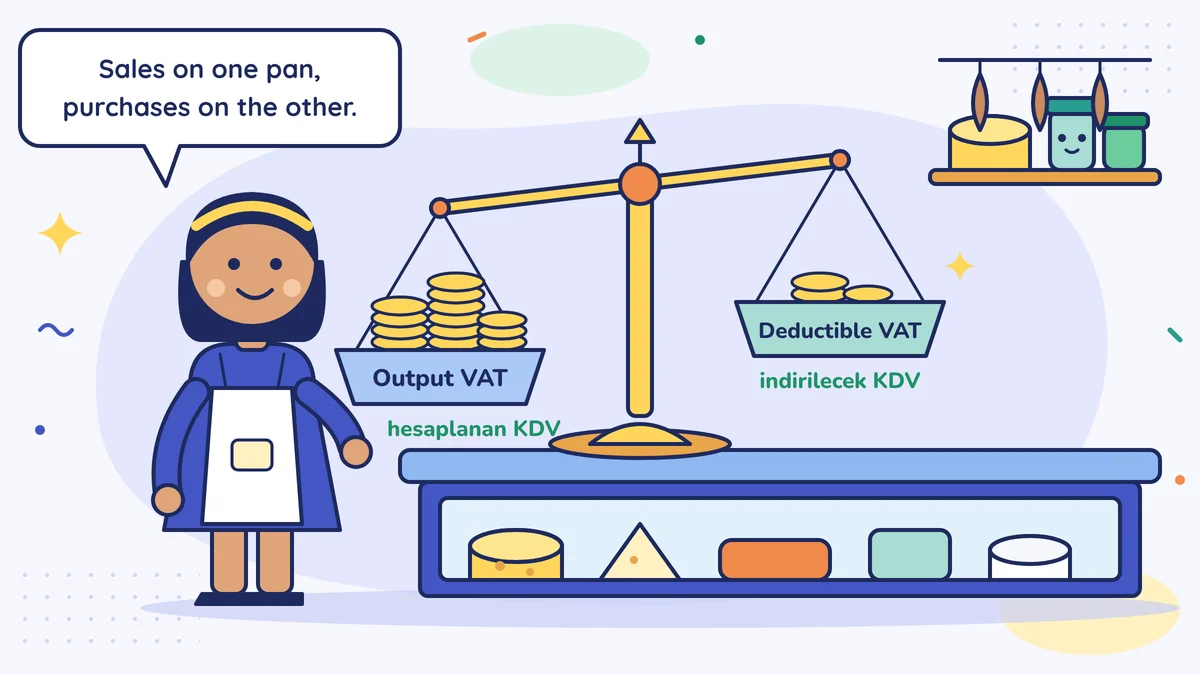
At the end of the counter in Zeynep Hanım's delicatessen stands an old scale with two pans. It is no longer used for weighing; it is there as decoration. But there is no better tool for understanding VAT.
On one pan you put the VAT you collected on sales, on the other the VAT you paid on purchases. If the sales pan is heavier, you pay the difference to the state. If the purchases pan is heavier, you pay nothing that month; the surplus stays for the next month.
You saw what VAT is in the article What is VAT? (in Turkish), and what happens on your side in the VAT month in the lesson The VAT return month. In this lesson we fill the pans line by line.
First a check: under simplified taxation you do not collect VAT on sales and you do not file a VAT return (VAT Law art. 17/4-a). This lesson is for VAT taxpayers, that is, those who file a VAT return every month. If you don't know which method you are under, see the lesson Simplified taxation or real taxation?.
Three rates, three lines
VAT is not the same on every product. The rates in force for 2026 are 1%, 10% and 20%. The general rate is 20%; on some goods and services 10% or 1% applies. Your mali müşavir (accountant) knows which product falls under which rate; because rates can change by Presidential decision, ask them about any product you are unsure of.
Zeynep Hanım's shelves have all three rates. We have rounded the figures so the calculation is easy to follow; in a real delicatessen most sales are food, so the share of lower-rate sales is usually larger. Her sales in October 2026 (excluding VAT):
| Sales group | Amount excl. VAT | Rate | VAT |
|---|---|---|---|
| 20% products | 50,000 | 20% | 10,000 |
| 10% products | 30,000 | 10% | 3,000 |
| 1% products | 20,000 | 1% | 200 |
| Output VAT | 13,200 |
Output VAT (hesaplanan KDV) is the tax you collect from the customer on a sale. It went into the cash box, but it isn't yours. After the VAT you paid on purchases is deducted, you pay the rest to the state by the 28th of the following month; until that day it is money held in trust, waiting in your cash box.
In retail sales the price on the receipt includes VAT. To find the VAT inside it, you divide the price by (1 + rate): on a 20% product, of a 120 lira sale, 100 lira is the goods themselves and 20 lira is VAT. The VAT calculator (in Turkish) does this calculation for you.
The other pan: deductible VAT
What Zeynep Hanım bought in the same month (excluding VAT):
| Purchase | Amount excl. VAT | Rate | VAT |
|---|---|---|---|
| 20% goods from the wholesaler | 30,000 | 20% | 6,000 |
| 10% goods from the wholesaler | 20,000 | 10% | 2,000 |
| 1% goods from the wholesaler | 10,000 | 1% | 100 |
| Shop rent (from a company, with an invoice) | 10,000 | 20% | 2,000 |
| Electricity | 2,000 | 20% | 400 |
| Deductible VAT | 10,500 |
Deductible VAT (indirilecek KDV) is the tax you paid on purchases and are able to deduct from the VAT on sales. Its name in the law is deduction (indirim) (VAT Law art. 29). Not every purchase's VAT can go onto this pan: there are conditions, such as the document being in your name and the purchase being business-related. We go through them one by one in the next lesson, Deductible VAT: which document reduces your VAT?.
Note: the rate on a purchase does not have to match the rate on a sale. You pay 20% VAT on rent, but the product you sell may be a 1% one. The calculation is done on the month's total, not product by product.
The scale: the October calculation
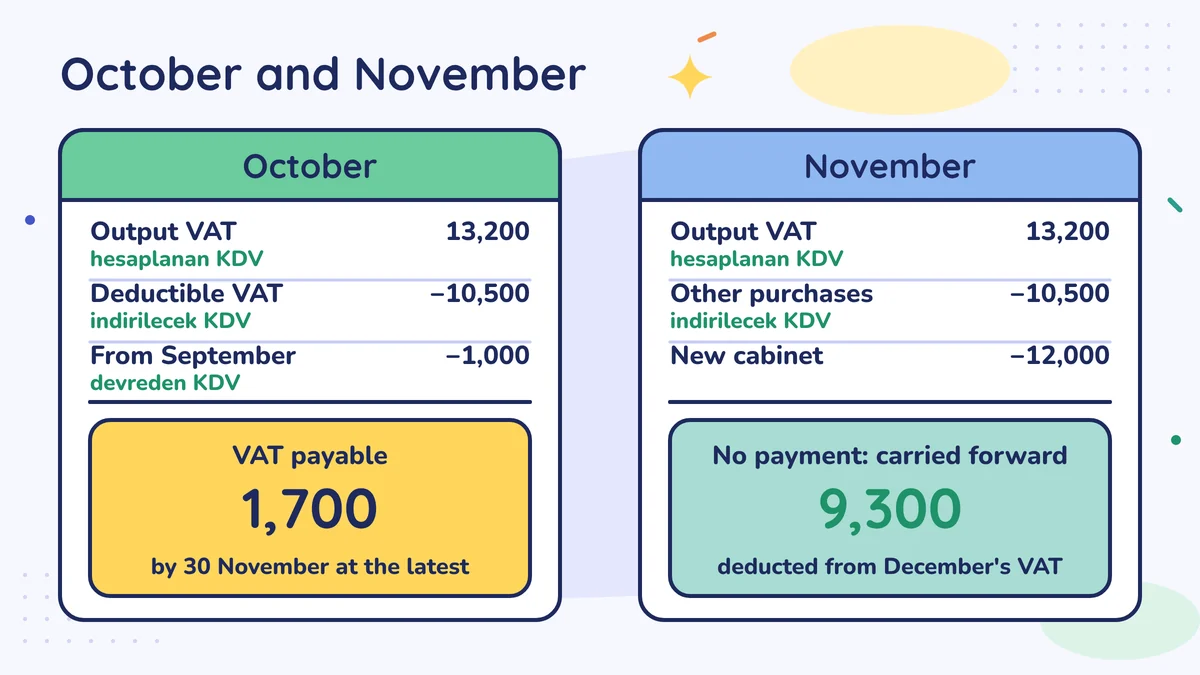
There was 1,000 lira of VAT carried forward from September. The calculation goes like this:
| Line | Amount |
|---|---|
| Output VAT (sales) | 13,200 |
| Deductible VAT (this month's purchases) | −10,500 |
| VAT carried forward from the previous month | −1,000 |
| VAT payable | 1,700 |
Zeynep Hanım pays the 1,700 lira for October's VAT on 30 November 2026 at the latest: because the last day, 28 November, falls on a Saturday, the payment moves to the first working day. All the days are in the lesson A month's calendar.
November: the scale tips the other way
In November Zeynep Hanım bought a new refrigerated cabinet: 60,000 lira plus 20% VAT, that is, 12,000 lira of VAT. Sales and other purchases stayed the same as in October.
| Line | Amount |
|---|---|
| Output VAT | 13,200 |
| Deductible VAT (other purchases) | −10,500 |
| Deductible VAT (cabinet) | −12,000 |
| VAT carried forward from the previous month | 0 |
| Result | −9,300 |
The purchases pan was heavier. No VAT is paid for November. The 9,300 lira difference becomes VAT carried forward (devreden KDV): it appears again as a line in December's calculation and is deducted from that month's VAT. If it isn't used up in December either, it moves on to January. As a rule it is not refunded in cash; it is used in later months. There are exceptions listed in the law: for example, if a large part of your sales are 1% or 10% products, a refund route may open at the end of the year for the VAT that could not be deducted during the year. Your mali müşavir knows the conditions, the lower limit and whether the VAT on fixed assets such as the cabinet counts towards this calculation.
So in a month when you make a big purchase, ask your mali müşavir in advance how your VAT will be affected. The VAT on the cabinet is not wasted, but it does not come back to you as cash straight away either.
Do you have to do the calculation yourself?
No. Your mali müşavir prepares the return. But knowing the logic of this calculation helps in two ways. First, when your mali müşavir says "your VAT came to 1,700 lira this month", you understand where the figure comes from. Second, you can make a rough estimate in the middle of the month and have the money ready.
Every month, ask your mali müşavir for three figures and write them in a notebook: output VAT, deductible VAT, and VAT carried forward to the next month. After six months you will know your business's VAT pattern by heart.
Zeynep Hanım pinned a small note next to the scale on the counter: "Sales pan, purchases pan, left over from last month." On the 15th of every month she fills in the three lines.
Do this this week
Ask your mali müşavir for the summary of last month's VAT return or the paper showing the amount payable (the tax assessment slip, tahakkuk fişi). Find three figures and write them in a notebook: output VAT, deductible VAT, and VAT carried forward to the next month. Then fill in the same three lines yourself from this month's sales and purchase invoices up to the 15th.
Common mistakes
- Thinking the whole VAT-inclusive amount that comes into the cash box is turnover. On a 20% product, 20 lira of a 120 lira sale is VAT; after the VAT on purchases is deducted, the rest is paid to the state by the 28th of the following month.
- Forgetting the VAT carried forward. The amount left over from the previous month is deducted from this month's calculation. Ask your mali müşavir for this figure every month and write it down.
- Calculating all products at the same rate. In 2026 there are rates of 1%, 10% and 20%. Selling a product at the wrong rate throws off both its price and its tax; for any product you are unsure of, ask your mali müşavir about the rate.
Sources
- Value Added Tax Law No. 3065, art. 17/4-a (simplified taxation), art. 28 (rates), art. 29 (deduction) (mevzuat.gov.tr)
- Official Gazette, Presidential Decision No. 7346 (7 July 2023): raising the 8% and 18% rates to 10% and 20%
- KPMG: 8% and 18% VAT rates raised to 10% and 20%
- GİB circular VUK-149/2022-12: extension of the VAT return to the 28th of the month (Alomaliye copy)
- GİB Tax Calendar
- KPMG: VAT Communiqué No. 56, 2026 refund lower limit for transactions at reduced rates
Translated from the Turkish lesson. Last checked against Turkish rules: 12 October 2026. Not yet reviewed by a licensed accountant.
This is general information about Turkish rules, not financial, tax or legal advice. Rules change; check the date and the sources, and ask a licensed accountant (mali müşavir) about your own situation. Disclaimer