Deductible VAT: which document reduces your VAT and which does not?
Not all the VAT you pay on purchases can be deducted from the VAT on sales. We sort a hairdresser's pile of documents for one month one by one: an invoice in her name, a receipt, a car, a fuel document without UTTS, a home bill and a late invoice. Which is deductible, which is not, and why?
For the VAT paid on a purchase to be deductible from the VAT on sales, the purchase must be business-related, the invoice or similar document must be issued in the business's name with the VAT shown separately, and the document must be entered in the books in time. The VAT on the business's purchase of a passenger car, the VAT on personal spending, and the VAT on fuel documents that should have been issued under UTTS but were not cannot be deducted. A retail receipt is, as a rule, not a document for deduction.
Derya Hanım the hairdresser's envelope
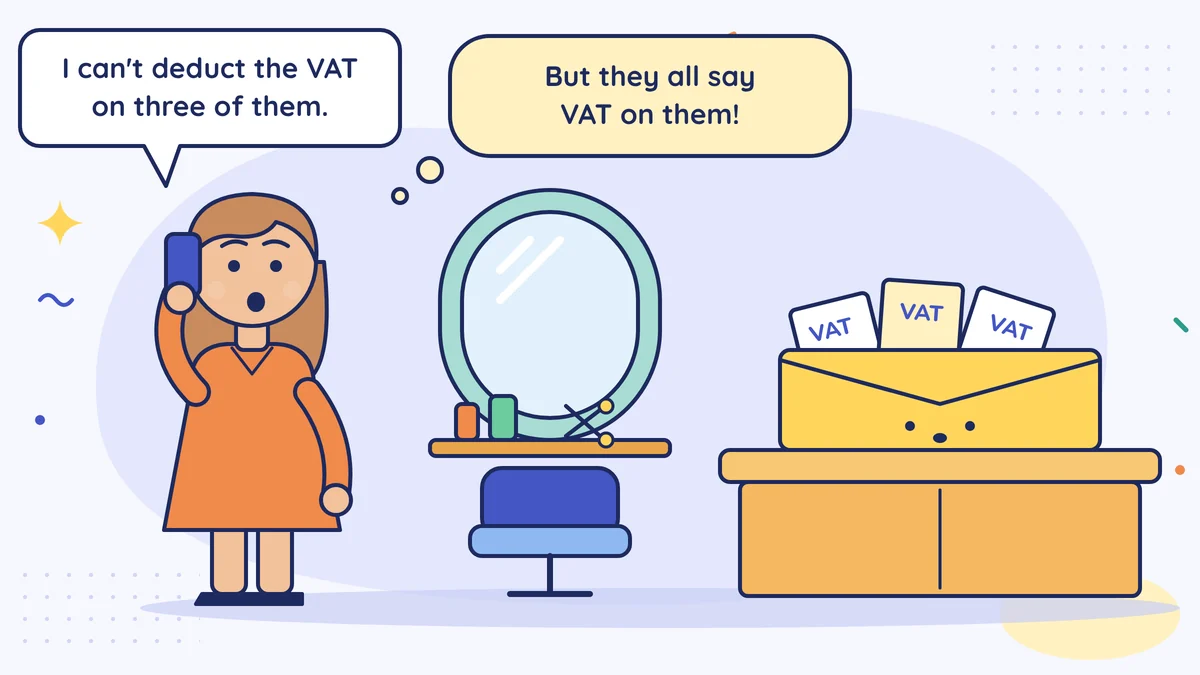
Derya Hanım's hair salon is under real taxation and files a VAT return every month. At the end of the month she puts all the documents in an envelope and sends it to her mali müşavir (accountant). One day her mali müşavir called: "I can't deduct the VAT on three of the documents in the envelope." Derya Hanım was surprised: "But they all say VAT on them."
Having VAT written on it is not enough. It's like a cinema ticket: if the ticket is not in your name, has expired or belongs to another screen, you can't get through the door. In this lesson we look at which documents "get through the door".
You saw how the calculation is done in the previous lesson. Now we look at what can go onto the deductible VAT pan.
Four conditions
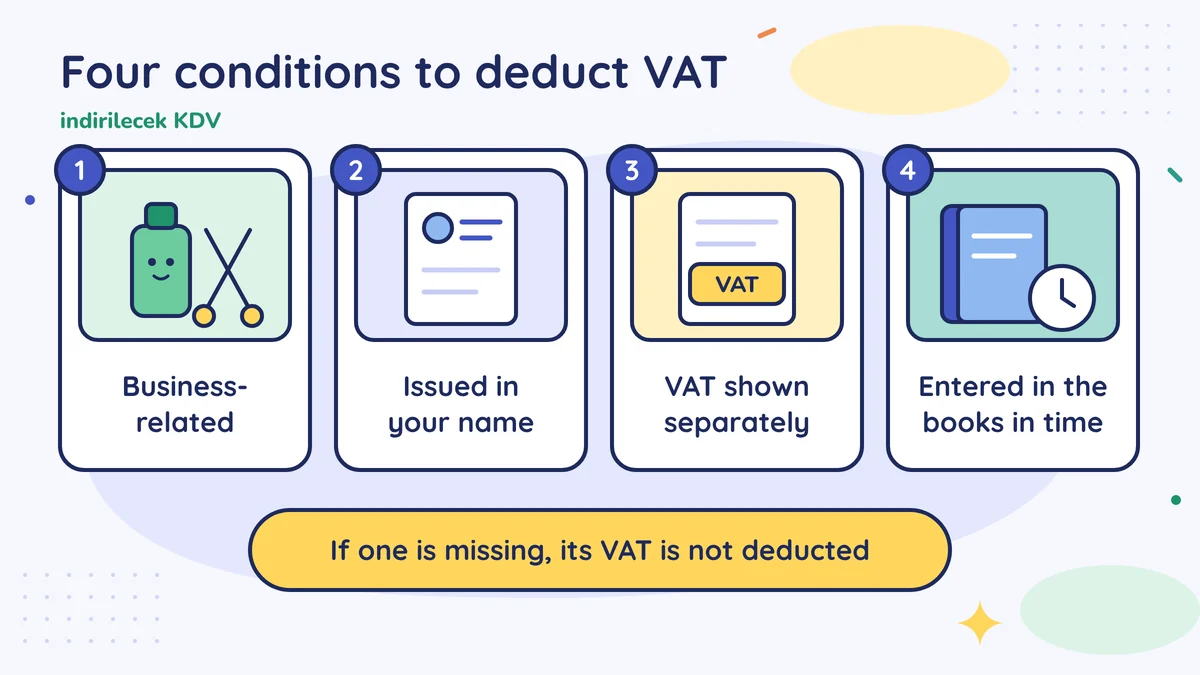
According to VAT Law art. 29, for you to deduct the VAT you paid on purchases from the VAT on sales:
- The purchase must be business-related. Goods you will sell, the shop's rent and electricity, a tool you use for work.
- The invoice or similar document must be issued in your name. In a sole proprietorship, your name and tax number; in a company, the company's name and tax number.
- The VAT must be shown separately on the document. On an invoice, VAT is written as a separate line.
- The document must be entered in the books in time. We look at the time limit below.
If one condition is missing, that document's VAT does not go onto the pan.
Derya Hanım's envelope, document by document
| Document | VAT | Deductible? | Why |
|---|---|---|---|
| Invoice from the shampoo and hair-dye wholesaler, in the salon's name | 3,000 | Yes | Business-related, in her name, VAT shown separately |
| Invoice for a hair dryer, in her husband's name | 1,000 | No | The invoice is not in the business's name |
| Home electricity bill | 400 | No | Not business-related, personal spending |
| Fuel document for her car, without UTTS | 300 | No | Explained separately below |
| Cleaning supplies from the supermarket, retail receipt | 100 | Ask your mali müşavir | As a rule a receipt is not a document for deduction |
| Last November's forgotten rent invoice | 2,000 | Yes, if the time limit has not run out | Deduction time limit below |
An invoice not in your name. Her husband bought the dryer with his own card and had the invoice issued in his own name. Even though the dryer is used in the salon, its VAT does not go into the salon's calculation. When buying, you need to give the business's name and tax number. We also talked about this in the lesson Business money and pocket money.
Personal spending. The home bill and the family's shopping do not count as expenses; and the VAT on spending that does not count as an expense cannot be deducted (VAT Law art. 30/d). We explained what counts as an expense in the article Which expenses can be recorded? (in Turkish).
Passenger cars and fuel
Buying a passenger car. The VAT on the purchase invoice of a passenger car bought for the business cannot, as a rule, be deducted (VAT Law art. 30/b). The exception is for those whose business is renting out or operating passenger cars. There is also an expense restriction on costs such as a passenger car's rent, fuel and maintenance: part of the cost cannot be deducted from profit, and the VAT on that part may not be deductible either. Whether the car belongs to the business or is rented, your mali müşavir does this calculation.
Fuel and UTTS. The National Vehicle Recognition System (Ulusal Taşıt Tanıma Sistemi, UTTS) is a system that records fuel purchases through a recognition device fitted to vehicles that belong to the business or are rented and used for work. Fitting the device to these vehicles is mandatory (except for public and diplomatic vehicles). According to the UTTS Implementation General Communiqué No. 1, fuel documents for these vehicles that are not issued under UTTS are treated as never having been issued, under Tax Procedure Law art. 227. The result: that document cannot be recorded as an expense and its VAT cannot be deducted. For petrol and diesel purchases this rule has applied since 1 July 2025, and for vehicles that run only on LPG since 1 January 2026.
If Derya Hanım's car is in the salon's records, the receipt for fuel bought without the device fitted is of no use. To what extent those under simplified taxation are subject to this rule is not yet clear; if you have a vehicle, ask your mali müşavir.
What about the retail receipt?
A retail sales receipt and a cash register receipt do not, as a rule, take the place of an invoice, so they are generally not documents for deduction. For some small workplace expenses the VAT on a receipt can also be deducted; ask your mali müşavir which ones. What is certain is this: always ask for an invoice for the goods you buy to sell and for the main materials of your work.
For 2026 the invoicing threshold is 12,000 lira (Tax Procedure Law General Communiqué No. 588, Official Gazette 31 December 2025). For purchases above this amount, the seller must give an invoice and you must take one. Below the threshold too, if you ask, the seller must give an invoice (Tax Procedure Law art. 232). Make it a habit to say "an invoice in the business's name" to the wholesaler, the repairer and the stationer.
A late invoice: the time limit for the right to deduct
Sometimes an invoice is forgotten in a drawer. According to VAT Law art. 29/3, the right to deduct can be used until the end of the calendar year following the calendar year in which the taxable event, that is, the purchase, took place; for this, the document must be entered in the books within that period.
Derya Hanım's rent invoice dated November 2025 turned up in October 2026. The time limit runs out on 31 December 2026; if she gives it to her mali müşavir right away, its VAT is deducted. If the same invoice had been found in 2027, its VAT would have been lost. Even if the VAT is deducted in 2026, the year to which the rent belongs as an expense may be 2025; since the 2025 return has already been filed, your mali müşavir looks at how this should be recorded. Still, send a late invoice without waiting; pushing the time limit is an unnecessary risk. The way to send documents regularly every month is in the lesson Keeping documents in order.
What came out of the envelope
There was 6,800 lira of VAT in Derya Hanım's envelope. 5,000 lira is definitely deducted (the wholesaler and the past rent). Her mali müşavir will tell her the status of the 100 lira on the receipt. And 1,700 lira was tickets turned away at the door. The next month Derya Hanım gave her husband a note: "If you buy anything for the salon, have the invoice issued in the salon's name." She also talked to her mali müşavir about a UTTS device for her car.
Do this this week
Put this month's purchase documents in front of you and ask four questions about each one: is it business-related, is it in my name or my company's name, is the VAT shown separately, has it gone to my mali müşavir? Set aside the invoices not issued in your name and ask the seller to correct them. If you use a vehicle for work, talk to your mali müşavir about whether a UTTS device is fitted.
Common mistakes
- Having the invoice issued in your own name or a relative's name. In a company, the VAT on an invoice not issued with the company's tax number, and in a sole proprietorship with your tax number, does not go into the business's calculation.
- Sending a fuel document for a vehicle without the device for the expense and VAT deduction. For a vehicle that belongs to the business or is rented and used for work, a fuel document not issued under UTTS is treated as never having been issued.
- Holding on to a forgotten invoice because "there's still time". The right to deduct ends at the end of the year following the year of the purchase; the VAT on an invoice found after that date is lost.
Sources
- Value Added Tax Law No. 3065, art. 29 (deduction, 29/3 deduction time limit), art. 30/b and 30/d (non-deductible VAT) (mevzuat.gov.tr)
- KPMG: The two-year right in VAT deduction (amendment to art. 29/3 by Law No. 7104)
- Tax Procedure Law No. 213, art. 227 and 232 (documentation rules, obligation to use invoices) (mevzuat.gov.tr)
- Alomaliye: Tax Procedure Law General Communiqué No. 588 (2026 limits and amounts, invoicing threshold 12,000 TL)
- Ministry of Treasury and Finance, National Vehicle Recognition System Implementation General Communiqué No. 1 (with amendments) (PDF)
- Alomaliye: The obligation of vehicle owners to comply with UTTS and the sanctions
- Alomaliye: VAT deduction and the expense restriction for passenger cars
Translated from the Turkish lesson. Last checked against Turkish rules: 12 October 2026. Not yet reviewed by a licensed accountant.
This is general information about Turkish rules, not financial, tax or legal advice. Rules change; check the date and the sources, and ask a licensed accountant (mali müşavir) about your own situation. Disclaimer