The bad-month scenario and the cash reserve: if money runs short, which payment comes first?
If sales fall by 30%, salaries, premiums and rent do not fall. Using Nihat Usta the restaurant owner's two-bad-months scenario, we work out the cash reserve, set it aside in a separate account, and, when money runs short, put the tax return, salaries, SGK, VAT and Bağ-Kur in order according to the cost of being late.
The cash reserve should be enough to cover the total shortfall that comes out of a bad-month scenario: cut sales by 20–30%, delay your largest receivable, add one unexpected cost and add up the shortfall. If money runs short, always file the tax return on time; make sure there is money in the account on the date of any cheque you gave; put salaries and the premiums and tax you deducted from employees' pay first, and talk to suppliers and the landlord before the payment day.
Nihat Usta the restaurant owner's two bad months
The rules described in this lesson are those of Turkish law.
Nihat Usta's restaurant runs with eight employees. In a normal month 900,000 lira comes in and 850,000 lira goes out. It grows by 50,000 lira a month.
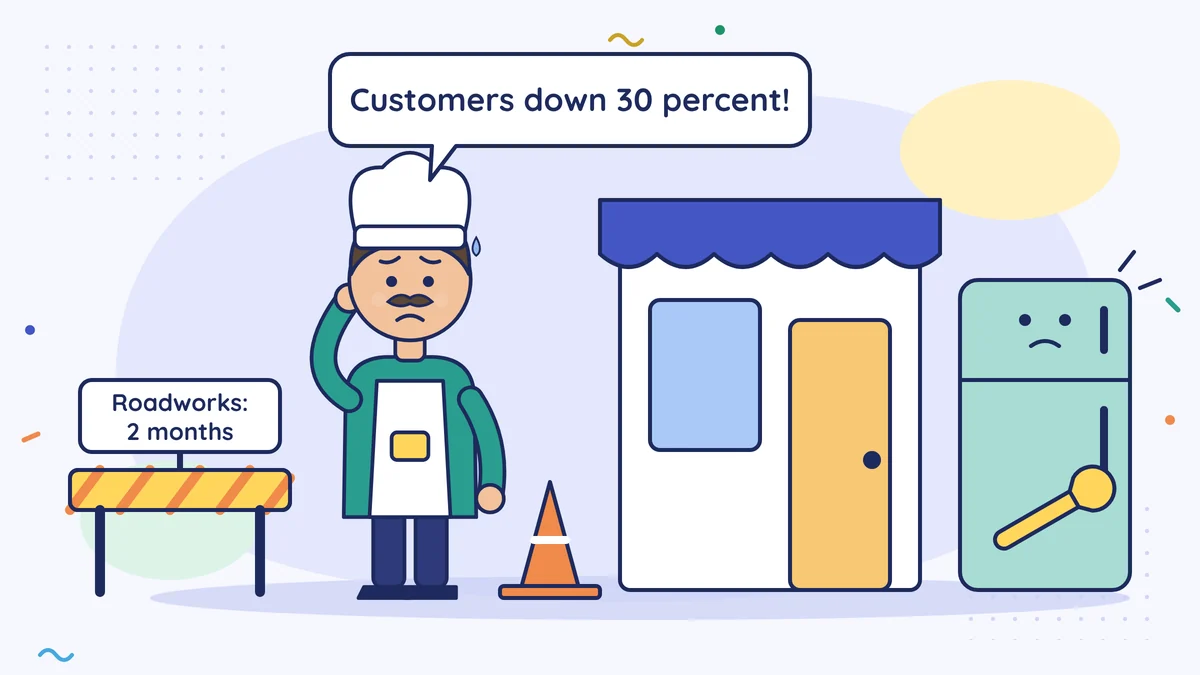
One morning roadworks started at the entrance to the street. The municipality said "it will take two months". Customers fell by 30%. The same week the cold room broke down.
Nihat Usta built a scenario, to think about a situation like this in advance rather than afterwards. In this lesson we build that scenario, and then work out the cash reserve (kenar parası).
The apartment block's water tank
A water tank looks useless while the mains supply is working. When the mains is cut off, it keeps you going for a few days. If the tank is empty, you are without water on the first day. If it is big enough to overflow, it puts a pointless load on the roof.
The cash reserve is the business's water tank. How big it should be is worked out with a scenario, not a guess.
The bad-month scenario
Take your 13-week plan and change the following:
- Cut sales by between 20% and 30%.
- Delay your largest receivable by one month.
- Add one unexpected cost: a breakdown, a fine, a lost customer.
Nihat Usta's figures (round and only an example; the Bağ-Kur line is 2026's lowest premium, rounded):
| Item | Normal month | Bad month 1 | Bad month 2 |
|---|---|---|---|
| Money in | 900,000 | 630,000 | 630,000 |
| Ingredients | −270,000 | −189,000 | −189,000 |
| Salaries (net) | −240,000 | −240,000 | −240,000 |
| SGK premium and muhtasar | −120,000 | −120,000 | −120,000 |
| Rent | −100,000 | −100,000 | −100,000 |
| VAT | −50,000 | −50,000 | −30,000 |
| Bağ-Kur | −10,000 | −10,000 | −10,000 |
| Electricity, gas, other | −60,000 | −55,000 | −55,000 |
| Cold room repair | −40,000 | ||
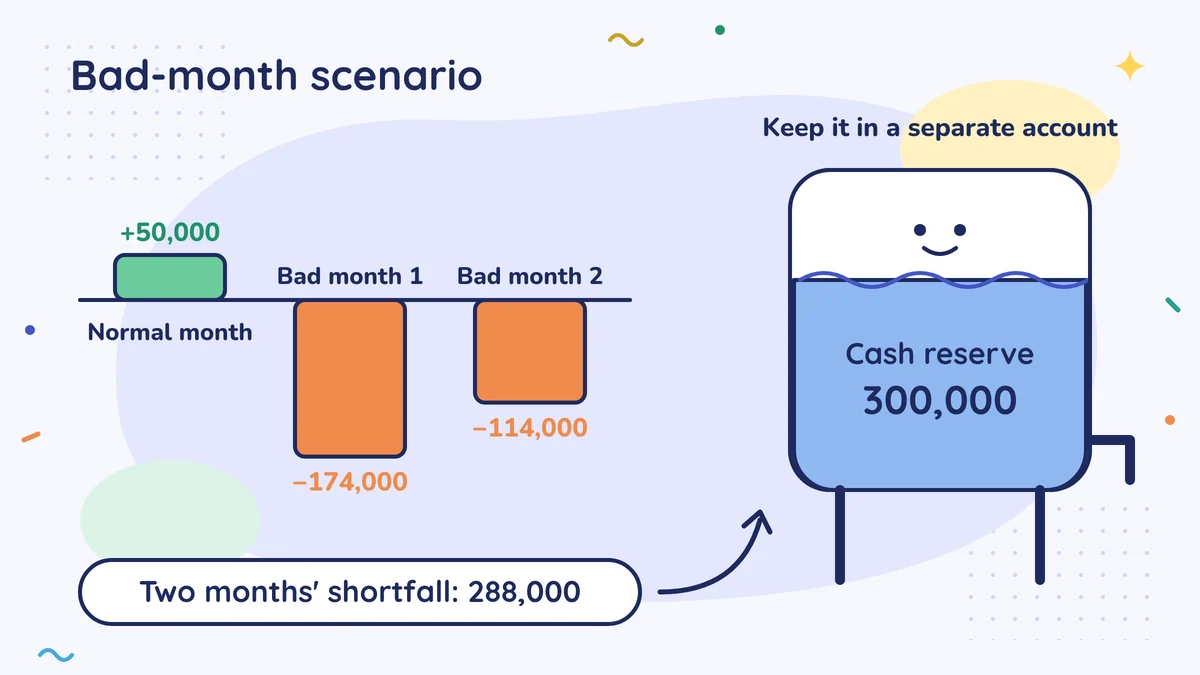
| Month result | +50,000 | −174,000 | −114,000 |
Notice two things.
Ingredients fall along with sales. Salaries, premiums and rent do not fall. In a bad month, fixed costs carry the weight. We look at separating fixed and variable costs in detail in the lesson Fixed and variable costs.
The VAT and premiums paid in a bad month are the good month's tax. A month's VAT and premiums are paid the following month. In the first month that sales fall, you pay the VAT of the previous, normal month. VAT only falls in the second month.
The total shortfall over the two months is 288,000 lira. That is why Nihat Usta's cash reserve target is 300,000 lira. As a general rule of thumb, some businesses keep a cash reserve equal to "three months of fixed costs"; this is a more cautious target. The scenario shows, with your own figures, the minimum you need.
How do you build up a cash reserve?
- Keep it in a separate account. Separate from your tax jar too. The jar is for this month's tax; the cash reserve is for a future bad month.
- Keep it where you can withdraw it straight away. Stock, machinery or a long-term investment is not a cash reserve; it does not turn into money on the day you need it.
- Fill it with a share of the good months. In normal months Nihat Usta sets aside half of the 50,000 lira left over. He reaches the target in a year.
- When you use it, refill it. The cash reserve is there to be used; when it runs out, you make a new plan to fill it.
A cash reserve does not replace a credit line, but the two work well together. It is easier to talk to the bank about a credit line before you need it, while business is good.
If money runs short: which comes first?
This is not a legal ranking. It is an order for thinking, based on the cost of being late and who gets hurt. Talk about your own situation with your mali müşavir (accountant).
| Payment | If it is late | Room to talk |
|---|---|---|
| Tax returns | Even if you can't pay, file the return on time. Late payment interest (gecikme zammı) runs on tax that is declared but paid late; filing the return late brings a separate penalty | None |
| A cheque you gave | If it bounces, penalties and a ban on writing cheques under the Cheque Law come into play, and your record at the bank is damaged | Very little; talk to the person you gave the cheque to before its date |
| Salaries | The employee's livelihood. If pay is not paid within 20 days of the pay day without force majeure, the employee may refuse to work; interest runs on late pay (Labour Law art. 34) | Very little |
| SGK premium and tax deducted from pay | Part of this is money you deducted from the employee's pay. On SGK premiums a late payment penalty and late payment interest run; incentives and the Treasury discount (Hazine indirimi) for that month may be lost | There is an instalment route for SGK premiums; for deducted tax, ask your mali müşavir |
| VAT | Late payment interest: 3.7% a month as of October 2026 (since 13 November 2025) | There is an instalment (tecil) route, but for VAT the number of instalments is generally smaller |
| Bağ-Kur | If not paid on time, that month's 5-point discount is lost: in 2026 the lowest premium becomes 11,808.23 lira instead of 10,156.73; on top of that a late payment penalty and late payment interest run. Until the debt is paid, the discount for the following months may also be lost | Little |
| Loans and credit cards | Default interest; your credit record is affected | With the bank, in advance |
| Rent and suppliers | Loss of trust, shorter credit terms on the next purchase | The most |
The items with the most room to talk come last: suppliers and rent. With them, too, you have the conversation before the payment day.
If you need to split a payment, you can apply to the tax office and to SGK for instalments (Law No. 6183, art. 48). In June 2026, Law No. 7582 raised the longest instalment period for tax debts from 36 months to 72 months. This is an upper limit: how many instalments are given depends on the type of tax and the state of the business. For VAT fewer instalments are generally given; some debts, such as provisional tax (geçici vergi), cannot be put into instalments. The application period for the special lower-interest instalment arrangement that came out in June 2026 ended on 31 August 2026; anyone applying today is subject to the general rules. Instalment interest (tecil faizi) runs on a debt put into instalments. The interest and conditions are set by what applies on the day you apply; the details are in the article What happens if I pay tax late? (in Turkish). You saw the conditions of incentives in the lesson What is an incentive.
Talking to employees
When the roadworks started, Nihat Usta explained the situation to his employees: salaries will be paid on time, but there will be no overtime for two months, and leave can be moved into this period. Overtime and annual leave have their own rules; you saw them in the lessons Overtime and Annual paid leave. A bad month that is talked about openly loses you fewer employees than a bad month that passes in silence.
The early-warning rule
Once you have set your cash reserve, add a rule to your 13-week plan: if the lowest week falls below the cash reserve, it is time to act. The order can be: speed up collections, cut stock purchases, talk to suppliers about credit terms, and finally look at financing. The first three are free; the fourth has a cost, and we compare the options in the lesson Loan, leasing or your own money?.
Do this this week
Make a copy of your 13-week plan. Cut sales by 30%, delay your largest receivable by one month, and add an unexpected cost of 50,000 lira. Write the largest shortfall that comes out as your cash reserve target, and open a separate account this month.
Common mistakes
- Thinking VAT will fall straight away in a bad month. In the first bad month you pay the VAT and premiums of the previous, normal month. VAT only falls in the second month.
- Not filing the return because you can't pay. Late payment interest runs on tax that is declared but paid late; filing the return late brings a separate penalty. Always file the return on time.
- Keeping the cash reserve in stock or in the tax jar. Stock does not turn into money on the day you need it, and the jar is for this month's tax. The cash reserve sits in a separate account you can withdraw from straight away.
Sources
- Labour Law No. 4857 (4857 sayılı İş Kanunu), art. 32 (payment of wages) and art. 34 (late payment of wages) (Ministry of Labour and Social Security PDF)
- Social Insurance and General Health Insurance Law No. 5510 (5510 sayılı Sosyal Sigortalar ve Genel Sağlık Sigortası Kanunu), art. 81 (Treasury discount), art. 88–89 (premium payment period, late payment penalty and late payment interest) (mevzuat.gov.tr)
- SGK: Insurance premium incentives 2026 presentation (4/b premium amounts, 35.75% and 30.75%)
- Alomaliye: 4/b Bağ-Kur 5-point premium discount 2026
- Cheque Law No. 5941 (5941 sayılı Çek Kanunu), art. 5 (bounced cheque) (mevzuat.gov.tr)
- Law No. 6183 on the Collection Procedure of Public Receivables (6183 sayılı Amme Alacaklarının Tahsil Usulü Hakkında Kanun), art. 48 (instalments, tecil) and art. 51 (late payment interest) (mevzuat.gov.tr)
- KPMG: Presidential Decision No. 10556 (10556 sayılı Cumhurbaşkanı Kararı) reset the late payment interest rate at 3.7%
- PwC: Summary of Law No. 7582 (7582 sayılı Kanun) (June 2026, 72 months for instalments)
- Andersen: Changes to instalment interest and the number of instalments (Collection General Communiqué Series B No. 20, Tahsilat Genel Tebliği Seri B No 20, Official Gazette 16.06.2026; applications closed on 31.08.2026, general instalment interest outside its scope 39%)
- Ekonomi Gazetesi: Deferral and instalments (shorter period for VAT under general instalments, provisional tax cannot be put into instalments; 72 months with Law No. 7582)
- PwC, Celal Özcan: Putting SGK premium debts into instalments under Law No. 6183
- Tax Procedure Law No. 213 (213 sayılı Vergi Usul Kanunu), art. 344, 352 (tax loss penalty and irregularity penalty) (mevzuat.gov.tr)
Translated from the Turkish lesson. Last checked against Turkish rules: 12 October 2026. Not yet reviewed by a licensed accountant.
This is general information about Turkish rules, not financial, tax or legal advice. Rules change; check the date and the sources, and ask a licensed accountant (mali müşavir) about your own situation. Disclaimer