A loan, leasing or your own money?
Zeynep Hanım the printer has three offers for a printing machine: paying up front, a bank loan and leasing. Alongside interest, we look at BSMV, KKDF and the arrangement fee, at how VAT is spread over the instalments in leasing, and at comparing the offers in the same way.
Your own money is the cheapest, but it empties the cash box in a day; if a few months of fixed costs are not left in the cash box after the purchase, it is not suitable. With a loan, in addition to interest there is BSMV (5% on commercial loans), KKDF, whose rate changes with the type of loan, and an arrangement fee. With leasing, the machine's VAT is spread over the instalments. Compare the offers not by the monthly instalment but by the total repayment excluding VAT, and check that the instalment is less than the monthly extra cash the machine brings in.
Zeynep Hanım the printer's three offers
The rules described in this lesson are those of Turkish law.
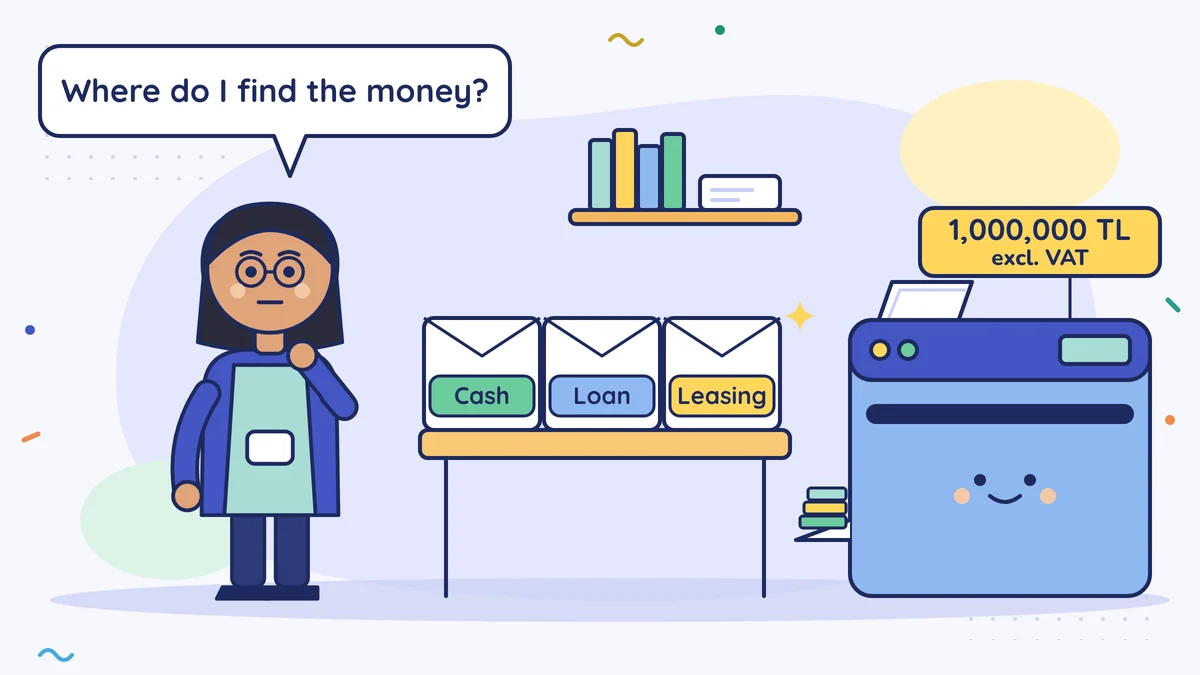
Zeynep Hanım's print shop wants to move from business cards to catalogue work. For this she needs a digital printing machine: 1,000,000 TL excluding VAT, 1,200,000 TL with 20% VAT. With the calculation from the previous lesson, she found that the machine would bring in about 80,000 TL of extra cash a month, that is, pay for itself in around 13 months. Now the question is where to find the money.
There are three options on her desk: buy it up front with the money in the cash box, take out a bank loan, or buy it through leasing, that is, financial leasing (finansal kiralama).
It's like buying a home
Someone buying a home thinks about the same three ways: buy it outright with their savings, take out a mortgage, or rent first and buy at the end. None of them is right on its own. The person who pays outright pays no interest but uses up their savings. The person who takes out a loan moves in straight away but pays interest. Which one suits is decided not by the price of the home but by the person's cash. It's the same with a machine.
1. Your own money
No interest, no charges, no waiting for approval. But 1,200,000 TL leaves the cash box today.
The question to ask is: after the purchase, how many months of fixed costs are left in the cash box? Rent, salaries, SGK (Social Security Institution), tax and a share for a bad month. If this is not left in the cash box, paying up front squeezes the business, even though it looks like the cheapest way. Also, if that money were waiting in the bank, it would earn something; paying up front means giving up that return.
2. A bank loan
The cost of a loan is not only interest. You also see other lines in the repayment plan:
- BSMV (Banking and Insurance Transactions Tax, Banka ve Sigorta Muameleleri Vergisi): a tax added to the interest the bank charges. On commercial loans the rate is 5%. Its basis is Expenditure Taxes Law art. 28 and the Presidential decisions issued under this article. On consumer loans such as personal loans, the rate has been 15% since 7 July 2023 (Presidential Decision No. 7345); taking out a personal loan in your own name for your business is expensive for this reason too, and it mixes the business with your pocket.
- KKDF (Resource Utilisation Support Fund, Kaynak Kullanımı Destekleme Fonu): a fund levy added to the loan. Under the July 2025 decision (Presidential Decision No. 10094, Official Gazette 18.07.2025), it is 0% on Turkish lira commercial loans and 1% on commercial loans linked to foreign currency and gold. The rates can change by Presidential decision; you see the current one in the bank's repayment plan.
- Arrangement fee, insurance, appraisal. The bank may also ask for collateral or a guarantor.
Interest is an expense of the business. But the interest on a loan taken for an investment that runs until the machine starts to be used (is capitalised) is added to the machine's cost and becomes an expense spread over the years through depreciation (amortisman). For the interest after the machine starts to be used, you choose between recording it directly as an expense or still adding it to the cost; the chosen way is continued in the following years (Tax Procedure Law General Communiqués No. 163 and 334). Ask your mali müşavir (accountant) which date applies to your investment. Also, in businesses whose debts exceed their equity, part of the interest and similar costs falling on the excess cannot be recorded as an expense. This is called the financing expense restriction (finansman gider kısıtlaması); it does not concern a business whose debt is less than its equity; for companies it is in Corporate Tax Law art. 11/1-i, and for sole proprietorships in Income Tax Law art. 41/1-9 (excluding the part added to the cost of the investment); if you keep books on the business account basis (işletme hesabı), ask your mali müşavir how it affects you. Your mali müşavir calculates both.
3. Leasing (financial leasing)
The leasing company buys the machine from the seller and leases it to you. If the contract has a purchase option, when the instalments are over the machine becomes yours for the price written in the contract; find this clause in the contract before signing (Law No. 6361). Until the instalments are over, the owner of the machine is the leasing company.
The differences:
- The VAT is spread over the instalments. The leasing company issues an invoice with VAT for each instalment. You don't pay the machine's VAT in one go. If you are a VAT taxpayer, you deduct the VAT on the instalment invoices from the VAT you collect on sales.
- The recording is a little different. Even though the owner of the machine is the leasing company, the machine goes into your records and you set aside its depreciation. Each instalment is split in two, principal and interest; the principal is not an expense, and the interest part becomes an expense or part of the cost (Tax Procedure Law repeated art. 290, mükerrer md. 290). Your mali müşavir splits the instalment into principal and interest.
- Read the contract. Is it in foreign currency? Is the interest fixed? What is the early repayment charge? Who takes out the insurance?
The three side by side
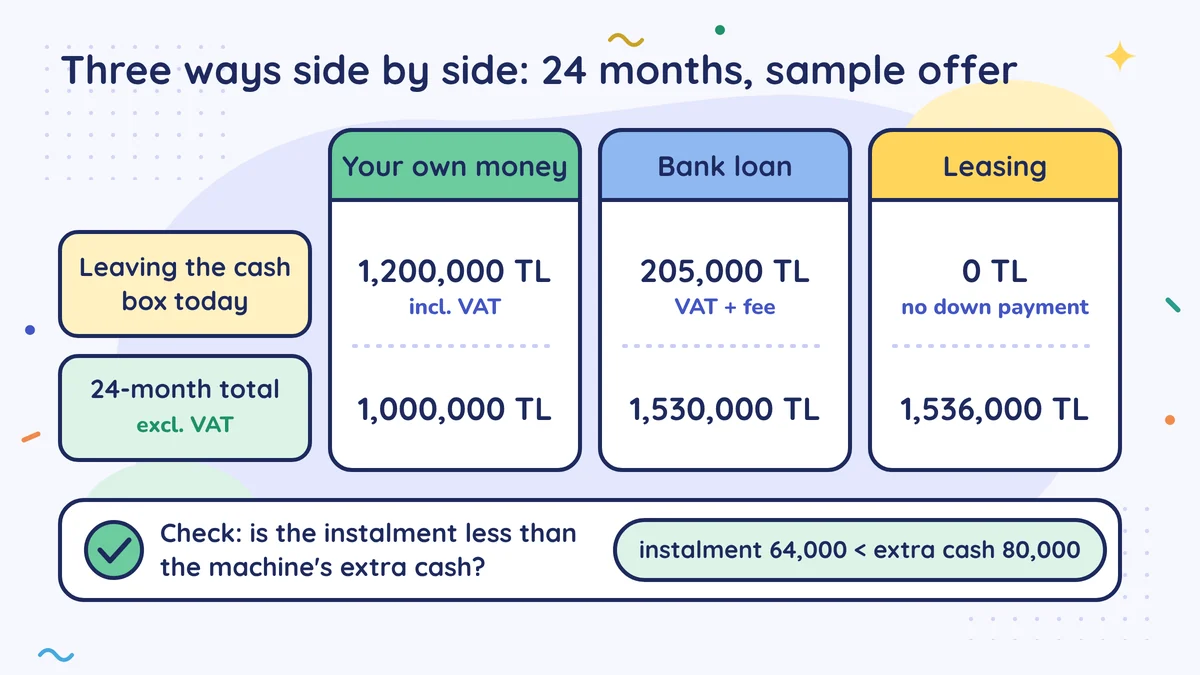
The sample offers in Zeynep Hanım's hands, 24 months, excluding VAT. The interest figures are examples; a real offer changes with the bank and the period.
| Your own money | Bank loan | Leasing | |
|---|---|---|---|
| Leaving the cash box today | 1,200,000 (incl. VAT) | 205,000 (the machine's VAT + arrangement fee) | 0 (no down payment in this example) |
| Monthly payment | none | about 63,500 | 64,000 + VAT |
| Total over 24 months (excl. VAT) | 1,000,000 | 1,530,000 | 1,536,000 |
The loan total: 1,000,000 principal + 500,000 interest + 25,000 BSMV (5% of the interest) + 5,000 arrangement fee (including its tax).
The total cost of the loan and of leasing are very close to each other. The difference is in the timing of the cash: with the loan, the machine's 200,000 TL of VAT leaves the cash box today; with leasing it is spread over the instalments. Your own money is the cheapest, but it empties the cash box in a day.
Questions for the decision
- Is the monthly instalment less than the monthly extra cash the machine brings in? Write it next to the figure you found in the previous lesson. If the instalment is bigger than the extra cash, the machine can't pay its own instalment.
- Can you pay the instalment in a bad month? Compare the bad scenario of the monthly extra cash with the instalment.
- Are the offers written in the same way? Ask each offer for the total repayment excluding VAT, with all charges. Looking only at the monthly instalment is misleading.
- Is the exchange rate and interest risk yours? If your income is in Turkish lira, think twice before taking on debt in foreign currency.
What did Zeynep Hanım do?
Because she wanted to keep three months' fixed costs in the cash box as a cash reserve (kenar parası), she didn't pay up front (The bad-month scenario and the cash reserve). She put the totals of the loan and leasing offers side by side; she saw that the 64,000 TL instalment was less than the 80,000 TL of monthly extra cash the machine would bring in. Preferring the VAT to be spread over the instalments, she chose leasing. Before signing the contract she showed it to her mali müşavir and asked how it would be recorded.
Do this this week
For an investment you are thinking of, ask your bank and a leasing company for a written repayment plan. Write the total repayment of the two plans side by side, excluding VAT and with all charges. Compare the monthly instalment with the monthly extra cash you found in the previous lesson.
Common mistakes
- Looking only at the monthly instalment. The longer the term, the smaller the instalment but the bigger the total; compare offers by total repayment.
- Taking out a personal loan for your business. On a consumer (personal) loan BSMV is 15%, on a commercial loan 5%; on top of that, the business's debt and your own debt get mixed up.
- Paying up front and emptying the cash box. Not paying interest is good, but if in a bad month there is no money left to pay salaries and tax, you end up needing a more expensive debt.
Sources
- Expenditure Taxes Law No. 6802, art. 28 (BSMV) (Gider Vergileri Kanunu)
- KPMG, Presidential Decision No. 7345: BSMV on consumer loans raised from 10% to 15% (Official Gazette 07.07.2023)
- Türkiye İş Bankası, What is BSMV (5% on commercial loans, 15% on consumer loans), 25.02.2025
- KPMG, Presidential Decision No. 10094: KKDF rates (Official Gazette 18.07.2025)
- Law No. 6361 on Financial Leasing, Factoring, Financing and Savings Financing Companies (Finansal Kiralama, Faktoring, Finansman ve Tasarruf Finansman Şirketleri Kanunu)
- Tax Procedure Law No. 213, repeated art. 290 (valuation in financial leasing) (Vergi Usul Kanunu, mükerrer md. 290)
- Corporate Tax Law No. 5520, art. 11/1-i (financing expense restriction) (Kurumlar Vergisi Kanunu)
- Income Tax Law No. 193, art. 41/1-9 (financing expense restriction for sole proprietorships) (Gelir Vergisi Kanunu)
- Tax Procedure Law General Communiqué No. 163 (adding investment loan interest to cost), Alomaliye text
- Alomaliye: GİB private ruling (04.12.2020), investment loan interest under Tax Procedure Law General Communiqués No. 163 and 334: cost until capitalisation, optional afterwards
Translated from the Turkish lesson. Last checked against Turkish rules: 12 October 2026. Not yet reviewed by a licensed accountant.
This is general information about Turkish rules, not financial, tax or legal advice. Rules change; check the date and the sources, and ask a licensed accountant (mali müşavir) about your own situation. Disclaimer