Fixed costs, variable costs and unit cost
Why does Ayşe Hanım, who sells the same cake at the same price, do well in some months and struggle in others? We split costs into fixed and variable and work out, in figures, a product's real cost (unit cost) and how much each sale contributes towards fixed costs.
A fixed cost is a cost paid every month regardless of how many units you sell (rent, salaries, the accountant's fee); a variable cost rises with every sale (ingredients, packaging, card commission). Unit cost is found by adding the share of fixed costs that falls on each product to the variable cost per product. Because the fixed-cost share depends on the number of units sold, the cost of the same product rises in a quiet month and falls in a busy one.
Ayşe Hanım the pastry shop owner's cake price
The rules described in this lesson are those of Turkish law.
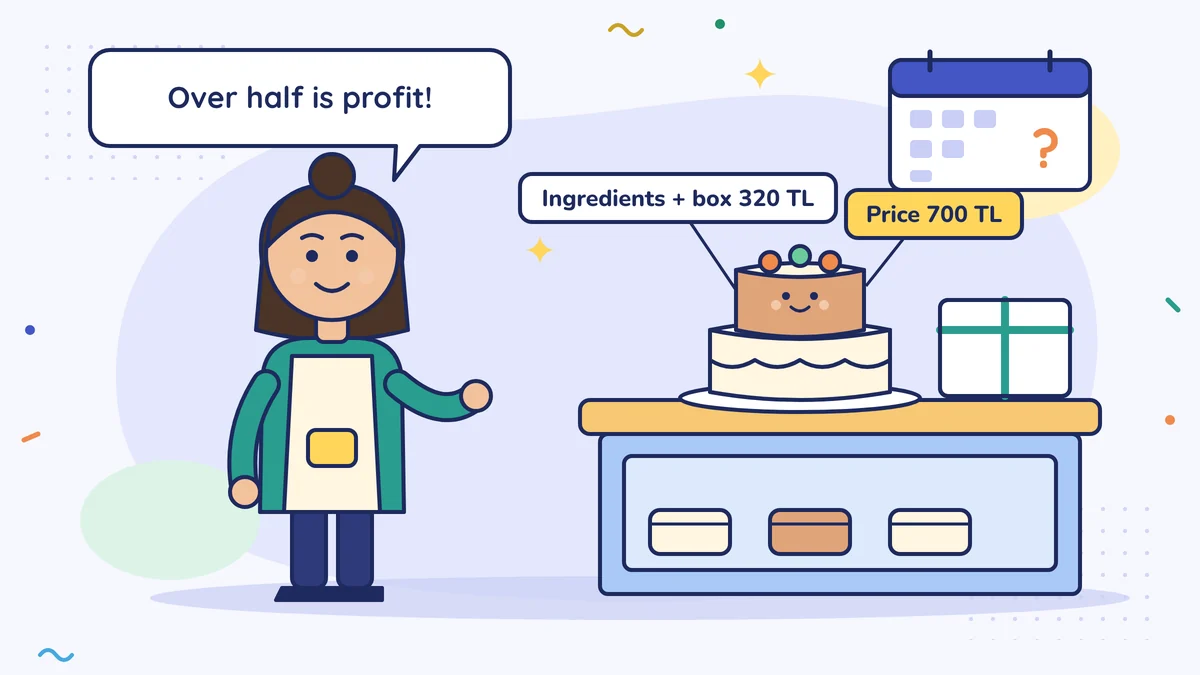
Ayşe Hanım has run a pastry shop in her neighbourhood for three years. She always sets the price of her cream cakes the same way: she adds up the ingredients and the box, and sells for a little more than twice that total. The ingredients and box for one cake come to 320 lira; she sells it for 700 lira excluding VAT. "More than half is profit," she says.
But the month-end figures don't come out the same every month. Some months are comfortable; in others she barely makes the rent. Same price, same ingredients. What has changed?
What changes is the number of cakes she sold that month. In this lesson we split costs into two groups to find out what a cake really costs her.
Think of a taxi meter
When you get into a taxi, the meter starts with a flag-down fare. Whether you go one street or ten kilometres, you pay that starting fare. Then the figure goes up a little with every kilometre.
A business's costs come in the same two parts:
- Fixed cost (sabit gider): A cost paid every month whether there are sales or not. Like the taxi meter's starting fare. Rent, an employee's salary and SGK premium, the mali müşavir's (accountant's) fee, internet, insurance.
- Variable cost (değişken gider): A cost that rises with every sale. Like the per-kilometre fare. Ingredients, packaging, the commission the bank takes on card payments, a bonus paid per sale, shipping.
"Fixed" does not mean "never changes"; it means "does not change with the number of units sold". Rent goes up once a year; but this month it is the same whether you sell 200 cakes or 500.
Ayşe Hanım's costs
Monthly fixed costs, rounded and excluding VAT:
| Cost | Monthly (TL) |
|---|---|
| Rent | 40,000 |
| One employee (salary and employer's SGK share) | 41,000 |
| Fixed part of electricity and natural gas (display fridge, lighting, heating) | 9,000 |
| Mali müşavir's fee | 6,000 |
| Internet, insurance, other | 4,000 |
| Total fixed costs | 100,000 |
The 41,000 lira on the employee line is rounded: for 2026, the employer's cost of an employee on the minimum wage, without incentives, is 40,874.63 TL a month. We did the calculation in the lesson What an employee really costs you.
A note on the rent line: if you rent the shop from a person rather than a company and you are not under simplified taxation, you pay part of the rent to the tax office on the landlord's behalf. This is called withholding tax (stopaj), that is, deducting the tax when you make the payment and paying it to the state. Your rent cost is not the amount the landlord receives, but the total of the two.
Variable costs per cake:
| Cost | Per cake (TL) |
|---|---|
| Ingredients (flour, cream, fruit, chocolate) | 300 |
| Box and ribbon | 20 |
| Electricity and gas the oven uses per cake | 10 |
| Bank commission on card payments (average) | 20 |
| Total variable costs | 350 |
When setting her price, Ayşe Hanım only saw the first two lines. The oven's energy and the bank commission also rise with every cake; they are variable costs too.
Unit cost: sharing fixed costs among the cakes
The real cost of one cake is called the unit cost (birim maliyet):
Unit cost = variable cost per cake + the share of fixed costs falling on each cake
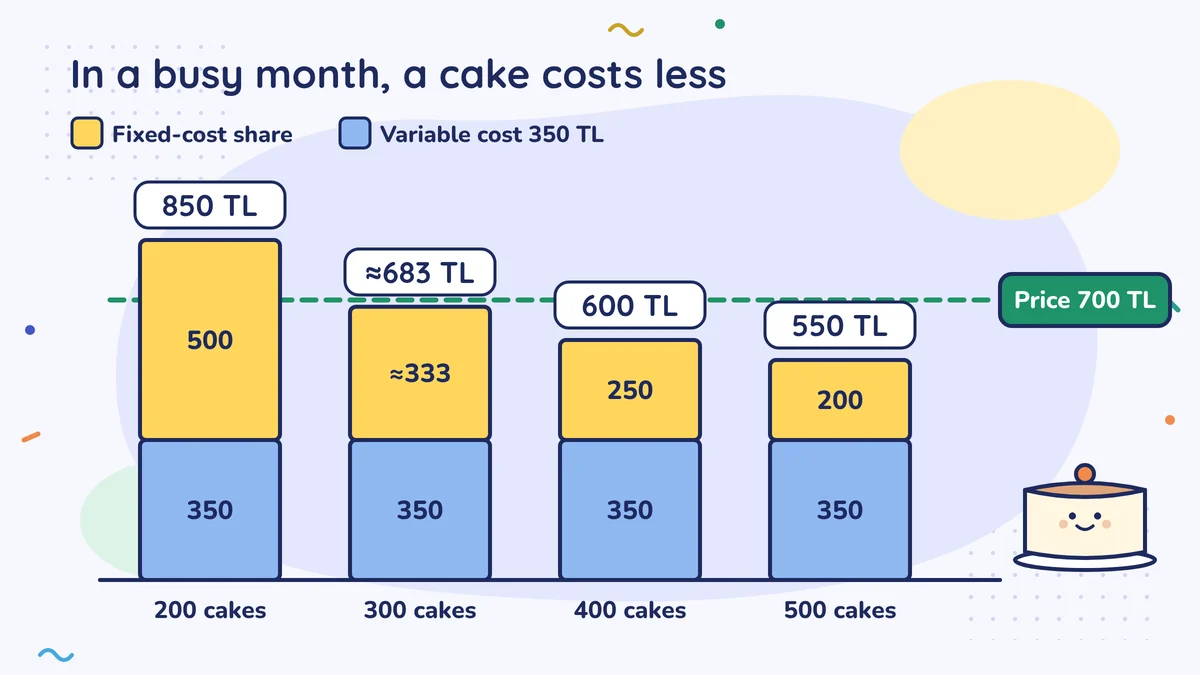
The fixed-cost share depends on how many cakes she sold that month:
| Monthly sales | Fixed-cost share per cake | Unit cost | Price | Profit per cake |
|---|---|---|---|---|
| 200 cakes | 100,000 ÷ 200 = 500 | 850 | 700 | −150 |
| 300 cakes | about 333 | about 683 | 700 | about 17 |
| 400 cakes | 250 | 600 | 700 | 100 |
| 500 cakes | 200 | 550 | 700 | 150 |
Same price, same ingredients; yet in a 200-cake month every cake makes a loss, and in a 500-cake month every cake earns well. This is the answer to Ayşe Hanım's question: fixed costs get thinner in a busy month and thicker in a quiet one.
Last month she sold 400 cakes. Sales 280,000, variable costs 140,000, fixed costs 100,000 lira; profit before tax 40,000 lira.
Contribution margin: what each sale contributes towards fixed costs
Take the variable cost away from the price: 700 − 350 = 350 lira. This is called the contribution margin (katkı payı). Each cake leaves 350 lira in the cash box. This money first has to cover the fixed costs. The month's first 100,000 lira of contribution pays the rent, the salary and the bills; every contribution after that is profit. At 400 cakes, 400 × 350 = 140,000 lira of contribution builds up; once fixed costs are taken out, 40,000 lira is left.
The contribution margin is the key to the next lesson. We will use it to find out how many cakes have to be sold to stop making a loss.
Points to watch when splitting costs
- Mixed costs: Part of the electricity bill (the display fridge, the lights) is fixed; part of it (the oven) rises with production. You don't need to split it down to the last kuruş. Look at the last few months' bills and divide them roughly; that is better than putting everything into one group.
- Stepped fixed costs: If Ayşe Hanım goes above 600 cakes a month, she will need a second employee or a second oven. At that point fixed costs go up a step. In other words, fixed costs are fixed only within a certain range of sales.
- Your own labour: In a sole proprietorship, money you pay yourself cannot be recorded as an expense (Paying yourself a salary). If Ayşe Hanım is a sole proprietorship, the remaining 40,000 lira has to cover a month of her labour, her own Bağ-Kur premium (Bağ-Kur is the social security scheme for the self-employed) and her income tax. When setting prices, factor in your own living separately: it doesn't go into the tax calculation, but it does go into yours. If you are a partner in a limited company and the company pays you a salary through the payroll, that salary is the company's expense; record it as a fixed cost.
- VAT: If you are a VAT taxpayer, do the calculation excluding VAT. The VAT you collect on sales is held in trust; because you can usually deduct the VAT you pay on purchases from the VAT you collect on sales, you don't add it to your costs. There are exceptions that cannot be deducted (for example, expenses unrelated to the business); ask your mali müşavir about any item you are unsure of. If you are under simplified taxation, you don't charge VAT and cannot deduct the VAT on purchases; so the total amount on the purchase invoice is your cost.
Where do you find the figures?
Your mali müşavir's table lists costs by type (rent, staff, energy); it does not split them into fixed and variable. You do the split. Take the last three months' costs, write F or V next to each line, and work out the monthly averages. Divide the total variable costs by the number of units you sold in those three months. If you are a company, the "cost of sales" line in the table is often close to the variable costs, but it is not exactly the same (The income statement line by line).
If you sell more than one product, find the variable cost for each product separately. Dividing fixed costs among products is harder; as a first step, start with your three best-selling products.
Do this this week
List the last three months' costs on a sheet of paper and write F (fixed) or V (variable) next to each line. Then find the variable cost per unit of your best-selling product or service and subtract it from the price: the figure you are left with is that product's contribution margin.
Common mistakes
- Setting the price by looking only at the ingredients. Rent, salaries and bills are inside every product too; their share changes with the number of units sold.
- Forgetting small variable costs such as card commission, packaging and wastage. Because they repeat with every sale, they add up to a large total by the end of the month.
- Calculating the unit cost once and using it for years. As sales volumes and costs change, so does the unit cost; update it at least every three months.
Sources
- Dr. Uğur Demir, Cost–Volume–Profit Relationships and Profit Planning (Maliyet Hacim Kâr İlişkileri ve Kâr Planlaması, Ankara University lecture notes): fixed and variable costs, contribution margin
- Bilgen Özkan (SMMM), Reaching Profit in Businesses: Break-Even Point Analysis (definition of contribution margin), Muhasebetr
- EY: 2026 minimum wage and employer cost
- Alomaliye: 2026 minimum wage briefing (employer cost without incentives 40,874.63 TL)
- Income Tax Law No. 193 (Gelir Vergisi Kanunu), art. 41 (a monthly payment the business owner makes to themselves cannot be recorded as an expense)
Translated from the Turkish lesson. Last checked against Turkish rules: 12 October 2026. Not yet reviewed by a licensed accountant.
This is general information about Turkish rules, not financial, tax or legal advice. Rules change; check the date and the sources, and ask a licensed accountant (mali müşavir) about your own situation. Disclaimer