Overtime, the weekly day off and holidays: how pay changes
Every hour over 45 hours a week costs more. Why is the employee's consent needed for overtime, and what is the annual limit? What is paid when someone works on a Sunday or a holiday?
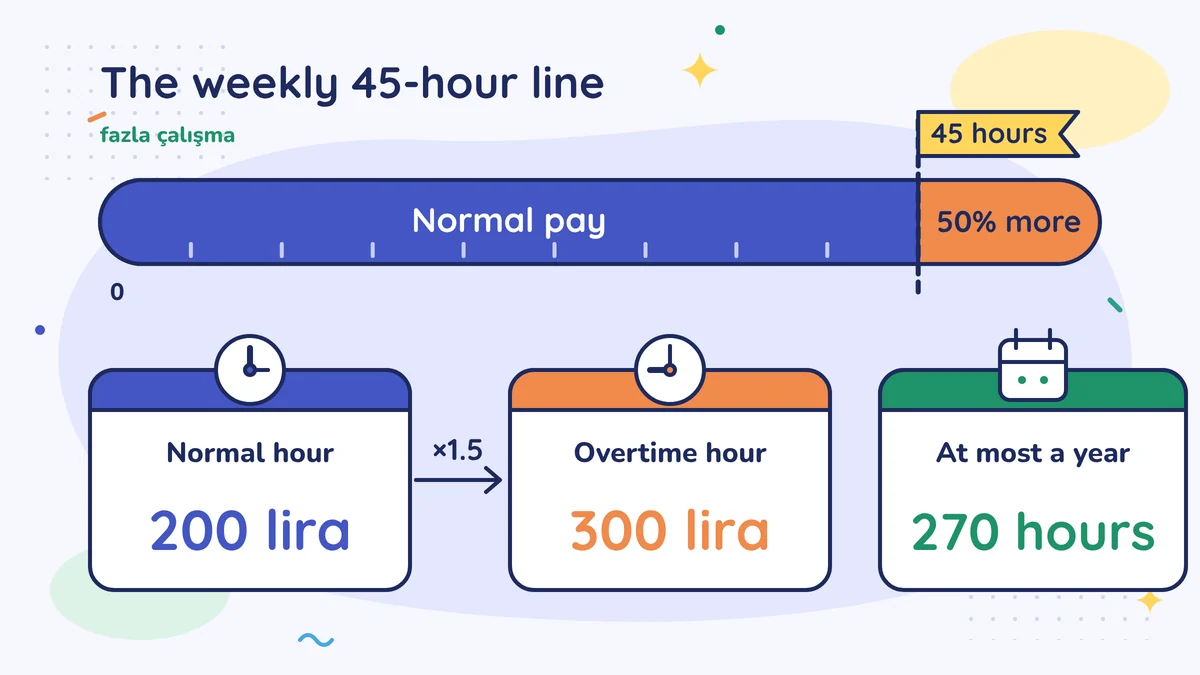
Work over 45 hours a week is overtime, and each hour is paid at 50% more than the normal hourly wage; if the employee wishes, instead of the pay they use 1.5 hours of time off for each hour. Overtime requires the employee's written consent and cannot go over 270 hours a year. The employee is given at least 24 hours of uninterrupted weekly rest every week. A person who works on a national holiday or public holiday receives one more day's wage on top of the wage for that day.
Yusuf Usta the car mechanic's winter month
When winter comes, Yusuf Usta's workshop fills up: batteries, tyres, antifreeze. For two weeks, his assistant (kalfa) Emre has been leaving not at seven in the evening but at nine. At the end of the month, Emre asked a little shyly: "Usta, will these evenings show up in my salary?" Yusuf Usta said, "We're family, we'll sort it out." But how much, and how, he had never worked out.

The rate per hour changes
You get in a taxi; one rate runs in the daytime and another at night. The same ride costs more at night. Working hours are the same. The first 45 hours of the week are counted at the normal rate, and the hours after that at the higher rate. The moment the hours pass 45, the meter changes.
How much is overtime?
Under Labour Law art. 41:
- Overtime (fazla çalışma): Work that goes over 45 hours a week. Each hour is paid at 50% more than the normal hourly wage.
- Extra hours (fazla sürelerle çalışma): If the contract sets the weekly hours below 45 (for example, 40 hours), work between 40 and 45 hours is paid at 25% more for each hour.
- Time off instead: If the employee wishes, instead of the higher pay they use 1 hour 30 minutes of time off for each hour of overtime, and 1 hour 15 minutes for each extra hour. They use this time off within six months, with nothing deducted from their wage.
- Annual limit: Overtime cannot go over 270 hours in a year.
Example: Emre's gross salary is 45,000 lira. In practice, the hourly wage is found by dividing the monthly wage by 225 hours: 45,000 ÷ 225 = 200 lira. One hour of overtime comes to 200 × 1.5 = 300 lira. If Emre worked 10 hours of overtime this month, 3,000 lira is added to his gross. Your mali müşavir (accountant) does the payroll; you give the hours correctly.
Daily work is not unlimited either: under art. 63, even if the hours are spread differently across the days, they cannot go over 11 hours a day. If the contract provides for balancing (denkleştirme) (working long in some weeks and short in others, provided the weekly average does not go over 45 hours within two months), a week that goes over 45 hours does not automatically count as overtime. If there is such a clause, leave the calculation to your mali müşavir.
The consent must be in writing
To have someone work overtime, you need the employee's written consent. Under the Overtime Regulation (Fazla Çalışma Yönetmeliği) art. 9, this consent is taken when the employment contract is made or when the need arises; it does not need to be renewed every year. The employee can withdraw their consent by giving 30 days' written notice. In compelling reasons and extraordinary situations, consent is not required.
Under art. 8 of the Regulation, some employees cannot be made to work overtime at all: those under 18, those whose health is shown by a doctor's report to be unsuitable, pregnant employees, those who have recently given birth and those who are breastfeeding, those working underground in mines (except in compelling and extraordinary situations), and part-time employees. That is why keeping someone who works half days on in the evening is against the rules. If you did have them work anyway, you must pay for those hours; ask your mali müşavir how to calculate it.
The weekly day off
Under art. 46, a person who has worked on the working days of that week is given at least 24 hours of uninterrupted rest within a seven-day period. The pay for the weekly day off is paid even though no work is done; it is included in the monthly salary.
The weekly day off does not have to be Sunday. If the workshop is open on Sundays, the day off can be Tuesday. Put which day it is in your working arrangements note (The first day and the first week). If you have the employee work on the weekly day off, extra pay arises. There is no separate rate in the law. In Court of Cassation (Yargıtay) practice, if 45 hours have already been reached that week, the hours on the day off are overtime and are paid at 50% more; the pay for the day off that is included in the salary is not cut either. If 45 hours have not been reached, the calculation changes; ask your mali müşavir. The simplest way is to keep the day off fixed.
National and public holidays
Which days are holidays is listed in the Law on National Holidays and Public Holidays (Ulusal Bayram ve Genel Tatiller Hakkında Kanun), Law No. 2429:
| Day | Length |
|---|---|
| 1 January | 1 day |
| 23 April, 1 May, 19 May, 15 July, 30 August | 1 day each |
| Republic Day | The afternoon of 28 October, and 29 October |
| Ramadan Feast (Ramazan Bayramı) | The afternoon of the eve, and 3 days |
| Feast of the Sacrifice (Kurban Bayramı) | The afternoon of the eve, and 4 days |
The dates of the religious holidays change every year. The administrative leave (idari izin) the government announces to extend a holiday is only for public-sector employees; at a private workplace it does not count as a public holiday. If you want to close on that day, talk with the employee in advance about whether the day will count as paid leave or come out of annual leave.
Under Labour Law art. 47, a person who does not work on these days is paid the full wage for the day. If they work, they are paid one more day's wage for each day they work. If Emre works on 29 October, one day's wage, that is 45,000 ÷ 30 = 1,500 lira, is added to his salary.
Whether there will be work on these days is agreed by contract; if the contract has no clause on it, the employee's consent is needed (art. 44).
Tie it to the timesheet
All these calculations come from the timesheet. Write overtime hour by hour, and holiday work day by day. In the sheet you send to your mali müşavir at the end of the month, these should show separately: Paying wages and the timesheet. The written record of overtime is the only evidence in your hands if an argument of the "it was never paid" kind comes up later.
That evening, Yusuf Usta hung an hours sheet on the back of the door. Every evening Emre writes down the time he leaves, and Usta signs it once a week. At the end of the month, two pages go to the mali müşavir.
Do this this week
Write down your employee's real start and finish times for the last four weeks and calculate the weekly total. If there is no record, start keeping one from this week. If there is a week over 45 hours, report the hours to your mali müşavir. If there is no overtime consent in the contract or on a separate sheet, sign one together with the employee this week.
Common mistakes
- Leaving overtime off the payroll with "we'll sort it out between us". The higher pay goes on the payroll; without a record, an argument comes up later.
- Keeping a part-time employee on in the evening. A part-time employee cannot be made to work overtime.
- Paying holiday work like a normal day. A person who works on a national holiday or public holiday receives one more day's wage on top of the wage for that day.
Sources
- Labour Law (İş Kanunu), Law No. 4857, art. 41, 44, 46, 47, 63 (Ministry of Labour and Social Security PDF)
- Regulation on Overtime and Extra Hours under the Labour Law (Ministry of Labour and Social Security PDF)
- Law on National Holidays and Public Holidays, Law No. 2429
- Kolay İK: Change to overtime consent (Official Gazette 25.08.2017, No. 30165; secondary source)
- Muhasebetr: Employees who cannot be made to work overtime (Regulation art. 8; secondary source)
- Muhasebetr: Pay for work on a public holiday (Labour Law art. 47; secondary source)
- Kolay İK: The weekly day off, content and practice (working on the weekly day off; secondary source)
Translated from the Turkish lesson. Last checked against Turkish rules: 9 October 2026. Not yet reviewed by a licensed accountant.
This is general information about Turkish rules, not financial, tax or legal advice. Rules change; check the date and the sources, and ask a licensed accountant (mali müşavir) about your own situation. Disclaimer