The 13-week cash plan: breaking the next three months into weeks
Looked at month by month, the cash box is growing; looked at week by week, two weeks go negative. Using Kerem Bey the printer's table for October 2026–January 2027, we look at the five lines of a 13-week cash plan, finding the lowest week, and moving the plan one week forward every Monday.
A 13-week cash plan is a table that writes down the money coming in and going out for each week of the next three months and shows what will be left in the cash box at the end of each week. It shows in advance the end-of-month squeeze that a monthly total hides, and the payments that come once every three months, such as provisional tax. The plan is updated every Monday: the week that has ended comes off, a new week is added at the end, and you look at the lowest week again.
Kerem Bey the printer's good months
The rules described in this lesson are those of Turkish law.
Kerem Bey's print shop works with six people. In October 2026 business is good: roughly 250,000 lira comes in every week. A big catalogue job has also come in from a supermarket chain. He will buy the paper for cash in the second week of November, and the customer will pay at the start of January.
Looking month by month, Kerem Bey feels comfortable: "The cash box is growing in October, and it will grow in November too." His mali müşavir (accountant) makes a suggestion: "Let's write out the next 13 weeks one by one."
You built a one-month calendar day by day in the lesson Cash flow calendar. In this lesson we stretch the same logic over three months, but we take the week as the unit, not the day.

Why 13 weeks?
Think of a hairdresser's appointment book. If it showed only today, the hairdresser would not know whether tomorrow morning is empty or full. If it showed a whole year at once, the lines would lose their meaning. A hairdresser keeps the book open a few weeks ahead and sees both the gaps and the busy days in advance.
13 weeks is roughly three months. This period shows the following:
- It shows each month's recurring payments three times side by side: salaries, rent, VAT, the muhtasar return, SGK.
- It catches the payments that come once every three months. Provisional tax (geçici vergi) is one of them; for the July–September 2026 period the last day is 17 November 2026.
- It shows the dip within the month. A squeeze that the monthly total hides comes out in the weekly table.
The five lines of the plan
- Opening cash. What is really in the cash box and the bank today? Write it from your bank statement, not from a guess. A credit card limit or an unused loan does not go on this line.
- Money in. First write the items with a fixed date: cheques falling due, collections under contract. Then the estimate of cash sales: the weekly average of the last few months, rounded down a little.
- Money out. Fixed costs (salaries, rent, SGK, taxes, loan instalments), supplier payments and large one-off items.
- End-of-week cash. The previous week's balance, plus money in, minus money out.
- The lowest week. Find the smallest figure in the table and mark it. That is the real answer of the plan.
Take the tax days from the lesson A month's calendar. There are days in this period that need attention. The last day for September VAT is 28 October 2026: it is the eve of Republic Day and the afternoon is a holiday, but the last day does not move; unless GİB announces an extension, that day stands. Because 31 October falls on a Saturday, the last day for September's SGK premium becomes 2 November 2026; because 28 November falls on a Saturday, the last day for October VAT becomes 30 November 2026.
Kerem Bey's table
The figures are round and only an example. "Money in" is 250,000 lira every week; the holiday week is a little less. "Money out" includes 110,000 lira of supplier and general costs every week, plus that week's special items on top.
| Week | Dates | In | Out | End of week | That week's special item |
|---|---|---|---|---|---|
| 1 | 12–18 Oct | 250,000 | 110,000 | 540,000 | |
| 2 | 19–25 Oct | 250,000 | 110,000 | 680,000 | |
| 3 | 26 Oct–1 Nov | 220,000 | 580,000 | 320,000 | Salaries, rent, muhtasar, VAT |
| 4 | 2–8 Nov | 250,000 | 210,000 | 360,000 | SGK premium |
| 5 | 9–15 Nov | 250,000 | 410,000 | 200,000 | Catalogue paper 300,000 |
| 6 | 16–22 Nov | 250,000 | 170,000 | 280,000 | Provisional tax |
| 7 | 23–29 Nov | 250,000 | 170,000 | 360,000 | Muhtasar |
| 8 | 30 Nov–6 Dec | 250,000 | 620,000 | −10,000 | Salaries, rent, VAT, SGK |
| 9 | 7–13 Dec | 250,000 | 110,000 | 130,000 | |
| 10 | 14–20 Dec | 250,000 | 110,000 | 270,000 | |
| 11 | 21–27 Dec | 250,000 | 110,000 | 410,000 | |
| 12 | 28 Dec–3 Jan | 250,000 | 710,000 | −50,000 | Salaries, rent, muhtasar, VAT, SGK |
| 13 | 4–10 Jan | 700,000 | 110,000 | 540,000 | Catalogue payment 450,000 |
Opening cash is 400,000 lira. At the end of the three months the cash box rises to 540,000 lira; Kerem Bey is not wrong to say "it's growing". But two weeks show a negative balance. These are the end-of-month weeks: salaries, rent, VAT and SGK all land in the same week.
Why is the VAT higher in week twelve? The catalogue is delivered in November and its invoice is issued in November. VAT does not wait for the money; it arises on delivery. Even though the money will come in January, November's VAT is paid on 28 December. We come back to this in the next lesson.
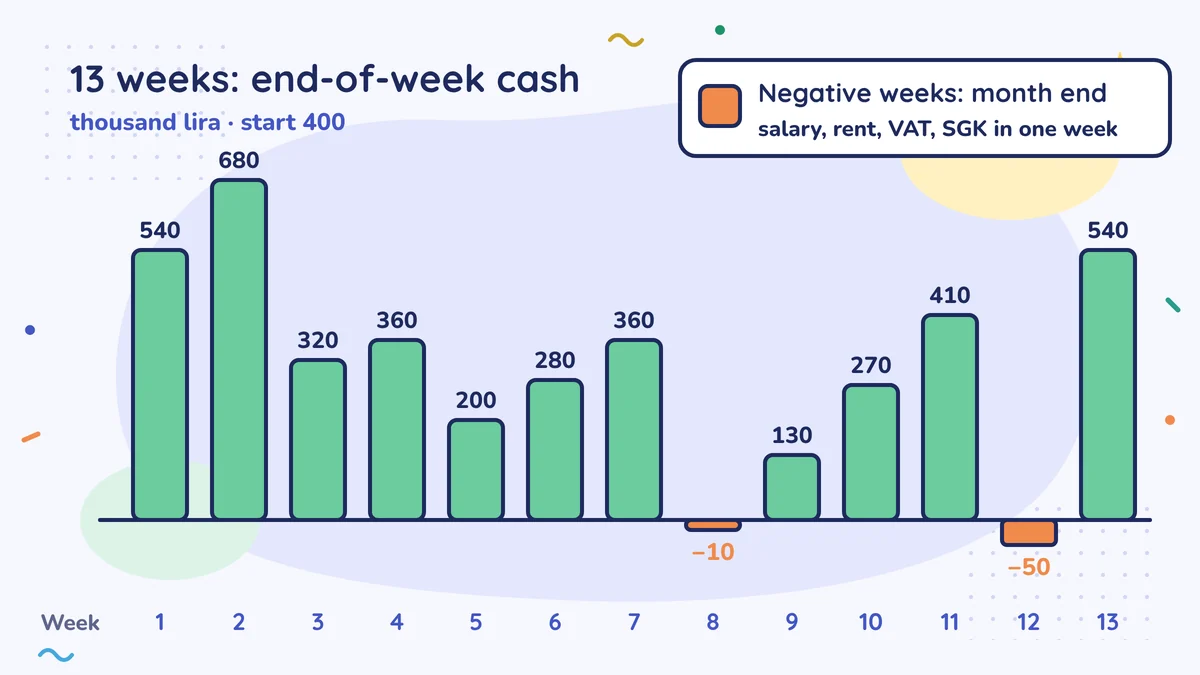
What do you do when you see the dip?
Kerem Bey has two months in hand. He talks about two things:
- With the paper supplier: paying half of the 300,000 lira now and half 45 days later.
- With the catalogue customer: a 20% advance when the job starts, that is, 90,000 lira.
When the table is recalculated, week 8 rises to 230,000 lira and week 12 to 40,000 lira. There are no negative weeks left. But 40,000 lira will not cover a machine breakdown. We work out how much of a cash reserve (kenar parası) you need to keep in the last lesson of this module.
This is the value of seeing it in advance. A conversation with the paper supplier six weeks ahead goes smoothly. The same conversation on payment day is harder.
The plan moves forward one week every Monday
A 13-week plan is not made once and put in a drawer. Every Monday:
- Write the real figures for the week that has ended and compare them with the estimate.
- Take that week off the table and add a new 13th week at the end.
- Look at the lowest week again.
Setting up the first table takes an hour or two; in the following weeks the job comes down to fifteen minutes. Every few weeks you also learn where your estimates went off. One customer's payment always comes a few days late, one cost always turns out a little higher. Over time the plan adjusts to your business.
Under simplified taxation and in a company
If you are under simplified taxation (basit usul), you have no VAT or provisional tax lines; if you have employees, the muhtasar and SGK lines are still there, and the rest of the plan is the same. If you have a sole proprietorship, your own Bağ-Kur premium (each month's, by the end of the following month) and the money you take home also go on the money-out side. If you have a company, the money the partners take from the company goes on the money-out side. The rules for money taken out of the company are in the lesson Paying yourself a salary.
Do this this week
This Monday, open a table and write out the next 13 weeks line by line. Take your opening cash from your bank statement, and ask your mali müşavir for the tax and premium days. Find the lowest week and note that week's figure on your phone.
Common mistakes
- Settling for the monthly total. At the end of the month the cash box looks as if it is growing, but when salaries, rent, VAT and SGK land in the same week, you can go negative that week.
- Writing money in optimistically. Write the day the customer actually pays, not the day they say. Round your cash sales estimate down a little.
- Making the plan once and leaving it. The plan moves forward one week every Monday. A plan that is not updated points in the wrong direction three weeks later.
Sources
- GİB Tax Calendar (Vergi Takvimi)
- Muhasebetr: 2026 tax calendar (days in October–November 2026)
- İSMMMO: GİB announcement (12.02.2024): the 25th of the month for KDV-2; the VUK-149 circular (the 28th of the month) applies for KDV-1
- Income Tax Law No. 193 (193 sayılı Gelir Vergisi Kanunu), repeated art. 120 (provisional tax) (mevzuat.gov.tr)
- Tax Procedure Law No. 213 (213 sayılı Vergi Usul Kanunu), art. 18 (when the last day falls on a holiday) (mevzuat.gov.tr)
- SGK: Employers' premium payment procedures (last day and the public holiday rule)
- Value Added Tax Law No. 3065 (3065 sayılı Katma Değer Vergisi Kanunu), art. 10 (taxable event) (mevzuat.gov.tr)
- General Communiqué on the Application of the Accounting System No. 1 (1 Sıra No'lu Muhasebe Sistemi Uygulama Genel Tebliği): cash flow statement (Alomaliye copy)
Translated from the Turkish lesson. Last checked against Turkish rules: 12 October 2026. Not yet reviewed by a licensed accountant.
This is general information about Turkish rules, not financial, tax or legal advice. Rules change; check the date and the sources, and ask a licensed accountant (mali müşavir) about your own situation. Disclaimer