Annual paid leave: who is entitled, when, and to how many days
When an employee completes a year, the right to leave arises. How many days depends on their length of service and age. Can leave be split, when is it paid, what happens to unused leave, and what record do you need to keep?
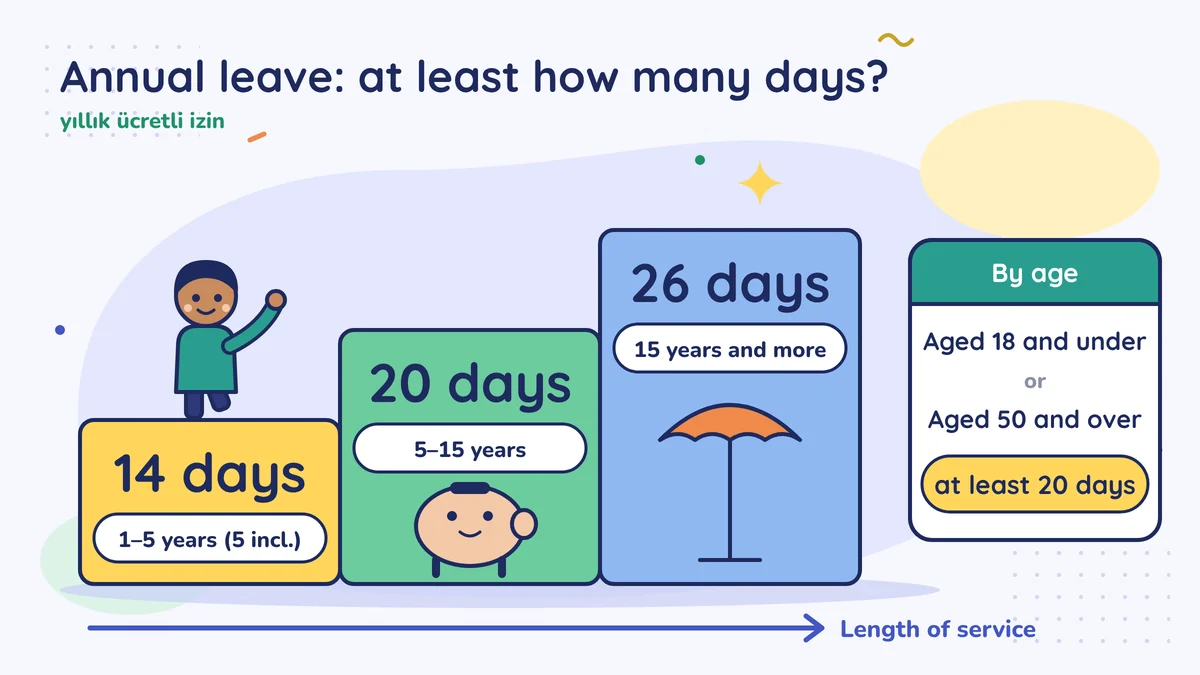
A person who has worked at least one year, including the probation period, is entitled to annual paid leave. Someone with between 1 and 5 years of service (5 included) gets at least 14 days, someone with more than 5 and less than 15 years gets at least 20 days, and someone with 15 years or more gets at least 26 days; those aged 18 and under and those aged 50 and over get at least 20 days. Leave pay is paid in advance, before the leave starts. Unused leave is not wiped out; it is paid when the employee leaves.
Kemal Bey the restaurant owner's March
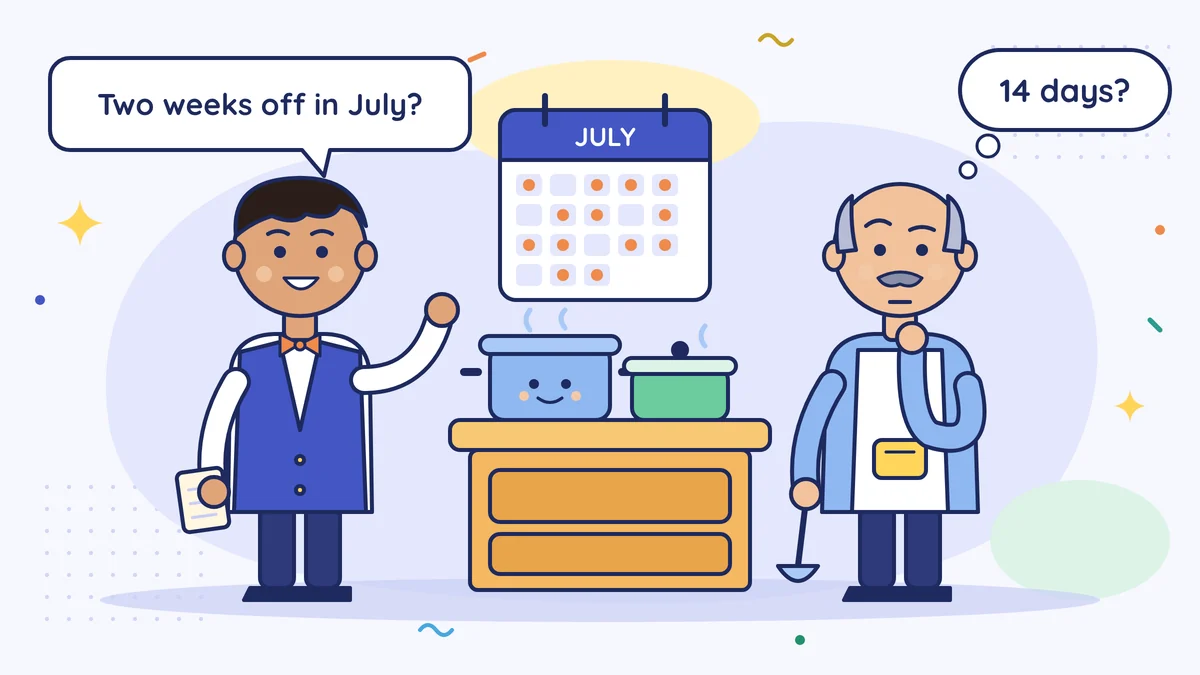
Oğuz started as a waiter at Kemal Bey's small home-cooking restaurant (esnaf lokantası) a year ago. When March came, he asked one morning: "Abi, my leave is due. I'm going back to my hometown in July, can I take two weeks?" Two things went through Kemal Bey's mind. July is the restaurant's busiest month. And what did "two weeks" mean: fourteen days, or with the two Saturdays included too?
Leave fills up like a piggy bank
You buy a child a piggy bank; a little money goes in every day, and at the end of the year it is opened. Annual leave works the same way. As the employee works, the piggy bank fills up; when a year is complete, it is opened and the days inside are used. A piggy bank has one more feature: the money inside does not disappear on its own. Unused leave is not wiped out either.
Who is entitled?
Under Labour Law art. 53, a person who has worked at least one year from the day they started work, including the probation period, is entitled to annual paid leave (yıllık ücretli izin). The right to leave cannot be waived. An agreement like "I don't want leave, give me the money for it" is not valid.
Points that change with the reader's situation:
- A part-time employee (for example, one who comes three days a week): Under the Annual Paid Leave Regulation (Yıllık Ücretli İzin Yönetmeliği) art. 13, they earn the right to leave just like a full-time employee; they cannot be treated differently.
- A fixed-term contract: If the contract fills one year, the right to leave arises.
- Seasonal or campaign work: These rules do not apply to work that by its nature lasts less than one year.
In counting the one year needed to become entitled, some absences such as illness are counted as days worked, within certain limits (art. 55). If the employee had a long sick report or unpaid leave in between, have your mali müşavir (accountant) calculate the date they become entitled.
How many days?
| Length of service | Minimum leave |
|---|---|
| From 1 year up to 5 years (5 included) | 14 days |
| More than 5 years, less than 15 years | 20 days |
| 15 years and more | 26 days |
| Aged 18 and under, or aged 50 and over | At least 20 days |
These are minimum periods. You can give more by contract; you cannot give less.
The weekly day off, national holidays and public holidays that fall within the leave are not counted as leave days (art. 56). If there are two Sundays within Oğuz's leave, those Sundays are not counted among the 14 days; the leave gets longer by that much. There is no separate rule in the law for Saturday. The general view in Court of Cassation (Yargıtay) decisions is that, unless the contract says otherwise, Saturday counts as a working day and uses up a leave day; if your contract says that Saturday is a day off, or that the working days are Monday to Friday, it does not. At workplaces that are already closed on Saturdays, this point is disputed. Ask your mali müşavir about your own situation.
If the employee will spend their leave outside the place where the workplace is located and asks for it with a document showing this, unpaid travel leave of up to 4 days in total is given for the journey there and back. If Oğuz is going to his hometown, he can ask for this.
Can it be split, and when is it used?
As a rule, leave is given without a break, and the employer cannot split the leave on their own. But if both sides agree, the leave can be divided into parts; one of the parts must be at least 10 days (art. 56). Oğuz's 14 days could, for example, be used as 10 days in July and 4 days in December.
Talk about the leave dates together. The Regulation (art. 5) says the employer can decide to have leave used in certain periods of the year. The employee asks for their leave in writing at least one month before the date they want (art. 7); the date they ask for does not bind you, but the work situation and their wish are taken into account together (art. 8). If Kemal Bey says "July won't work", he can suggest June or September. Never letting the employee use their leave for years is not a solution, though: the right builds up, and the amount to be paid on the day they leave grows.
Leave pay is paid in advance
The pay for the leave period is paid in advance, or as an advance payment, before the employee starts their leave (art. 57). Example: Oğuz's gross salary is 45,000 lira. If you count the month as 30 days, his daily pay is 1,500 lira, and the pay for 14 days comes to 21,000 lira. If payday falls after he returns from leave, you need to give the pay for the leave days before he goes on leave. Your mali müşavir sets up how it shows on the payroll.
Leave days are marked as "annual leave" on the timesheet and count as full days. No separate notification is made to SGK (Social Security Institution) for annual leave; leave days are not deducted from the premium days. How the timesheet is kept is in the lesson Paying wages and the timesheet.
What happens to unused leave?
Leave is not wiped out. When the employee leaves, the pay for the leave days they were entitled to but did not use is paid, based on their wage on the date they leave (art. 59). If Oğuz works for three years without using any leave and then leaves, the pay for 42 days is paid. The full calculation for leaving is in the last lesson of the module: When an employee leaves.
Keep a leave record
The employer must keep an annual leave record (yıllık izin kayıt belgesi) for each employee (art. 56). The Regulation gives a sample form for this. In its simplest form, these columns are enough: the date of entitlement, the days earned, the start and end dates of the leave, the days used, the days remaining, and the signatures of both sides.
Years later, in an argument of the "I never used my leave" kind, this piece of paper is your best evidence. Attach the leave request to the record too, and keep it in the personnel file (özlük dosyası). The personnel file was explained in the lesson The first day and the first week.
In the end, Kemal Bey and Oğuz agreed like this: 10 days at the start of September, and 4 days in the New Year week. That same day, Kemal Bey wrote the first line in the leave book.
Do this this week
Write down each employee's start date and find the day their first right to leave arises. Open a simple leave record sheet: date of entitlement, days earned, days used, days remaining. If anyone has built up leave, agree on dates with them.
Common mistakes
- Paying money instead of letting the employee use the leave. While the employment continues, the right to leave cannot be turned into money; the leave is used. Paying for it only comes up when the contract ends.
- Deducting a Sunday or a holiday that falls within the leave from the leave. The weekly day off, national holidays and public holidays are not counted in the leave period.
- Not keeping records. Without the leave record and leave requests, it becomes hard to show later that the leave was used.
Sources
- Labour Law (İş Kanunu), Law No. 4857, art. 53–60 (Ministry of Labour and Social Security PDF)
- Labour Law, Law No. 4857 (mevzuat.gov.tr)
- Annual Paid Leave Regulation (Yıllık Ücretli İzin Yönetmeliği) (Lexpera; art. 5, 6, 7, 8, 13, 20)
- Alomaliye: The 2016 rule on splitting annual leave (secondary source)
- Cott: What you want to know about annual paid leave (secondary source)
- Cott: Does Saturday count as annual leave? (Court of Cassation 9th and 22nd Civil Chambers; secondary source)
Translated from the Turkish lesson. Last checked against Turkish rules: 9 October 2026. Not yet reviewed by a licensed accountant.
This is general information about Turkish rules, not financial, tax or legal advice. Rules change; check the date and the sources, and ask a licensed accountant (mali müşavir) about your own situation. Disclaimer