Tax audit and on-site inspection: what is the difference, and what happens when they come?
One day an inspection officer comes, and a few weeks later a letter arrives saying "an audit has begun". The two are not the same thing. An on-site inspection is a photograph of that day; a tax audit checks whether your accounts are correct. Where it is done, how long it takes, your rights over the official report, and the 30 days after the notice.
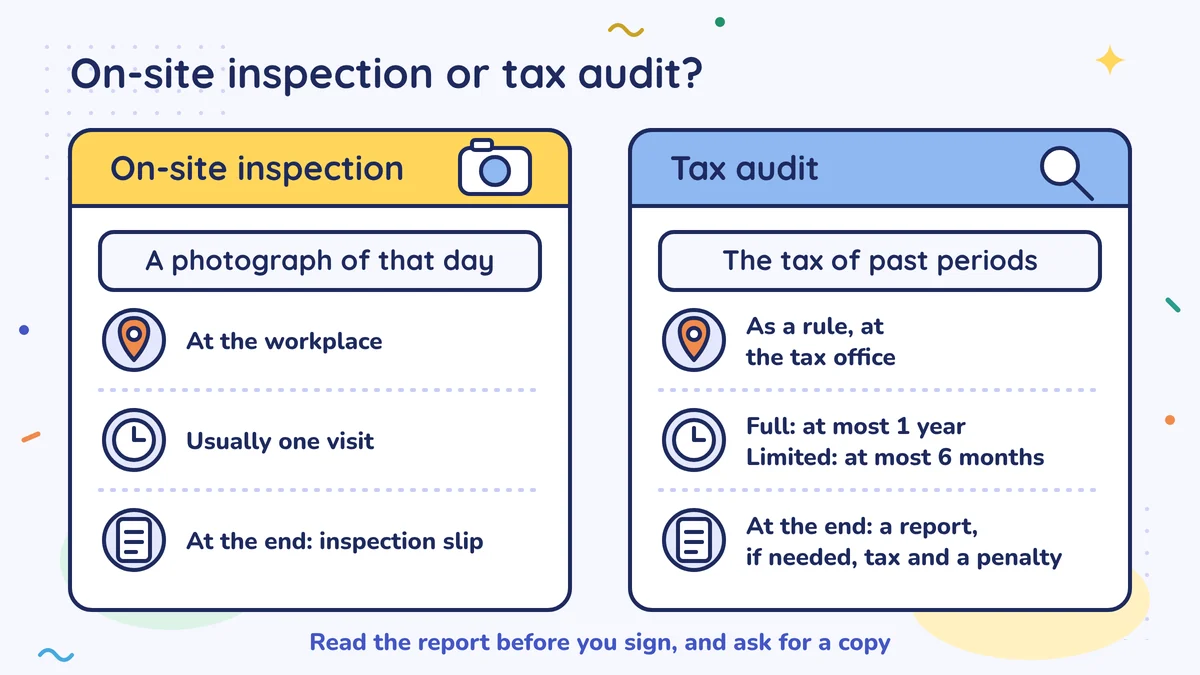
An on-site inspection (yoklama) records what is happening at the workplace that day: does the workplace really exist, are documents being issued. No tax is calculated from the books. A tax audit (vergi incelemesi), on the other hand, examines with books and documents whether the tax paid is correct. Since 1 July 2022 it is, as a rule, carried out at the tax office; a full audit takes at most 1 year and a limited audit at most 6 months, and if needed an extension of up to 6 months can be given. You have the right to have your objection written into the official report and to ask for a copy of it.
Saadet Hanım the printer's two visitors
The rules described in this lesson are those of Turkish law.
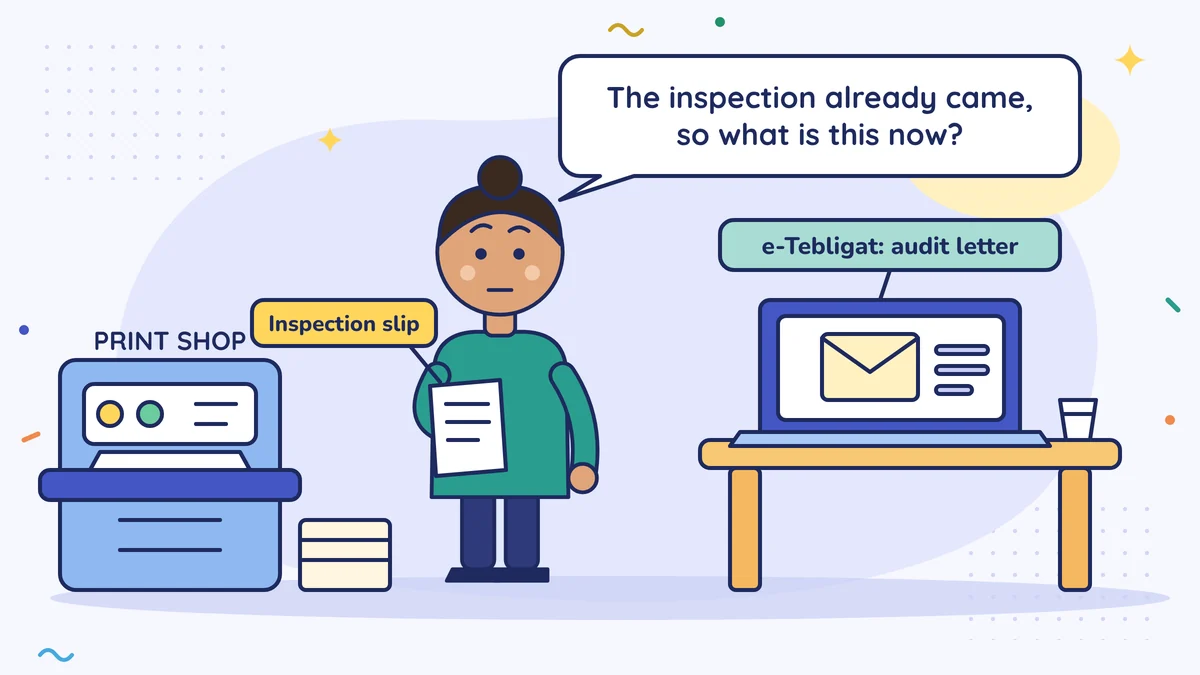
Saadet Hanım's print shop is a limited company with eight employees. On the first Monday of September an inspection officer came. He looked at the sign, the cash register and that day's invoices, filled in a slip, had Saadet Hanım sign it and left her a copy. It took half an hour.
Three weeks later a letter landed in her e-Tebligat (electronic notification) box: "A tax audit has begun concerning your 2025 VAT deductions." Saadet Hanım called her mali müşavir (accountant): "The inspection already came, so what is this now?"
They are two separate things. In this lesson we tell them apart, and we look at what happens when an audit comes and what rights you have.
The roadside stop and the vehicle test station
A traffic officer stops you on the road, looks at your licence and registration, writes down what he sees, and you drive on. This is like an on-site inspection. At a vehicle inspection, though, the car goes up on the lift and the brakes, exhaust and chassis are measured one by one. This is like an audit.
On-site inspection: a photograph of that day
The purpose of an on-site inspection (yoklama) is to examine and record, on the spot, the taxpayer and the physical facts and records related to the business (Tax Procedure Law, VUK, art. 127). The inspection officer looks at these: is the workplace at the declared address, is the business really being carried on, are documents being issued properly, are there goods without invoices.
The inspection officer cannot carry out a tax audit. He cannot do calculations from your books and work out a tax. He writes what he sees on the inspection slip (yoklama fişi). The slip is drawn up in two copies, signed by you or your authorised person, and one copy is left with you (VUK art. 131–132). Do not sign the slip without reading it; if what is written differs from what you saw, say so and ask for it to be written on the slip. The inspection officer must show you his authorisation document with a photo (VUK art. 129).
We saw the inspection that comes when you start a business in the lesson How do you register the start of business?. Later inspections work with the same logic.
Tax audit: are the accounts correct?
The purpose of an audit is to examine, establish and ensure the correctness of the taxes that should be paid (VUK art. 134). It is carried out by officials such as tax inspectors and the tax office managers authorised by law (VUK art. 135).
| On-site inspection | Tax audit | |
|---|---|---|
| What it looks at | The situation that day | The tax of past periods |
| Where | At the workplace | As a rule, at the tax office |
| How long it takes | Usually one visit | Full: at most 1 year, limited: at most 6 months |
| At the end | Inspection slip | A report, and if needed tax and a penalty |
How does it start? The person carrying out the audit notifies you in writing of the subject of the audit and that it has begun (VUK art. 140). This letter usually comes to your e-Tebligat box. If you are required to use e-Tebligat but have still not signed up, the last day is 30 November 2026; the details are in the article Mandatory e-Tebligat (in Turkish). A letter that lands in the box is deemed delivered to you at the end of the fifth day (VUK art. 107/A), so check the box every week.
Where? Since 1 July 2022 it is, as a rule, carried out at the tax office. If you wish and your workplace is suitable, it can also be done at the workplace (VUK art. 139). Books and documents are requested in writing and a period is given for handing them over; in practice this period is usually 15 days. If you have a valid excuse you can ask for extra time. Not handing over the books and documents at all is the most expensive route: that period's VAT deductions may not be accepted, and the tax may be calculated on the office's estimate. If some are missing, hand over what you have on time, and report the missing ones and the reason in a letter.
How long does it take? At most 1 year in a full audit, and at most 6 months in a limited audit (one that looks at only one subject). If needed, an extension of up to 6 months can be given (VUK art. 140).
A new step. Since 1 August 2026 the Tax Inspection Board (Vergi Denetim Kurulu, VDK) can, with a "Pre-Audit Preparation File" (İncelemeye Hazırlık Dosyası), ask for information in the form of set tables before an audit starts or as it starts. A letter sent before the audit starts does not in itself mean the audit has begun, but it is a request for information. If it is not answered on time and in full, a special irregularity penalty (özel usulsüzlük cezası), that is, the penalty for not giving the requested information, may be imposed (VUK repeated art. 355). Prepare the answer with your mali müşavir.
Your rights: the official report, time, place
The person carrying out the audit records the events and account positions they consider necessary in an official report (tutanak); the report is signed by you or your authorised person (VUK art. 141). Those who sign must be given a copy of the report (Regulation on the Procedures and Principles to Be Followed in Tax Audits, Vergi İncelemelerinde Uyulacak Usul ve Esaslar Hakkında Yönetmelik, art. 16).
- Do not sign the report without reading it. If there is a point you disagree with, you have the right to have your objection and explanation written into the report.
- Ask for a copy. Later, when a notice arrives, you can compare what was written.
- Ask for extra time. If you cannot gather the documents in the time given, ask before the time runs out, in writing, with your reasons.
- Ask about the place. You can ask for the audit to be carried out at your workplace; the decision belongs to the administration.
- Put the hand-over on record. Make a list of whatever you hand over, and get a signature confirming it was received.
The report and after
When the audit ends, a report is written. Based on the report, the tax office sends a tax and penalty notice (vergi ve ceza ihbarnamesi), that is, the official letter stating the tax and penalty to be paid. There is also a stage before the report is written at which settlement can be requested (pre-assessment settlement, tarhiyat öncesi uzlaşma); your mali müşavir follows its timing and conditions. Within 30 days after the notice reaches you, you have several routes: filing a lawsuit, if the conditions are met settlement (uzlaşma), that is, trying to agree with the tax administration on the amount, or using the penalty reduction (cezada indirim) and paying. With the penalty reduction, the tax loss penalty (vergi ziyaı cezası, the penalty imposed for tax paid short), irregularity and special irregularity penalties are halved (in 2026 the reduction is 75% for irregularity and special irregularity penalties not exceeding 40,000 TL); for this you must apply within 30 days, pay the tax and the remaining penalty on time, and not file a lawsuit (VUK art. 376). Your mali müşavir, and if needed a tax lawyer, will tell you which one suits you. Do not leave the notice waiting in a drawer; 30 days is a short time.
If you notice a mistake: correct it on your own
If you have found a mistake in your books and no audit has started for that type of tax, there is the route of correcting it with voluntary disclosure (pişmanlık): you correct the return yourself, and if you pay the tax and the voluntary disclosure surcharge (pişmanlık zammı) for the delay within 15 days, no tax loss penalty is imposed (VUK art. 371). Once an audit has started, this route closes for the type of tax being audited. If a Pre-Audit Preparation File letter has come, the VDK says voluntary disclosure cannot be used on that subject; this view is disputed, so talk to your mali müşavir. In other words, call your mali müşavir the day you find the mistake.
Saadet Hanım's folder
Saadet Hanım forwarded the letter to her mali müşavir the same day. She wrote the 15 days given for handing over in the letter into her calendar. She filed 2025's purchase invoices, payment receipts and delivery notes (irsaliye) month by month. Her mali müşavir asked separately about the invoices of two of the suppliers; the goods-received records and bank payments were ready. She handed over the documents with a list and got a signed copy of the list. Four months later the audit ended. There was one line in the report: 6,000 lira of VAT deducted twice by mistake. Saadet Hanım wrote that she had no objection, and paid using the penalty reduction.
Do this this week
Log in to your e-Tebligat box through the Internet Tax Office (İnternet Vergi Dairesi) and see whether any letter has come in the last three months. If your mali müşavir checks the box, ask them for the list for the last three months. Then set a weekly reminder on your phone saying "check e-Tebligat", and agree this rule with your mali müşavir: every letter from the tax office is forwarded to them the same day.
Common mistakes
- Signing the inspection slip or the audit report without reading it. Have a finding you disagree with written into the report as an objection, and ask for a copy.
- Not checking the e-Tebligat box. A letter is deemed delivered to you at the end of the fifth day after it lands in the box; the period for handing over documents starts running before you have seen it.
- Leaving the notice waiting. The period for applying for a lawsuit, settlement or the penalty reduction is 30 days from the day the notice reaches you; take it to your mali müşavir the same day.
Sources
- Tax Procedure Law No. 213, art. 127–141 (on-site inspection and tax audit), art. 371 (voluntary disclosure), art. 376 (penalty reduction) (Vergi Usul Kanunu) (mevzuat.gov.tr)
- EY Türkiye, circular on Law No. 7338: moving the audit to the tax office, the start letter (VUK 139–140), the change to voluntary disclosure
- Hukukçular Evi: Tax audit (VUK 134–141): duration, official report, place of audit
- Hukukçular Evi: What is an on-site inspection? (VUK 127–132)
- Erdem & Erdem: A new era in tax audits, the Pre-Audit Preparation File (İncelemeye Hazırlık Dosyası) (31.07.2026)
- Ekonomi Gazetesi, Yaşar Çatalkaya: The VDK Pre-Audit Preparation File and the right of voluntary disclosure (August 2026)
- GİB, Penalty reduction in tax penalties (03.08.2026, Alomaliye copy)
- Andersen: Amendment to the Regulation on the Procedures and Principles to Be Followed in Tax Audits (Vergi İncelemelerinde Uyulacak Usul ve Esaslar Hakkında Yönetmelik) (2022): notification of the start of an audit, audit at the office, copy of the official report
Translated from the Turkish lesson. Last checked against Turkish rules: 13 October 2026. Not yet reviewed by a licensed accountant.
This is general information about Turkish rules, not financial, tax or legal advice. Rules change; check the date and the sources, and ask a licensed accountant (mali müşavir) about your own situation. Disclaimer