Internal control: separating duties in a small team, approval, counts and bank reconciliation
If the person who holds the till, makes the payments, writes the books and counts in the evening is the same person, both mistakes and losses are noticed late. Splitting duties in a team of seven, giving approval with an amount limit, unannounced cash counts and a monthly bank reconciliation table. The aim is not to suspect anyone; it is to find mistakes early.
The core of internal control is that the person who starts a task, approves it, records it and checks it should not be the same. If there are few people, you take on the missing check yourself: you approve payments, count the cash unannounced once a month, and read the bank statement yourself. Bank reconciliation means explaining, item by item, the difference between the balance on the statement and the balance in the records.
Feride Hanım the café owner's 60,000 lira
The rules described in this lesson are those of Turkish law.
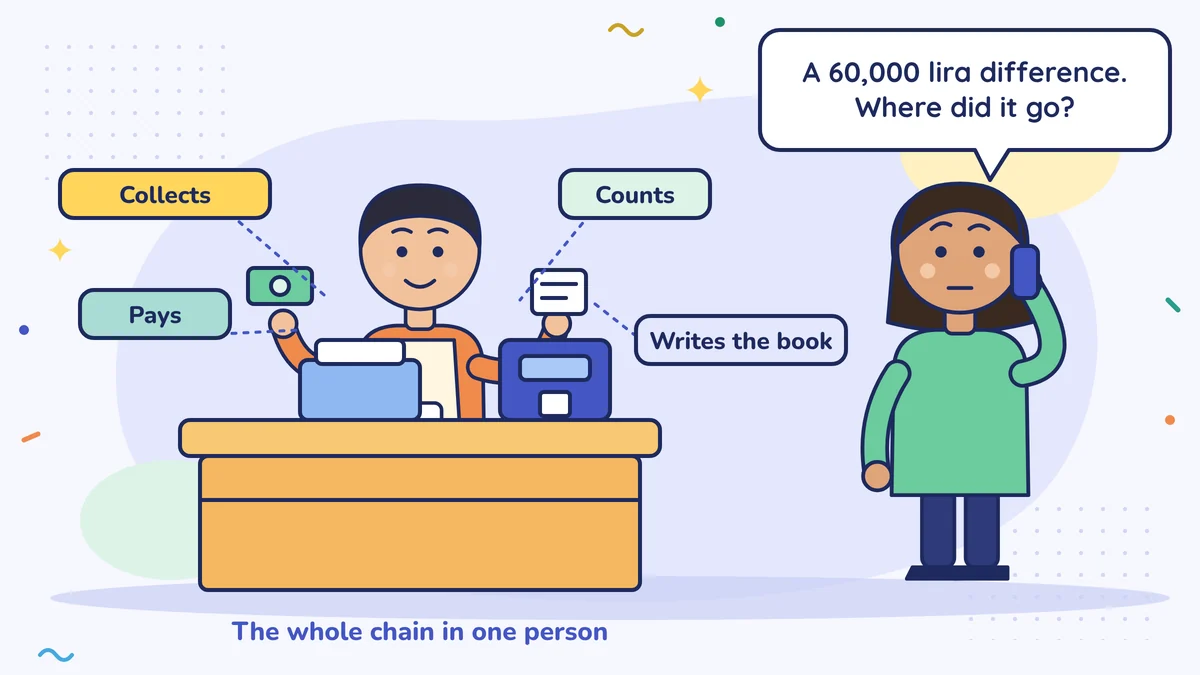
Seven people work in Feride Hanım's café. Onur the cashier is good at his job, and Feride Hanım trusts him. Onur holds the till, pays suppliers in cash, counts the till in the evening and writes the day's total in the book.
In June her mali müşavir (accountant) asked: "Over six months there is a 60,000 lira difference between the cash in the records and the money deposited in the bank. Where did it go?" At the end of a long week most of the difference was found: refunds that were never recorded, a payment written twice, vegetable purchases whose receipts were lost. 9,000 lira of it was never explained.
Nobody blamed anybody. But Feride Hanım understood one thing: when a single person held the whole chain, nobody saw either the mistakes or the losses in time.
The restaurant's three doors
In a well-run restaurant the waiter takes the order, the kitchen does not send out food without a ticket, and the cashier takes the money. Nobody holds the whole chain alone. This is not because nobody is trusted; it is because each link in the chain naturally checks the one before it.
That is what internal control (iç kontrol) is. The person who starts, does, approves, records and checks a task should not be the same person. The aim is to protect assets, prevent mistakes and irregularities, and keep records correct. The honest employee benefits too: when a difference comes up, no suspicion is left hanging over them.
Splitting duties: it works even with three people
Feride Hanım split the tasks like this:
| Task | Done by | Checked by |
|---|---|---|
| Sales and collection | Cashier | The shift supervisor, with the end-of-day report |
| End-of-day cash count | Cashier and shift supervisor together | Both sign |
| Paying suppliers | Feride Hanım approves | Bank record |
| Bank password and payment approval | Only Feride Hanım | |
| Recording | Mali müşavir | Monthly reconciliation |
| Bank reconciliation | Feride Hanım | The mali müşavir looks at it at month end |
If the team is very small, giving each task to a different person is not possible. Then you take on the missing check yourself. The rule is simple: the person who holds the money should not be the person who checks that money's records. In a two-person shop, that person is you.
Banks' corporate internet banking often has a "one person enters, the other approves" option: your employee prepares the payment order and you approve it from your phone. Ask your bank.
Approval: write down an amount limit
You don't have to approve every payment. But set a limit and put it in writing. Feride Hanım's rule became this:
- Small daily purchases up to 2,000 TL: the shift supervisor, with an invoice or receipt.
- Every payment above that: with Feride Hanım's approval, through the bank.
- Opening a new supplier or changing a supplier's bank account: only Feride Hanım.
The last item is important. Before sending money because of an e-mail saying "our account number has changed", call the supplier on the number you already know and ask. Fraud can be committed with fake notices like this.
Counts: unannounced is best
Cash. It is counted every evening and compared with the end-of-day report (the cash register's Z report) and the card sales total. On top of that, once a month, count it yourself in the middle of the day without warning. The aim of the count is not to catch anyone; it is so that the cashier, too, can sign saying "everything is in place".
Stock. You don't need to count the whole shop every month. Choose the twenty most expensive items that go missing most often, and count those once a month. In a café these are coffee beans, milk, syrup and desserts. If the count shows a difference, ask why: waste, free treats, or a recording issue? The monthly counting method is in the lesson Stock: money waiting on the shelf, and the year-end count in the lesson The December count.
Bank reconciliation: explaining the difference line by line
We saw looking at the statement at month end in the lesson The 30-minute month-end checklist. Reconciliation (mutabakat) is one step further: it is a small table that explains, one by one, the difference between the balance on the statement and the balance in the records.
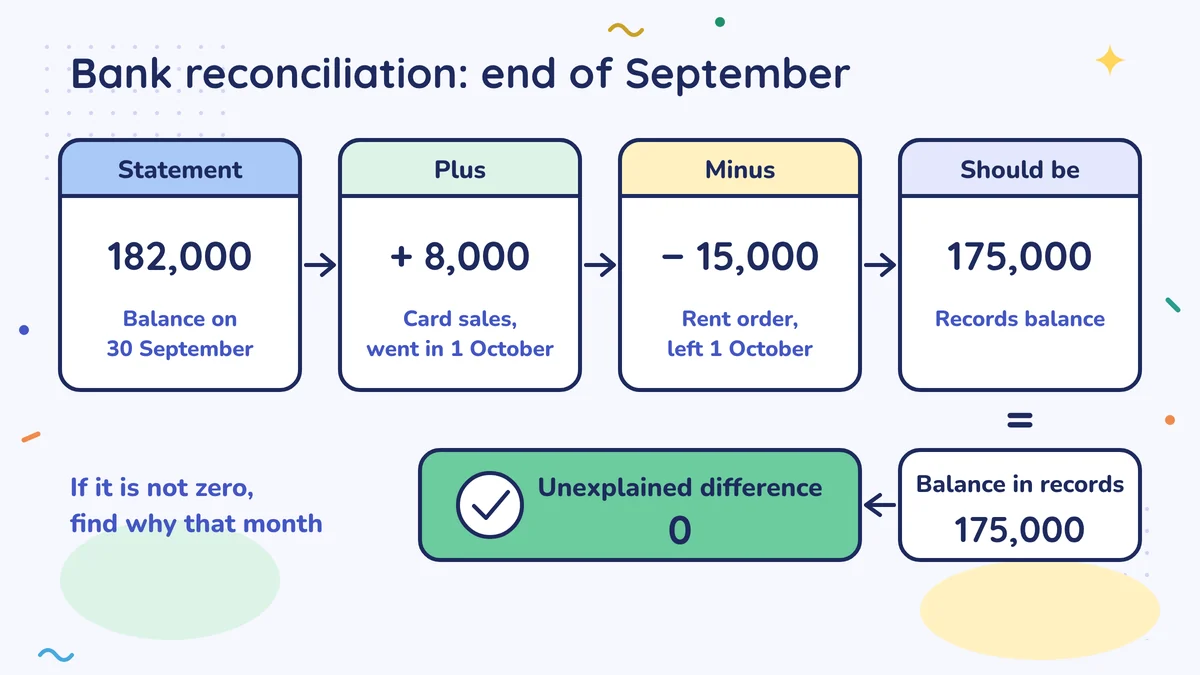
Feride Hanım's table for the end of September:
| Item | Amount |
|---|---|
| Balance on the bank statement (30 September) | 182,000 |
| Plus: card sales of 30 September, reached the bank on 1 October | 8,000 |
| Minus: rent order given on 30 September, left the bank on 1 October | 15,000 |
| Balance the records should show | 175,000 |
| Balance in the records | 175,000 |
| Unexplained difference | 0 |
If the table closes at zero, the job is done. If it doesn't, the unexplained difference is either a recording error or a transaction you don't know about; finding either in that month is easier than finding it at the end of the year.
There are two rules. Do the reconciliation on the same day every month. And do not have it done by the person who holds the money; either you do it or your mali müşavir does.
Feride Hanım's October
Onur is still at the till. The evening count is now done together with the shift supervisor, and both sign. Suppliers are paid through the bank, with the approval on Feride Hanım's phone. In the middle of October Feride Hanım did an unannounced count; the till came out 150 lira over, because a customer had left without taking his change. At the end of the month the bank reconciliation closed at zero. Onur's comment was this: "Now when a difference comes up, nobody looks at me, they look at the table."
Do this this week
On a sheet of paper, write down the money tasks in your café or shop: who collects, who counts, who pays, who records, who checks. If the same person's name appears on three or more lines, this week move one of those lines to someone else or to yourself. Put your first bank reconciliation table in your calendar for the last working day of the month.
Common mistakes
- Leaving the till's records and checking to the person who holds the till as well. A mistake or loss stays invisible for months; even an honest employee cannot be protected from suspicion.
- Sending money because of an "our account number has changed" e-mail. Do not change a supplier's bank account without first calling them on the number you already know.
- Closing a difference in the bank reconciliation by saying "it's a commission". Every difference should be explained with a line; an unexplained difference is investigated that month.
Sources
Translated from the Turkish lesson. Last checked against Turkish rules: 13 October 2026. Not yet reviewed by a licensed accountant.
This is general information about Turkish rules, not financial, tax or legal advice. Rules change; check the date and the sources, and ask a licensed accountant (mali müşavir) about your own situation. Disclaimer