Normal or declining balance? Two methods, the same total
Two tables for Halil Usta's 500,000 lira laser cutting machine: an equal share every year, or a larger share in the first years. The declining balance rate, who can choose it, why switching only works one way, its effect on tax and on a loan discussion, and how the profit or loss is found when the machine is sold.
In the normal method, the cost is divided equally over the useful life. In the declining balance method, the rate is twice the normal rate, cannot exceed 50%, and is applied each year to the remaining value; in the last year the whole remainder is recorded as an expense (VUK repeated art. 315). Only those keeping books on the balance-sheet basis can choose declining balance; the total expense is the same, what changes is how it is spread over the years.
Halil Usta's two tables
The rules described in this lesson are those of Turkish law.
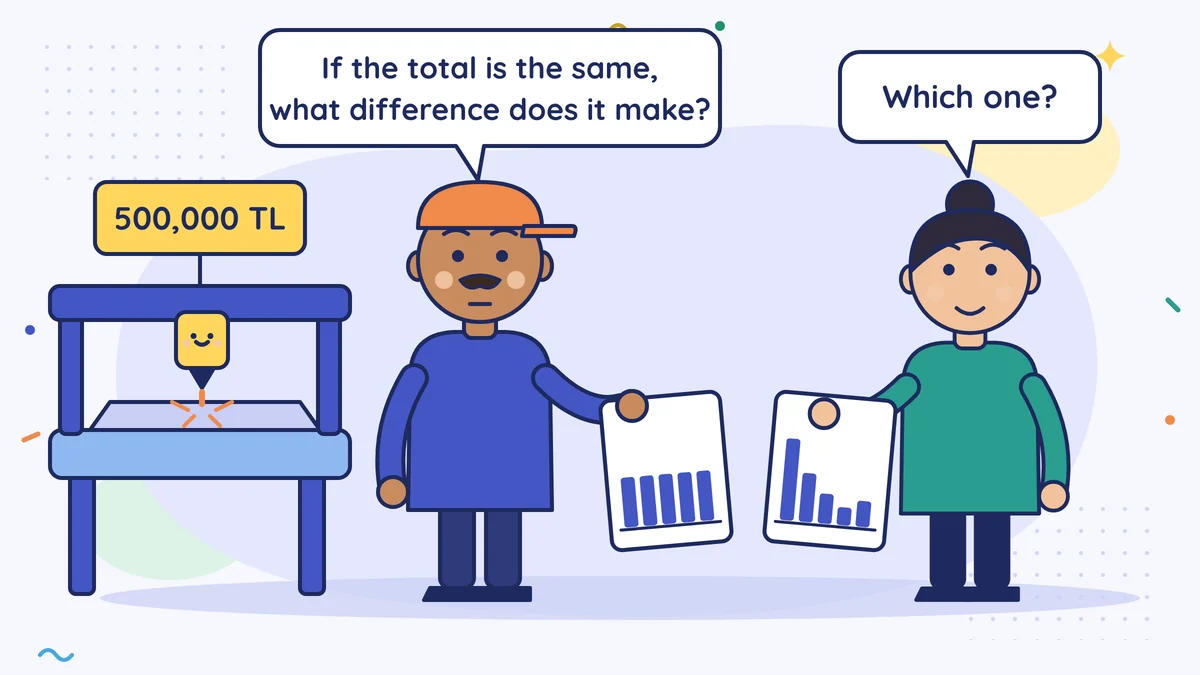
Halil Usta's metal cutting workshop is on an industrial estate. His company is a limited company, and its books are kept on the balance-sheet basis (bilanço esası). In January 2026 he bought a laser cutting machine for 500,000 lira (excluding VAT). His mali müşavir (accountant) sent two tables: "We can set aside depreciation (amortisman) in two ways. The total is the same; the spread over the years is different. Which one?"
Halil Usta looked at both, then turned to his mali müşavir: "If the total is the same, what difference does it make?"
The difference is in the timing. Ask at a car dealership and they will tell you: a new vehicle loses more value in its first years and less in the later years. The two routes of depreciation reflect this difference.
In the previous lesson we saw what depreciation is and where useful life and the rate come from (What is depreciation?). In this lesson we assume, for the example, that the list says 5 years for this machine.
The normal method: the same share every year
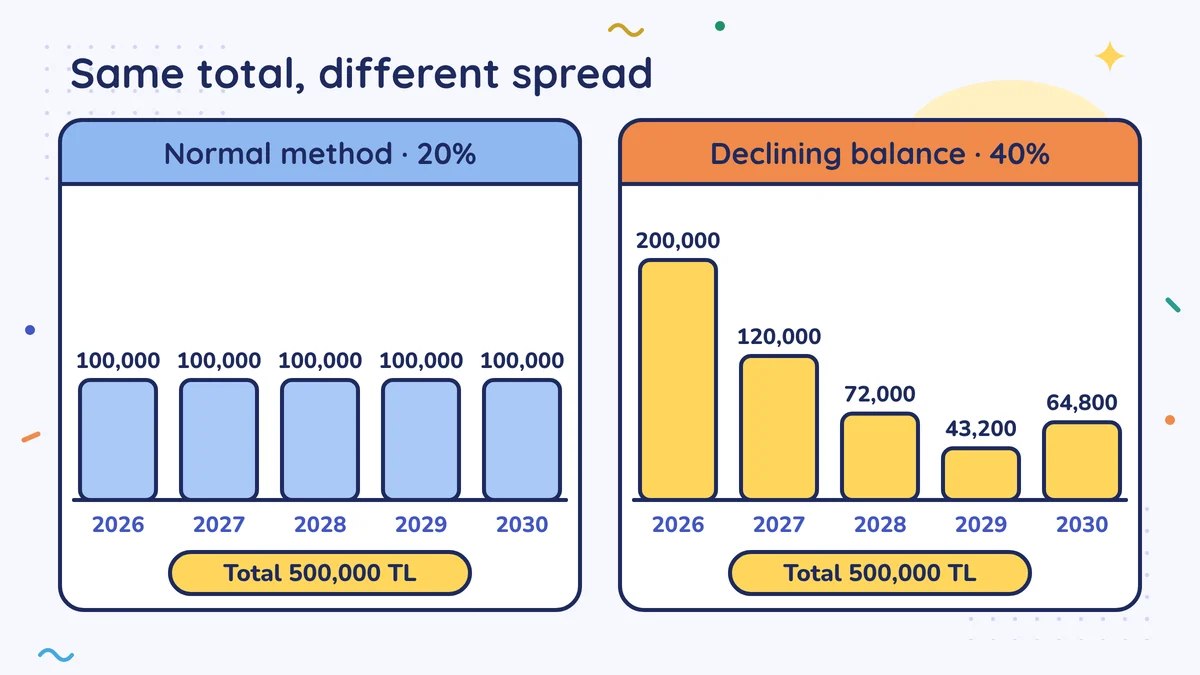
The cost is divided equally over the useful life. For 5 years the rate is 20%, that is, 100,000 lira every year.
Declining balance: a lot first, then less
The rate is twice the normal rate, but cannot exceed 50%. Each year this rate is applied not to the cost but to the value remaining after the amounts set aside so far are deducted. In the last year of the period, the whole remaining value is recorded as an expense (VUK repeated art. 315).
For a 5-year machine the rate is 20% × 2 = 40%.
| Year | Normal method | Declining balance | Year-end remaining value under declining balance |
|---|---|---|---|
| 2026 | 100,000 | 200,000 (500,000 × 40%) | 300,000 |
| 2027 | 100,000 | 120,000 (300,000 × 40%) | 180,000 |
| 2028 | 100,000 | 72,000 (180,000 × 40%) | 108,000 |
| 2029 | 100,000 | 43,200 (108,000 × 40%) | 64,800 |
| 2030 | 100,000 | 64,800 (the whole remainder) | 0 |
| Total | 500,000 | 500,000 |
The two columns have the same total: 500,000 lira. Under declining balance the expense in the first two years is larger, and the expense in the last years is smaller.
Watch the 50% limit: a fixed asset (demirbaş) with a useful life of 3 years has a normal rate of about 33%; twice that is 66%, but under declining balance 50% applies.
Who can choose declining balance?
Only those keeping books on the balance-sheet basis (VUK repeated art. 315). If you keep a business book (işletme defteri), you use the normal method.
Switching works only one way (VUK repeated art. 320):
- A fixed asset that started under declining balance can switch to the normal method in a later year. The remaining value is divided equally over the remaining years; the change is stated in the tax return.
- A fixed asset that started under the normal method cannot later switch to declining balance.
So the decision is made in the year the machine is bought.
Why would you want more expense in the first years?
When the expense is large in the first years, profit looks small, and so does tax. In later years the opposite happens. The total tax is roughly the same; what changes is when the tax is paid. Tax not paid today means money that stays in the business for a few years.
But it doesn't help in every case:
- If you are already making a loss, the large expense in the first years does not reduce tax today; the loss grows. A loss can be deducted from the profits of the following five years, but any part that cannot be used within that period is lost. Talk with your mali müşavir about which method suits you with this in mind.
- If you want a bank loan, the balance sheet shows lower profit in the first years. Be ready to explain this in the loan discussion.
- If you will sell the machine early, the profit or loss on the day of sale changes too (see below).
The route chosen goes into the calculation of the tax return; have your mali müşavir put the decision in your file as a written note.
What happens when the machine is sold?
When the machine is sold, the sale price is compared with the value remaining in the books. The value remaining in the books is found by deducting the depreciation set aside so far from the cost.
Suppose Halil Usta chose the normal method and three years' shares (300,000 lira) have been set aside. He sells the machine at the start of 2029 for 250,000 lira.
| Item | TL |
|---|---|
| Cost | 500,000 |
| Depreciation set aside so far | −300,000 |
| Value remaining in the books | 200,000 |
| Sale price (excluding VAT) | 250,000 |
| Profit on sale | 50,000 |
These 50,000 lira are added to that year's profit. If declining balance had been chosen, the value remaining in the books after three years would be 108,000 lira; on the same sale the profit would come to 142,000 lira. In an early sale, the expense brought forward into the first years comes back as profit in the year of sale.
When you sell, a sales invoice is issued; if you are a VAT taxpayer, VAT is added to the invoice.
Halil Usta's decision
Halil Usta was planning to use the machine for at least seven years, and the workshop had been making a profit for two years. With his mali müşavir he settled on declining balance. "Profit will look lower for the first two years," said the mali müşavir, "we'll explain that to the bank." Halil Usta put both tables in his file.
Do this this week
For the most expensive machine you bought this year or are thinking of buying, write out the two tables on paper: the normal method and declining balance. Next to them, note how many years you plan to use the machine and whether you expect a profit or a loss over the next two years; talk to your mali müşavir with this note.
Common mistakes
- Thinking declining balance reduces tax. The total expense is the same; tax only shifts earlier or later.
- Putting the decision off. A fixed asset that started under the normal method cannot later switch to declining balance; the decision is made in the year it is bought.
- Forgetting the book value when selling. The profit on sale is the difference between the sale price and the value remaining in the books; in an early sale, expense brought forward comes back as profit in the year of sale.
Sources
- Tax Procedure Law No. 213 (213 sayılı Vergi Usul Kanunu), art. 315 and repeated art. 315 (declining balance), repeated art. 320 (change of method) (mevzuat.gov.tr)
- Muhasebetr, Vedat Erdem: the declining balance method (twice the rate, 50% limit, last year, switching methods)
- Muhasebetr, Emine Koçakerim: switching from declining to normal is possible, from normal to declining is not
- VUK General Communiqué No. 333 (333 Sıra No'lu VUK Genel Tebliği) (Alomaliye copy)
Translated from the Turkish lesson. Last checked against Turkish rules: 13 October 2026. Not yet reviewed by a licensed accountant.
This is general information about Turkish rules, not financial, tax or legal advice. Rules change; check the date and the sources, and ask a licensed accountant (mali müşavir) about your own situation. Disclaimer