Unit cost for manufacturers: raw materials, labour and production overheads
Bayram Usta, who runs a shoe workshop, says a pair costs him 750 lira; his mali müşavir records the stock at 700 lira. The three items of production cost, why administrative and selling expenses do not go into stock, separating what was sold from what is left in the storeroom, work in progress, allocating production overheads, and wastage.
The unit cost (birim maliyet) of manufactured goods is found by dividing raw materials and supplies, direct labour and production overheads by the number of units produced (VUK art. 275). As a rule, administrative and selling expenses are expenses of the period; they do not go into the value of stock. Goods produced but not sold stay in stock at this cost and become an expense in the period in which they are sold.
Bayram Usta's shoes
The rules described in this lesson are those of Turkish law.
Bayram Usta's shoe workshop is in Merter. He makes 1,000 pairs of men's shoes a month and sells them wholesale to shops. One day his mali müşavir (accountant) asked: "At how many lira shall we record the 200 pairs waiting in the storeroom?" Bayram Usta said: "A pair costs me 750." The mali müşavir shook his head: "That figure includes my accounting fee too. We can't put that into stock."
Think of a cook. The cost of the dish cooking in the pot includes the meat, the vegetables, the gas for the stove and the cook's work. The salary of the restaurant's bookkeeper, however, is a cost of the restaurant, not of the dish. The same distinction is made in manufacturing.

The three cost items of a product
The cost of manufactured goods is made up of these items (Tax Procedure Law, Vergi Usul Kanunu, VUK, art. 275):
- Raw materials and supplies (ilk madde ve malzeme): Everything that goes into the product. For Bayram Usta: leather, soles, lining, thread, glue. If the product is sold in a box, the box too.
- Direct labour (direkt işçilik): The wages of those who make the product directly, plus the employer's SGK (social security) contribution. The cutter, the upper stitcher, the assembler.
- Production overheads (genel üretim gideri): Expenses incurred for production that cannot be tied directly to a single pair. The workshop rent, the electricity for the machines, the depreciation (amortisman) of the machines, the foreman's wages, cleaning the workshop.
Administrative and selling expenses (accounting, the office, marketing) do not go into the cost of the product; they are recorded as expenses of the period. The law allows a share of general administrative expenses that falls on manufacturing to be added to cost, but this is optional. Decide once with your mali müşavir and follow the same route every year.
One month at Bayram Usta's
October 2026, excluding VAT, rounded figures:
| Item | Monthly (TL) | Per pair (1,000 pairs) |
|---|---|---|
| Leather, soles, lining, thread, box | 400,000 | 400 |
| Wages of four craftsmen and the employer's SGK contribution | 200,000 | 200 |
| Workshop rent | 60,000 | |
| Electricity | 15,000 | |
| Depreciation of the machines | 10,000 | |
| Foreman and cleaning | 15,000 | |
| Total production overheads | 100,000 | 100 |
| Production cost | 700,000 | 700 |
| Accounting, office, selling expenses (period expense) | 50,000 | does not go into stock |
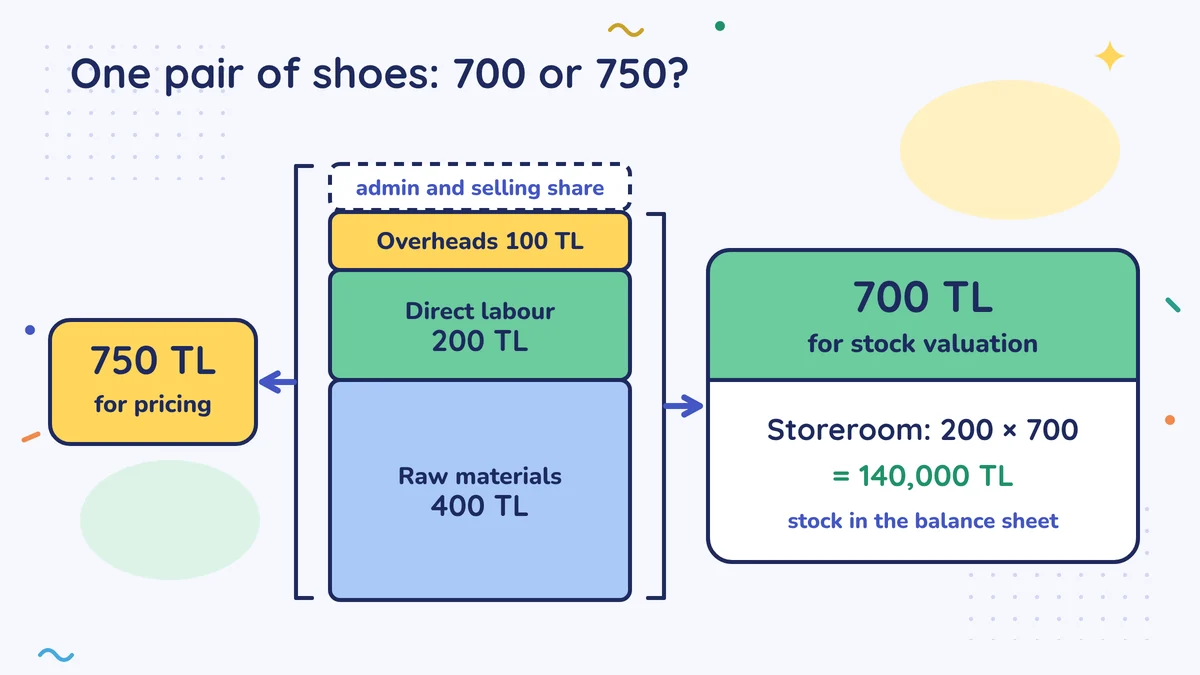
The production cost of one pair is 700 lira. The 750 lira Bayram Usta mentioned was this figure with the share of administrative and selling expenses added.
The depreciation of the machines also goes into this table. You saw how depreciation is worked out in the lesson What is depreciation?.
What was sold and what is left in the storeroom
In October 1,000 pairs were produced, 800 pairs were sold and 200 pairs were left in the storeroom.
| Calculation | TL | |
|---|---|---|
| Cost of goods sold (an expense in the income statement) | 800 × 700 | 560,000 |
| Finished goods in the storeroom (stock in the balance sheet) | 200 × 700 | 140,000 |
| Period expense | 50,000 |
The production cost of the 200 pairs in the storeroom has not yet become an expense; it will become one in the month they are sold. Getting this wrong shifts profit between months and years. If you record all production expenses as that month's expense, this month's profit looks small and the profit in the month the shoes in the storeroom are sold looks large.
Unfinished work is stock too. Leather that has been cut but not yet stitched is valued on 31 December as work in progress (yarı mamul) at the cost spent up to that point. List these separately in the year-end count.
The difference from the unit cost used in pricing
In the lesson Fixed costs, variable costs and unit cost we included all fixed costs in the unit cost. There the question was: "At what price do I have to sell to cover all my costs?" That is why the accounting fee and selling expenses went into the calculation as well.
Here the question is different: "At how many lira do I record the goods in the storeroom?" Only the cost of production goes into this. When setting a price, Bayram Usta uses 750 lira; when valuing stock, 700 lira. Both are right; they answer different questions.
Allocating: which product do production overheads go to?
If you make a single product, dividing production overheads by the number of units is enough. If Bayram Usta made both men's shoes and boots, he would have to allocate the rent and electricity between the two products using some measure. The most common measures: the hours the craftsmen spend on each product, the hours the machines run, or the amount of raw materials. Whichever measure you choose, use the same one every month.
Manufacturers keeping books on the balance-sheet basis (bilanço esası) track these items in the cost accounts of the uniform chart of accounts (tekdüzen hesap planı) that begin with 7. In the option called 7/A, 710 is raw materials and supplies, 720 is direct labour and 730 is production overheads. Businesses whose total assets (the total of the assets in the balance sheet) or net sales exceed the limit announced by the Ministry of Finance must use 7/A; those below it can also choose 7/B, which tracks expenses by type (you saw this in the lesson The uniform chart of accounts). If you keep a business book (işletme defteri), there are no 7 accounts, but finished goods and unfinished work in the storeroom are still valued at this production cost. Your mali müşavir keeps the records; what they expect from you is how many units were produced in the month, how many were sold, and a list of the unfinished work at the end of the month.
Wastage
Leftover pieces when leather is cut, broken soles and spoiled glue are the natural losses of production. Wastage (fire) within reason goes into the cost of raw materials. What counts as reasonable varies by sector and product; if an unusual loss occurs, document it with a written record and ask your mali müşavir.
Bayram Usta's new habit
On the last day of every month Bayram Usta fills in one page: how many pairs were produced, how many were sold, how many pairs and how much unfinished work are in the storeroom. With this page his mali müşavir records the stock at 700 lira and the cost of what was sold in the right month. Bayram Usta, for his part, keeps doing his price calculation at 750 lira in his own notebook.
Do this this week
Split last month's expenses into three groups: the materials that go into the product, the wages of those who make the product directly, and the workshop's other expenses. Add the three together and divide by the number of units produced. Write the figure you get next to the unit cost you use when setting prices, and talk about the difference with your mali müşavir.
Common mistakes
- Calculating stock with the wrong items. Counting only materials shows stock too low, and adding accounting and selling expenses shows it too high; the three items of production go into stock, and administrative and selling expenses are, as a rule, expenses of the period.
- Counting all production as an expense of the month it was produced. The cost of finished goods waiting in the storeroom becomes an expense in the month they are sold; otherwise profit shifts between months and years.
- Forgetting unfinished work in the count. Work that has been cut but not finished is also stock, as work in progress; it is recorded at the cost up to that point.
Sources
- Tax Procedure Law No. 213 (213 sayılı Vergi Usul Kanunu), art. 275 (cost of manufactured goods) (mevzuat.gov.tr)
- Alomaliye: Cost (maliyet bedeli) (the elements in VUK art. 275; accounts 710, 720, 730; a share of general administrative expenses is optional)
- Vergi Raporu: 7/A and 7/B cost accounts and period-end procedures
- General Communiqué on the Application of the Accounting System No. 1 (1 Sıra No'lu Muhasebe Sistemi Uygulama Genel Tebliği): the uniform chart of accounts (Alomaliye copy)
- TÜRMOB: who must apply the 7/A option (those not exceeding the limit can choose 7/A or 7/B)
- Alomaliye: Limits for keeping cost accounts under the 7/A and 7/B options (example year 2022)
Translated from the Turkish lesson. Last checked against Turkish rules: 13 October 2026. Not yet reviewed by a licensed accountant.
This is general information about Turkish rules, not financial, tax or legal advice. Rules change; check the date and the sources, and ask a licensed accountant (mali müşavir) about your own situation. Disclaimer