Stock valuation: cost, average cost, count differences and impairment
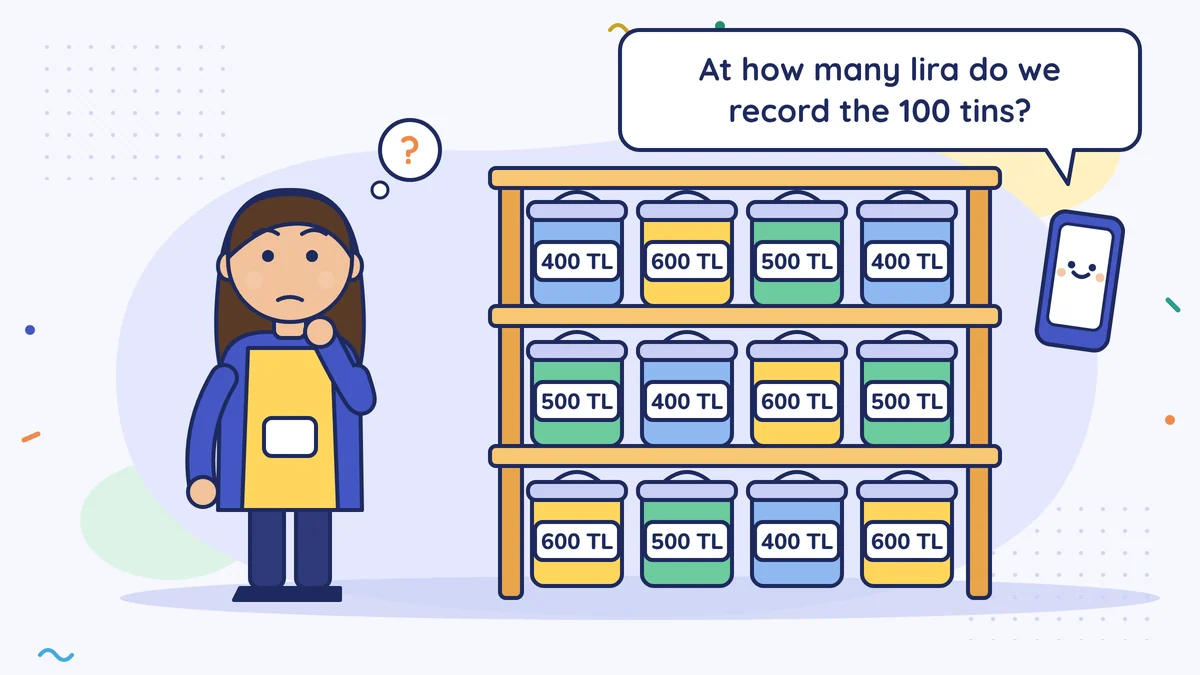
Gönül Hanım the hardware shop owner bought the same paint at three different prices during the year; at how many lira are the 100 tins on the shelf recorded? The cost rule, the difference between average cost and first in, first out, what to do when the records and the shelf don't match at the count, and on what condition the value of goods whose price has fallen or that have spoiled can be written down.
Goods bought in order to sell are valued at the end of the year at cost, that is, the purchase price plus the costs of bringing the goods in (VUK art. 274). If the same goods were bought at different prices, in practice average cost or first in, first out is used; the route chosen is kept every year. A fall in value is recorded only under the conditions in the law and with documents; the reason for a count difference is found and reported to the mali müşavir.
Gönül Hanım the hardware shop owner's paint at three prices
The rules described in this lesson are those of Turkish law.
The best-selling item in Gönül Hanım's hardware shop is interior wall paint. In 2026 she bought the same paint three times, and each time the price went up:
| Purchase | Quantity | Unit price (excl. VAT) | Amount |
|---|---|---|---|
| January | 100 tins | 400 | 40,000 |
| May | 100 tins | 500 | 50,000 |
| September | 100 tins | 600 | 60,000 |
| Total | 300 tins | 150,000 |
During the year she sold 200 tins; on 31 December 100 tins were left on the shelf. Her mali müşavir (accountant) asked: "At how many lira shall we record the 100 tins on the shelf?"
Think of the minced meat at the butcher's. What arrives in the morning and what arrives at noon get mixed on the same counter; nobody knows which kilo came from which batch. The paint tins get mixed on the shelf too. That is why a calculation route is chosen.
The rule: cost
Goods you bought in order to sell are valued at the end of the year at cost (maliyet bedeli) (Tax Procedure Law, Vergi Usul Kanunu, VUK, art. 274). Cost is found by adding to the purchase price on the invoice the costs, such as delivery, of bringing the goods to the shop (VUK art. 262). Not the sales price on the label. This rule applies on the balance-sheet basis (bilanço esası) and with a business book (işletme defteri) alike; if you are under simplified taxation (basit usul) the rules are different, so ask your mali müşavir. We explained how to do the count in the lesson The December count; here we look at how many lira the counted goods are recorded at.
When the same goods are bought at different prices, two routes are used in practice.
Average cost
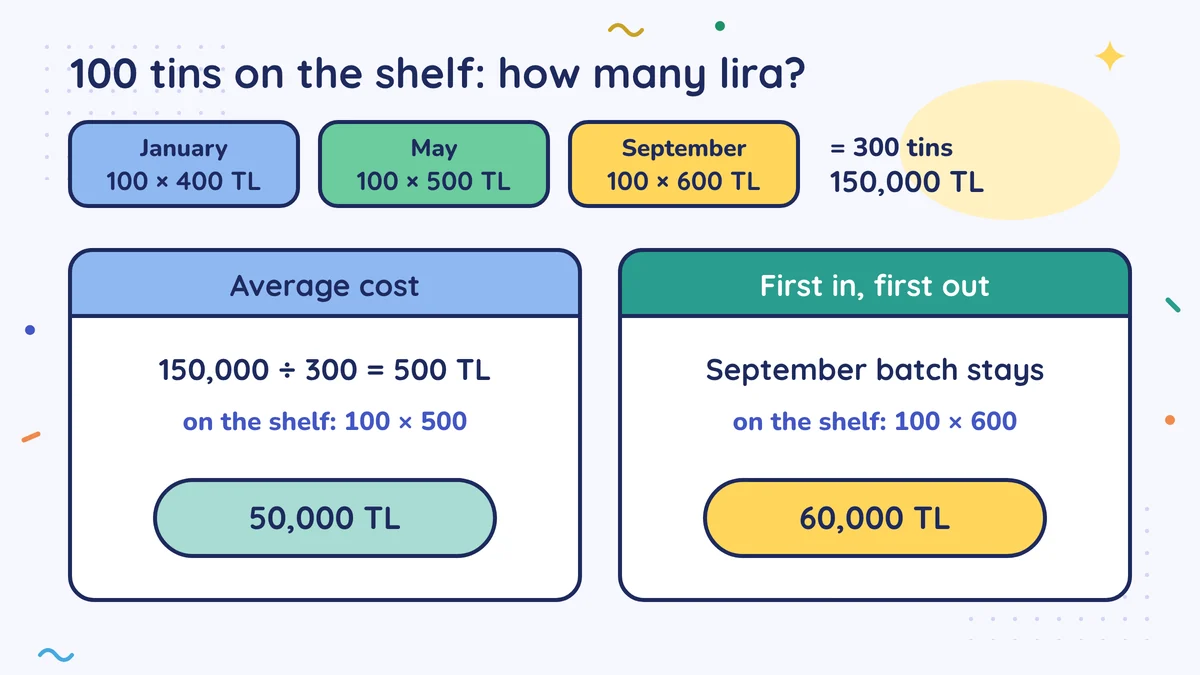
The year's total purchase amount is divided by the total quantity: 150,000 ÷ 300 = 500 lira. The 100 tins on the shelf are 50,000 lira. The cost of the 200 tins sold is 100,000 lira.
(There is also the "moving average" route, which recalculates the average after each purchase; its result comes out slightly different. If stock is tracked with a program, that is usually the one used.)
First in, first out
It is assumed that goods bought first are sold first. The January and May batches count as sold, and the 100 tins bought in September count as left on the shelf: 100 × 600 = 60,000 lira. The cost of goods sold is 90,000 lira.
| Average cost | First in, first out | |
|---|---|---|
| Left on the shelf | 50,000 | 60,000 |
| Cost of goods sold | 100,000 | 90,000 |
| Gross profit (if sales are 260,000) | 160,000 | 170,000 |
When prices are rising, first in, first out shows this year's profit a little higher. Next year the difference reverses, because the year-end stock is the following year's opening stock.
On the tax side, the "last in, first out" route is not accepted. Whichever route you choose, use the same one from year to year; changing the method shifts profit between years, and you will be asked for the reason. Make the choice with your mali müşavir.
Count difference: when the records and the shelf don't match
If you keep stock records, the records show 100 tins and there are 92 tins on the shelf. Or the other way round. If you have no stock records, you can make this comparison from the purchase and sales invoices for a few of your best-selling products. When a difference turns up, first find the reason. Most often it is one of these:
- A purchase or sales invoice was not entered in the records.
- A customer return or a return to a supplier was not processed.
- Goods that broke, spilled or spoiled were not noted.
In a tax audit, an unexplained shortage can raise the question of sales without an invoice, and an unexplained surplus the question of purchases without an invoice. So don't hide the difference; write down the reason and give it to your mali müşavir.
Small losses that are in the nature of the work, that is, wastage (fire) (spilling, breakage, evaporation), are a cost of the work if they are within reason. What is reasonable varies by sector; document it with a written record. The tax and VAT consequences for goods that are stolen, lost or destroyed, however, are different from wastage. For example, the VAT you deducted on the purchase of goods that are stolen, lost or burned in an ordinary fire is corrected (VAT Law art. 30/c). In earthquakes and floods, and in fires in places where the Ministry of Treasury and Finance has declared force majeure (mücbir sebep, an extraordinary situation beyond one's control) because of the fire, this correction is not made. Ask your mali müşavir about each case separately.
Impairment: if the goods' price has fallen
Goods can lose value while they sit on the shelf. The law has two separate cases:
- Price fall: If on the valuation day the sales price has fallen 10% or more below cost, the goods can be valued at fair value (emsal bedeli), that is, the market value on that day, instead of cost (VUK art. 274).
- Spoilage and damage: If the value of the goods has fallen significantly because of fire, earthquake or flooding, or because of spoiling, rotting, breakage and the like, fair value is again applied (VUK art. 278). In this case the value is mostly set, on application, by the assessment commission (takdir komisyonu), that is, the tax office's valuation board.
In Gönül Hanım's storeroom, 20 tins of paint turned out to be damaged by damp. She cannot say "I'll record these at half price"; a fall in value needs documents. Her mali müşavir will decide which route to follow. Gönül Hanım's job is to set the tins aside, photograph them and report them to her mali müşavir with a dated note.
Gönül Hanım's year end
Gönül Hanım settled on average cost with her mali müşavir. She added a column to her count list: "last purchase date". Goods that had not sold for a year showed up in that column on their own. You saw why money waiting on the shelf matters in the lesson Stock: money waiting on the shelf, and how many days it takes stock to turn into cash in the lesson The cash conversion cycle.
Do this this week
Put this year's purchase invoices for your three best-selling products side by side and calculate the average purchase price. If there are goods on the shelf that have spoiled, broken or not sold for a long time, put them in a separate box, photograph them and send them to your mali müşavir with a dated note.
Common mistakes
- Giving an estimated figure without counting, or recording stock at the sales price. Year-end stock is based on an actual count and on the purchase price plus the costs of bringing the goods in; an estimated figure cannot be defended in a tax audit, and stock recorded at the sales price taxes the profit on goods not yet sold.
- Writing down goods that have lost value as you see fit. A fall in value depends on the conditions in the law and on documents; the decision is made with your mali müşavir.
- Quietly closing a count difference. An unexplained shortage or surplus can raise the question of sales or purchases without an invoice. Find the reason, write it down, give it to your mali müşavir.
Sources
- Tax Procedure Law No. 213 (213 sayılı Vergi Usul Kanunu), art. 262 (cost), art. 274 (merchandise), art. 278 (goods that have lost value) (mevzuat.gov.tr)
- Value Added Tax Law No. 3065 (3065 sayılı Katma Değer Vergisi Kanunu), art. 30/c (goods destroyed or lost) (mevzuat.gov.tr)
- Alomaliye: Fair value in the valuation of merchandise (10% price fall VUK art. 274; disaster and spoilage VUK art. 278)
- Alomaliye: Valuation of goods that have lost value under tax law (assessment commission)
- Muhasebetr, Cihan Tekin: stock valuation methods and the VUK (average cost, first in, first out; last in, first out is not applied)
- Alomaliye: The VAT position of goods that are destroyed, lost, stolen, subject to wastage or have lost value
- MuhasebeTR, Vedat Erdem (2026): the current text of VAT Law art. 30/c (destroyed goods, except earthquake, flood and fire in places declared force majeure)
Translated from the Turkish lesson. Last checked against Turkish rules: 13 October 2026. Not yet reviewed by a licensed accountant.
This is general information about Turkish rules, not financial, tax or legal advice. Rules change; check the date and the sources, and ask a licensed accountant (mali müşavir) about your own situation. Disclaimer