The annual return: income tax in March, corporate tax in April
If provisional tax is the deposit, the annual return is the final bill. A sole proprietorship declares its 2026 profit on 1–31 March 2027 and pays the tax in two instalments, in March and July; a company files in April and pays in one go. With a worked example using the 2026 tariff, and the situation under simplified taxation.
A sole proprietorship under real taxation files its annual income tax return for 2026 profit on 1–31 March 2027; the tax is paid in two equal instalments at the end of March and the end of July, and the provisional tax paid during the year is deducted. Limited and joint-stock companies file the corporate tax return on 1–30 April 2027 and pay the tax in one go in the same month; for 2026 the general rate is 25%. Under simplified taxation, the profit from this business is exempt, so no annual return is filed.
Ayşe Hanım the café owner's March phone call
The rules described in this lesson are those of Turkish law.
Ayşe Hanım has been running a café for three years. Every March her mali müşavir (accountant) calls: "I've prepared your annual return; the first instalment is due at the end of March." Every March Ayşe Hanım asks the same thing: "Didn't I pay provisional tax during the year? What tax is this?"
Think of a suit ordered from a tailor. At the fittings you pay a deposit; on the day of delivery the final bill is made up and the deposit is deducted. Provisional tax is the deposit. The annual return is the final bill.

What is the annual return for?
During the year, every three months, you paid provisional tax (geçici vergi) on the profit up to that date. When the year ends, the whole year's profit is brought together in a single return, the tax is calculated according to the tariff, and the provisional tax paid during the year is deducted from this amount. If anything is left, it is paid. What happens if the provisional tax turns out to be too high is explained in the lesson Provisional tax at year end.
Profit is not final until the year-end work is done. That is why the count and the cash and bank reconciliation (The December count) and the receivables and fixed asset (demirbaş) list (The year-end file for your mali müşavir) come before the return.
Who files which return, and when?
| Who | Return | Filing period for 2026 profit | Payment |
|---|---|---|---|
| Sole proprietorship under real taxation (business book or balance sheet) | Annual income tax | 1–31 March 2027 | Two equal instalments: end of March and end of July |
| Self-employed professional (such as a lawyer, architect or accountant) | Annual income tax | 1–31 March 2027 | The same |
| Limited and joint-stock company | Corporate tax | 1–30 April 2027 | In one go, by 30 April 2027 |
| Sole proprietorship under simplified taxation | No return for this profit | None | None |
The last day for the second instalment, 31 July 2027, falls on a Saturday; because in tax a last day that falls on a weekend moves to the first working day (VUK art. 18), by rule it becomes Monday 2 August 2027. This date becomes final when GİB's 2027 tax calendar is published; check it there once more at that time.
A note: if you moved from simplified taxation to real taxation on 1 January 2026 (this happened for some businesses in districts with a population over 30,000 in metropolitan cities; Presidential Decision No. 10679, Simplified taxation or real taxation?), your first annual return will be filed in March 2027.
Income tax: Ayşe Hanım's calculation
A sole proprietorship's profit is taxed on a progressive tariff: as profit grows, the part falling into higher brackets is taxed at a higher rate. The tariff for non-wage income for 2026 profit (Income Tax General Communiqué Serial No. 332, 332 Seri No'lu Gelir Vergisi Genel Tebliği):
| Profit bracket | Rate |
|---|---|
| Up to 190,000 lira | 15% |
| From 190,000 to 400,000 lira | 20% |
| From 400,000 to 1,000,000 lira | 27% |
| From 1,000,000 to 5,300,000 lira | 35% |
| Over 5,300,000 lira | 40% |
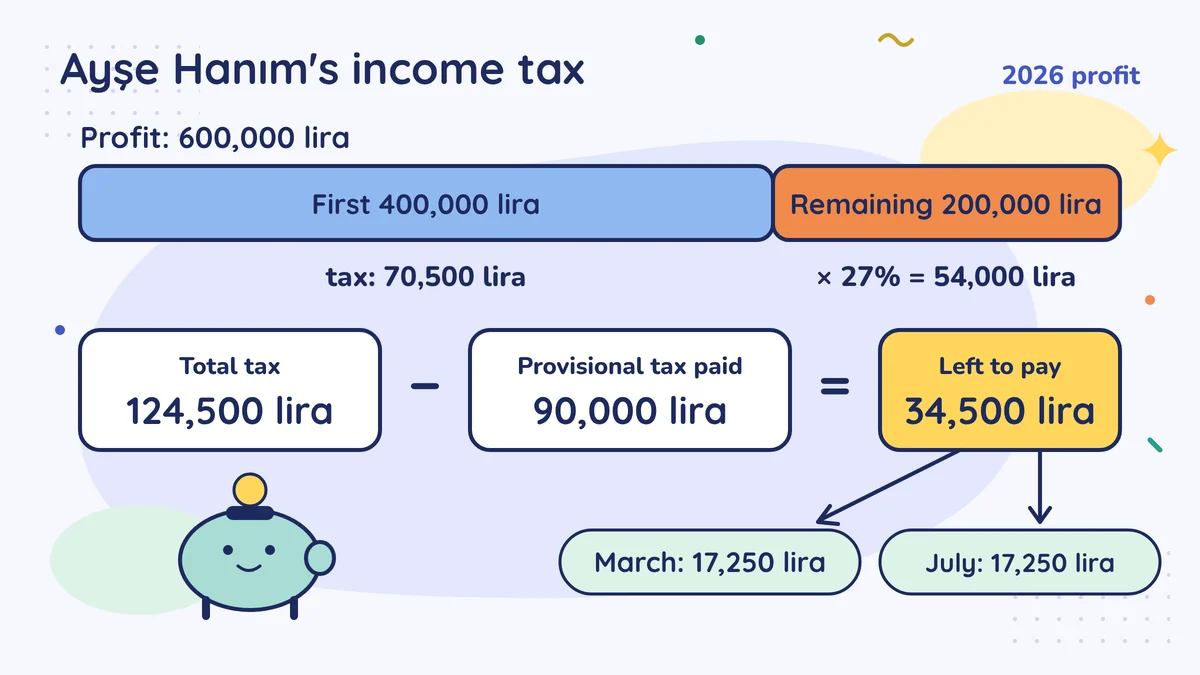
Ayşe Hanım's 2026 profit, after expenses and the Bağ-Kur contributions she paid were deducted, came to 600,000 lira.
- The tax on the first 400,000 lira is ready-made in the tariff: 70,500 lira.
- The remaining 200,000 lira × 27% = 54,000 lira.
- Total income tax: 124,500 lira.
- Provisional tax paid for 2026 (including the last period, paid in February 2027, 600,000 × 15%): 90,000 lira.
- Left to pay: 34,500 lira. 17,250 lira at the end of March, 17,250 lira in July.
If you have a flat you rent out or any other income, tell your mali müşavir. Someone who declares commercial profit on a return cannot benefit from the residential rent exemption (Income Tax Law, Gelir Vergisi Kanunu, art. 21); flat rent, whatever the amount, goes onto the same return. Your other income has its own rules; let your mali müşavir assess all of it.
Corporate tax: Cemil Usta's limited company
Cemil Usta runs his car repair business as a limited company. The company's profit is taxed not on a tariff but at a single rate: for 2026 the general rate is 25% (Corporate Tax Law, Kurumlar Vergisi Kanunu, art. 32). The company's 2026 profit came to 1,000,000 lira: the tax is 250,000 lira.
During the year, 220,000 lira of provisional tax had been calculated and paid over four periods. After the year-end count and the final adjusting entries, the profit rose a little; the 30,000 lira difference will be paid in one go in April 2027 together with the return. This is the difference from income tax: there are no instalments.
Two extra points:
- Minimum corporate tax. The tax calculated after deductions and exemptions cannot be less than 10% of the profit before those deductions (KVK art. 32/C). For a company with no exemptions, like Cemil Usta's, this usually changes nothing; your mali müşavir does the calculation.
- The company's profit is not your pocket money. The profit left after tax stays in the company. If it is distributed to the partners, a separate calculation arises (Paying yourself a salary).
If you are under simplified taxation
Kemal Usta the shoe repairer is under simplified taxation. The profit he earns from this business is exempt from income tax (Income Tax Law repeated art. 20/A); he files no annual return for this profit, and pays no provisional tax either. Still, he has two jobs at the end of the year: having his October–December purchases and sales entered into the Defter-Beyan System by the end of January, and keeping his documents. Kemal Usta also has a flat that is rented out; if the residential rent exceeds that year's exemption amount, a separate return may be needed for it. He asks his mali müşavir about this every February.
When the draft comes, ask
Ask your mali müşavir for the draft of the return before it is filed, and ask three questions:
- "Why is my annual profit different from the figure in the provisional tax returns?"
- "Do I have any spending this year (such as donations, education or health) that I can deduct on the return?"
- "How much will I pay, and on which days?"
This year Ayşe Hanım asked the third question in January. The answer was 34,500 lira; until March she put money aside every month (Setting money aside for tax). This time the March phone call was no surprise.
Do this this week
Write a single message to your mali müşavir: "Roughly how much tax will the annual return for 2026 come to, and after provisional tax is deducted, what will I pay in March and July (or in April, if I am a company)?" Write the figure you get in your calendar together with the payment days.
Common mistakes
- Thinking the annual tax is done once provisional tax is paid. Provisional tax is an advance payment; when profit becomes final with the year-end entries, the difference shows up on the annual return.
- Mixing up the payment rules for a sole proprietorship and a company. Income tax is paid in two instalments, in March and July; corporate tax has no instalments and is paid in one go in April.
- Hiding your other income from your mali müşavir. For someone who declares commercial profit there is no residential rent exemption; flat rent, whatever the amount, goes onto the same return. If your mali müşavir doesn't know, the return is filed incomplete.
Sources
- Alomaliye: Return filing and payment periods (based on GİB)
- Alomaliye: Annual income tax filing period, 1–31 March and two instalments
- Alomaliye: Income Tax General Communiqué Serial No. 332 (332 Seri No'lu Gelir Vergisi Genel Tebliği) (2026 tariff)
- Alomaliye: General corporate tax rate of 25% in 2026
- TÜRMOB: Domestic minimum corporate tax (Kurumlar Vergisi Kanunu, art. 32/C)
- Alomaliye: Profit exemption under simplified taxation (Gelir Vergisi Kanunu, repeated art. 20/A)
- Income Tax Law No. 193 (Gelir Vergisi Kanunu), art. 21, 92 and 117 (mevzuat.gov.tr)
- PwC: Declaring rental income (those who cannot benefit from the residential exemption)
- KPMG: Presidential Decision No. 10679 reorganising the scope of simplified taxation (Official Gazette 11.12.2025, in force 1.1.2026)
Translated from the Turkish lesson. Last checked against Turkish rules: 12 October 2026. Not yet reviewed by a licensed accountant.
This is general information about Turkish rules, not financial, tax or legal advice. Rules change; check the date and the sources, and ask a licensed accountant (mali müşavir) about your own situation. Disclaimer