Simplified taxation or real taxation?
You have opened a sole proprietorship (şahıs işletmesi); you pay tax in one of two ways: simplified taxation (basit usul) or real taxation (gerçek usul). In 2026, some businesses in the large districts of metropolitan cities were moved out of simplified taxation. In this lesson you see the difference and how to work out your own situation.
Simplified taxation is a simple path for small sole traders: since 2021 its earnings have been exempt from income tax; there are no legal books, no VAT return and no annual income tax return. But since 1 January 2026, in metropolitan provinces, businesses such as trading, manufacturing, construction, restaurants and car repair in districts with a population of more than 30,000 have moved to real taxation. If your business and your district are in this group, real taxation is compulsory (apart from one small exception).
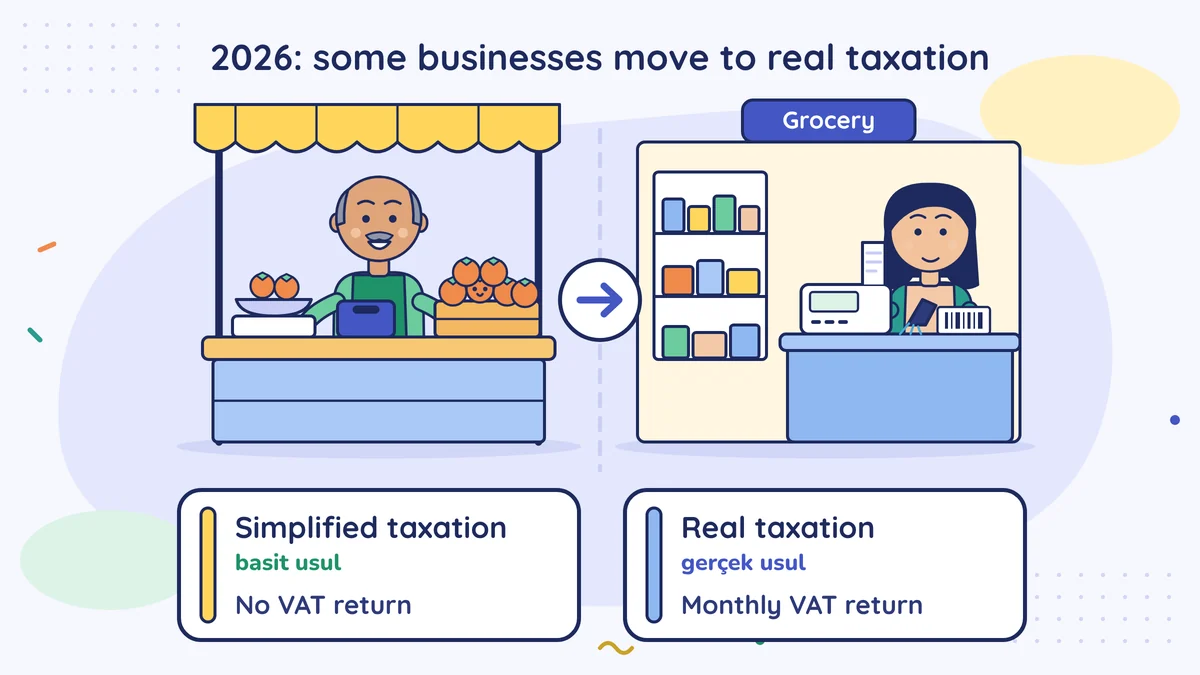
A market stall and a grocery shop
Hasan Abi, who sells tomatoes at the market, has a pair of scales and a money box. In the evening he roughly knows what he sold and what he bought. The neighbourhood grocery shop, on the other hand, has a barcode reader, till receipts, shelf records and a monthly stock count. They sell the same product; the order the state asks of them is different.
Simplified taxation (basit usul) is the order of the stall. Real taxation (gerçek usul) is the order of the shop. You can find the details in the article What is simplified taxation, do I qualify? (in Turkish). Here we go briefly, step by step.
The difference between them
| Topic | Simplified taxation | Real taxation |
|---|---|---|
| Who | Only sole proprietorships | Sole proprietorships and companies |
| Legal books | Not compulsory | A sole proprietorship mostly keeps a business book (işletme defteri); a company always keeps balance sheet books (bilanço defteri) |
| VAT | No calculation or payment | Monthly VAT return |
| Income tax | Simplified taxation earnings are exempt from tax, no annual return | Tax on earnings; advance tax during the year (provisional tax, geçici vergi), annual return at the end of the year |
| Purchase and sales records | Entered into the Defter-Beyan System (Defter-Beyan Sistemi) in three-month periods, by the end of the following month; documents are kept | Entered in your books; documents are kept |
Simplified taxation does not mean "I don't do anything". When you sell, you give a receipt or an invoice, you keep your documents, you make SGK notifications if you have employees, and you enter your records into the Defter-Beyan System. But there is no VAT (KDV) (in Turkish) calculation and no VAT return. And a calendar note: under the current rule, from 1 January 2027 those under simplified taxation and those who keep a business book will issue invoices online as e-Archive invoices (e-Arşiv fatura), not on paper. Talk to your mali müşavir (accountant) about getting ready now.
Who qualifies for simplified taxation?
The conditions are written in articles 46–48 of the Income Tax Law (Gelir Vergisi Kanunu). Examples: working in the business yourself, keeping your yearly purchases, sales or revenue (the total money coming into the business) below a certain limit, and your rent not exceeding a certain amount. The amount limits are updated every year, so we don't write figures here. Find out the current limit from your mali müşavir or from GİB (Revenue Administration). Limited and joint-stock companies cannot use simplified taxation. Some businesses also cannot use simplified taxation whatever the limit; ask your mali müşavir whether your business is on this list.
What changed in 2026?
The change came with two Presidential Decisions: Decision No. 10380, published in the Official Gazette (Resmî Gazete) on 9 September 2025, and Decision No. 10679, which amended it and was published on 11 December 2025. The result: from 1 January 2026, in provinces with a metropolitan municipality, in districts with a population of more than 30,000, those doing the following kinds of business moved to real taxation:
- All kinds of manufacturing and buying and selling of goods (except those who sell retail by going around without a shop or moving from market to market)
- Construction work
- Motor vehicle maintenance and repair
- Restaurants and similar businesses
- Places of entertainment and leisure
- Urban passenger transport
The move is automatic; the tax office looks at TÜİK (Turkish Statistical Institute) population data for the last day of the previous year. One exception: tradesmen in former towns and villages that have become neighbourhoods (mahalle) and have a population of no more than 2,000 can stay under simplified taxation, except for urban passenger transport. For businesses that are not clearly on the list or are borderline, trust your mali müşavir, not comments on the internet.
What changes when you move to real taxation? An example
Mehmet Usta repairs cars in a metropolitan city, in a district with a population above 30,000. He used to be under simplified taxation. After 2026:
- He does a 1,000 lira job for a customer and adds 20% VAT, that is 200 lira, to the invoice. The invoice total is 1,200 lira.
- He bought a spare part for 600 lira + 120 lira VAT.
- On the next month's return he pays 200 minus 120, that is 80 lira of VAT. Deducting the VAT you paid on purchases from the VAT you collected on sales is called VAT deduction (KDV indirimi) (VAT Law art. 29).
We explained the logic of VAT with the example of money held in trust in the article What is VAT? (in Turkish). In current practice the VAT return is due on the 28th of the month; if that falls on a weekend, it moves to the first working day (tax calendar (in Turkish)).
Check your own situation in 5 questions
- Am I a sole proprietorship? If I am a company, the answer is no.
- Do I work in the business myself? (An apprentice or helper working with me does not change this.)
- Am I in a metropolitan province, in a district with a population of more than 30,000?
- Is my business in one of the six groups above?
- Are my yearly figures below the current limits?
If you said "I am a company" to question 1, or "no" to question 2 or 5, you cannot use simplified taxation. If you said "yes" to both questions 3 and 4 (and the 2,000-population exception does not apply to you), you are again under real taxation. If you are not sure, ask your tax office or your mali müşavir for a written answer.
Is leaving simplified taxation bad?
At first glance it sounds like bad news, because the workload increases. But real taxation has good sides too. You can deduct the VAT you paid on purchases: the VAT on the goods and services you buy is subtracted from the VAT you collect from customers when you sell. If you keep your expenses on record, your profit calculation becomes clearer. When you work with large firms, invoices and regular records build trust. When a bank or a landlord asks "does your business have records?", you can show documents.
The first three months after the move
- Agree with a mali müşavir. For most tradesmen, the easiest way is for them to handle your books, VAT calculation and returns. You saw who does what in the lesson the mali müşavir's job.
- Review your price list. Is the job you call "1,000 lira" including or excluding VAT? If it excludes VAT, it becomes 1,200 lira on the invoice; don't let the customer be surprised.
- Collect your purchase documents. Goods bought without an invoice do not give a VAT deduction.
- Write the 28th of the month in your calendar. It is the due day of the VAT return in current practice.
- Check your shop rent. If your landlord is a person (not a company), under real taxation you have to hold back part of the rent when you pay it and pay that part to the state on the landlord's behalf; this is called withholding tax (stopaj) and it is reported with a return. Under simplified taxation you did not have this duty; it is often missed during the move. Ask your mali müşavir how to do it.
Do this this week
Check your own business with the 5 questions above and write the answers on paper. Then ask your mali müşavir or your tax office: "Am I counted as simplified taxation or real taxation?" Keep the answer in writing or as a message.
Common mistakes
- Saying "I was under simplified taxation last year, so I still am this year". In 2026, some businesses in the large districts of metropolitan cities moved to real taxation automatically.
- Thinking simplified taxation means "I keep no records at all". You need to keep your documents and enter your records into the Defter-Beyan System.
- Forgetting the VAT calculation during the move. Tell your customer clearly whether your price includes or excludes VAT.
Sources
- KPMG: Presidential Decision No. 10679, scope of simplified taxation (Official Gazette 11.12.2025)
- Presidential Decision No. 10380, Official Gazette 09.09.2025 (Alomaliye)
- Presidential Decision No. 10679, TÜRMOB circular
- Income Tax Circular/100: population criterion in simplified taxation (Alomaliye)
- GİB, Defter Beyan System
- Income Tax General Communiqué Serial No. 320: simplified taxation earnings exemption, GVK art. 20/A (GİB Defter Beyan information text)
- VUK General Communiqué No. 486 (as amended by No. 532), art. 7: recording period under simplified taxation (TÜRMOB circular)
- VUK General Communiqué No. 589: move to e-Archive for simplified taxation and business book users on 1 January 2027 (Alomaliye)
Translated from the Turkish lesson. Last checked against Turkish rules: 7 October 2026. Not yet reviewed by a licensed accountant.
This is general information about Turkish rules, not financial, tax or legal advice. Rules change; check the date and the sources, and ask a licensed accountant (mali müşavir) about your own situation. Disclaimer