Provisional tax at year end: deduction, refund of the excess and setting money aside every month
Provisional tax is an advance on the annual tax; at the end of the year the account closes. If the annual tax is higher, the difference is paid in March and July; if it is lower, the excess is first counted against other tax debts, and the rest is refunded on written request. Why there is usually a difference, and how much to set aside every month.
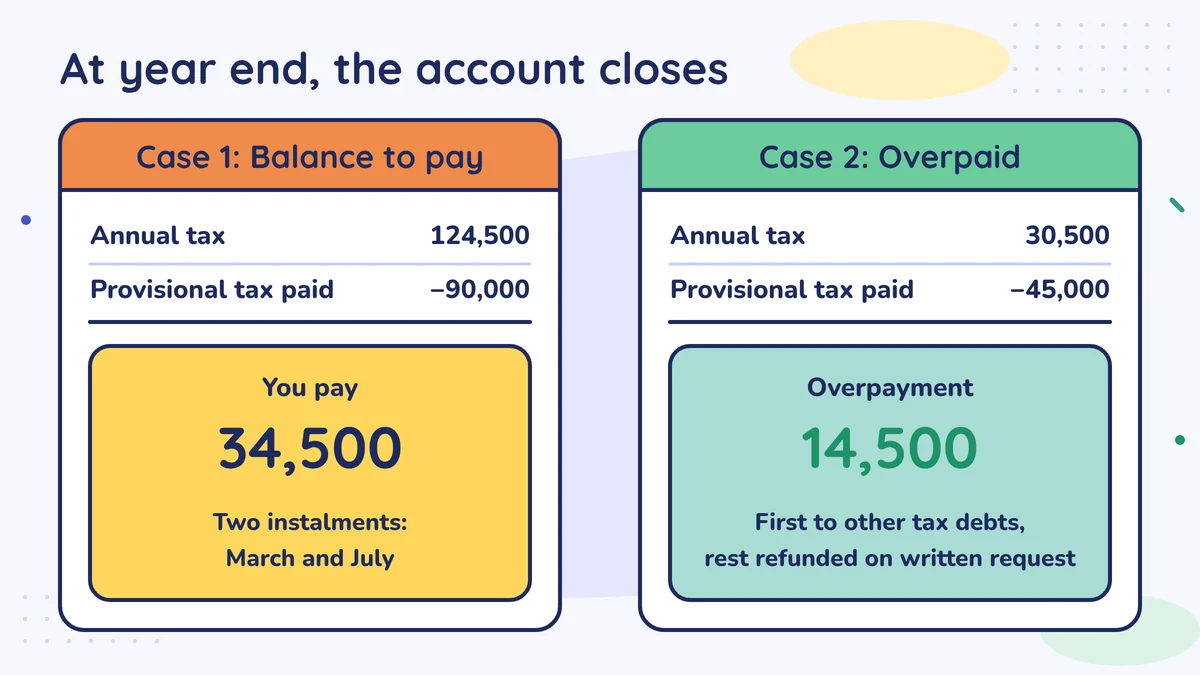
The provisional tax (geçici vergi) you paid during the year is deducted from the income tax or corporate tax calculated in the annual return. If something is left, you pay it; for a sole proprietorship, in two instalments, in March and July. If you overpaid, the excess is first counted against other tax debts, and the rest is refunded if you request it in writing by the end of the year in which the return is filed. Because provisional tax is a flat 15% and annual tax is progressive, you may need to set aside more than 15%.
Emre Bey the haulier's travel advance
The rules described in this lesson are those of Turkish law.
Emre Bey has two lorries. Before his driver sets off on the İzmir run, he gives him a 5,000 lira travel advance: fuel, motorway tolls, food. When the driver gets back, they settle up with the receipts. If 4,200 lira was spent, 800 lira comes back; if 5,600 was spent, Emre Bey makes up the 600 lira. The advance is not the final account; the account closes on the return.
Provisional tax is likewise an advance on the annual tax. It is paid four times over the year, and the account becomes final in the annual return once the year closes.

What happens at the end of the year?
For a sole proprietorship, the profit for 2026 is declared with the annual income tax return filed in March 2027; for a company, the corporate tax return is filed in April. Tax is calculated on the whole year's profit, and then the provisional tax paid during 2026 is deducted from this amount (GVK repeated art. 120). Only provisional tax that was actually paid is deducted.
The result goes one of two ways: either there is an amount left to pay, or an amount has been overpaid.
Case 1: A balance is left to pay
Say Emre Bey's 2026 profit is 600,000 lira. Income tax under the 2026 tariff (non-salary income) is calculated like this:
| Bracket of profit | Rate | Tax |
|---|---|---|
| First 190,000 | 15% | 28,500 |
| Between 190,000 and 400,000 (210,000) | 20% | 42,000 |
| Between 400,000 and 600,000 (200,000) | 27% | 54,000 |
| Annual income tax | 124,500 |
Provisional tax he paid during the year: 600,000 × 15% = 90,000 lira. What is left: 124,500 − 90,000 = 34,500 lira. This amount is paid in two instalments: the first on 31 March 2027, the second at the end of July. Because 31 July 2027 falls on a Saturday, by the rule the deadline for the second instalment becomes Monday 2 August 2027; the dates become final once GİB publishes its 2027 calendar. In the example, no other deductions or exemptions were assumed; if you have any, your mali müşavir (accountant) will take them into account.
Why was there a balance left? Provisional tax is a flat 15% whatever the profit. Annual income tax, however, is progressive: the part of profit above 190,000 lira is taxed at 20%, the part above 400,000 at 27%. As profit goes beyond the first bracket, provisional tax falls behind the annual tax. This is not a mistake; it is the natural result of the system.
In a company this difference is usually small, because the provisional tax rate and the corporate tax rate are the same (the general rate for 2026 is 25%).
Case 2: Overpaid
Now think of the opposite. Suppose Emre Bey's 2026 had gone differently: in the first nine months total profit since the start of the year reached 300,000 and 45,000 lira of provisional tax was paid; then a loss came in the last quarter, and annual profit fell to 200,000.
Annual tax: 28,500 + (10,000 × 20%) = 30,500 lira. Provisional tax paid: 45,000. Excess: 14,500 lira.
This excess is used like this (GVK repeated art. 120):
- First it is deducted from the annual tax; the annual tax is closed in full.
- What is left over is counted against other tax debts, for example a VAT or muhtasar (withholding tax) debt. This is called offsetting (mahsup). Your mali müşavir prepares the request for it.
- If there is still something left after these, it is refunded to you if you request it in writing.
The request has a deadline: the end of the year in which the annual return is filed. Because the return for the 2026 profit will be filed in March 2027, the last day is 31 December 2027. If this deadline passes, the right to a refund is lost. The easiest way is to ask your mali müşavir in March, when filing the return, to prepare the refund or offsetting request at the same time.
In March, ask for a copy of the annual return and look at two of its lines: the annual tax calculated and the provisional tax deducted. The amount deducted should match the payment receipts for the four provisional tax payments you made during the year. If you paid a period late or a payment was short, you will see a difference on this line; then work out together with your mali müşavir which period was short.
How much should you set aside every month?
We set up the logic of the tax jar (vergi kumbarası) in the lesson Setting money aside for tax. Here provisional tax adds just one fine adjustment to it: set the jar rate according to the annual tax, not according to provisional tax.
Emre Bey used to set aside 15% of his profit every month. With about 50,000 lira of profit a month, that came to 7,500 lira. On provisional tax days the jar was enough, but when March came there was no money in the jar for the 34,500 lira.
Now he does it like this:
| Step | Emre Bey's figure |
|---|---|
| Annual profit estimate from the mali müşavir | 600,000 lira |
| Estimated annual tax | 124,500 lira (about 21% of profit) |
| Into the jar every month | 124,500 ÷ 12 ≈ 10,400 lira |
| On provisional tax days | Pays from the jar |
| Left in the jar at the end of the year | Ready for the March and July instalments |
The profit estimate is updated each provisional tax period. In November, when the mali müşavir calculates the January–September profit, Emre Bey also readjusts his monthly share. If profit has fallen, the share goes down; if it has risen, it goes up.
Only income tax goes into this jar. Your Bağ-Kur premium, your employee's SGK premium and VAT are calculated separately; the share you set aside for them should also be kept separate.
Emre Bey's driver now closes the advance without trouble on his return. And Emre Bey is getting ready to meet March the same way.
Do this this week
Ask your mali müşavir for your estimated annual profit for 2026 and your estimated annual income (or corporate) tax. Subtract the provisional tax you have paid this year from this estimate, divide the rest by the months left until March, and put that amount into the jar every month.
Common mistakes
- Setting aside only 15%. In 2026 provisional tax is a flat 15% and annual income tax is progressive; once profit goes above 190,000 lira, an extra payment comes up at the end of the year.
- Forgetting to make a request for overpaid provisional tax. After it is counted against other debts, if the remaining amount is not requested in writing by the end of the year in which the return is filed, the right to a refund is lost.
- Forgetting the second instalment in July. For a sole proprietorship, the rest of the annual income tax is paid in two instalments; the second is at the end of July (in 2027, 2 August because of the weekend).
Sources
- Income Tax Law No. 193 (193 sayılı Gelir Vergisi Kanunu), repeated art. 120 (provisional tax), mevzuat.gov.tr
- Text of GVK repeated art. 120 (secondary copy, fatiharas.com)
- Alomaliye: Taxes to be offset on the annual return and refunds (the condition of having been paid)
- Income Tax General Communiqué Serial No. 332 (332 Seri No'lu Gelir Vergisi Genel Tebliği), Official Gazette 31.12.2025 (2026 income tax tariff; Alomaliye text)
- Alomaliye, 05.10.2026: general corporate tax rate of 25% (2026) and the 2027 arrangement
- PwC: tax provisions of Law No. 7456 (7456 sayılı Kanun) (corporate tax 25%, financial sector 30%)
- GİB Tax Calendar
Translated from the Turkish lesson. Last checked against Turkish rules: 12 October 2026. Not yet reviewed by a licensed accountant.
This is general information about Turkish rules, not financial, tax or legal advice. Rules change; check the date and the sources, and ask a licensed accountant (mali müşavir) about your own situation. Disclaimer