Putting in capital and capital increase: the right way to put money into the company
Cemil Usta's company has 10,000 lira of capital, while the money he put into the company from his own pocket sits as 'payables to partners'. The difference between capital and a debt to a partner, meeting the minimum capital by the end of 2026, the sources of an increase and its steps.
Money you put into the company becomes either capital or the company's debt to you; the two are different. Capital is the company's permanent money and is not easily taken back; a debt is repaid. Companies set up before 1 January 2024 whose capital is below 50,000 lira for a limited company or 250,000 lira for a joint-stock company must raise their capital to this amount by 31 December 2026; otherwise the law deems these companies to have been dissolved (TTK provisional art. 15). The Ministry of Trade can extend this deadline, but as of 12 October 2026 no extension has been announced.
Cemil Usta's two lines
The rules described in this lesson are those of Turkish law.
Cemil Usta's car repair shop was set up as a limited company in 2019. He is the only partner. The capital is 10,000 lira, the minimum amount at the time. Last year he put 200,000 lira of his own savings into the company to buy a new car lift.
His mali müşavir (accountant) showed him the balance sheet (bilanço): "Capital stands at 10,000 lira. The 200,000 lira you put in is on the payables to partners line. And one more thing: you need to raise the company's capital to 50,000 lira by the end of this year."
Cemil Usta asked two questions: "Why didn't the money I put in become capital? Why do I need to increase the capital?"

Foundation and loan
Think of a house. The foundation is laid once and stays under the house; nobody pulls bricks out of the foundation to take them back. Scaffolding borrowed from the neighbour, on the other hand, is given back when the job is done.
Capital is the company's foundation. The partners put it in and it becomes the company's permanent money. On the balance sheet it sits in equity (özkaynak); equity means the company's own money (capital plus profit left in the company). The partners cannot take it back whenever they like; reducing capital is a separate and long process.
Money a partner puts into the company as a loan is like the scaffolding. The company pays it back to the partner. On the balance sheet it appears as "payables to partners" (ortaklara borç).
| Capital | Payables to partners | |
|---|---|---|
| How is it put in? | With a general meeting decision and registration with the trade registry | The partner pays the money into the company's account |
| Can it be taken back? | Not easily; a capital reduction is needed | The company pays it back |
| Where on the balance sheet? | Equity | Liabilities |
| Watch out for | Payment deadline, registration | If it exceeds three times equity and interest is paid to the partner, there may be tax consequences |
Which is more suitable depends on your business. But there is one point you need to know: the part of a loan taken from partners (or from persons related to them) that exceeds three times the company's equity at the start of the period is treated for tax purposes as thin capitalisation (örtülü sermaye), that is, money put in as a loan but used like capital (Corporate Tax Law, Kurumlar Vergisi Kanunu, art. 12). Interest and exchange differences paid or calculated to the partner on this part cannot be recorded as an expense and are treated as a profit share (kâr payı) distributed to the partner. If no interest is paid to the partner, this consequence generally does not arise. Cemil Usta's 200,000 lira may exceed three times equity; but since no interest is paid to him, there is no tax consequence today. Review these amounts with your mali müşavir from period to period. We explained why it matters to make every money transaction with a partner through the bank, whatever the amount, in the lesson Business money and pocket money.
End of 2026: meeting the minimum capital
Since 1 January 2024, the minimum capital for newly established companies has been 50,000 lira for a limited company and 250,000 lira for a joint-stock company (Presidential Decision No. 7887). Companies set up before that date whose capital is below these amounts must raise their capital to the minimum by 31 December 2026. Those that do not are deemed by law to have been dissolved (infisah) (TTK provisional art. 15, added by Law No. 7511). There is no such capital rule for a sole proprietorship.
The law gives the Ministry of Trade the power to extend this deadline by one year at a time, at most twice. On 12 October 2026, when this lesson was written, we had seen no announcement of an extension. Rather than waiting for an extension, it is safer to start the work now, because the decision, registration and announcement take time and registry offices get busy at the end of the year.
The law made this compliance increase easier: at the general meeting (genel kurul) held for compliance no meeting quorum is required, the decision is taken by a majority of the votes present at the meeting, and privileged shares (shares with special rights in voting or in profit) cannot block this decision.
Where can capital be increased from?
For Cemil Usta's 40,000 lira shortfall there are three sources:
- Cash: The partner puts in new money. The money is paid into the company's bank account.
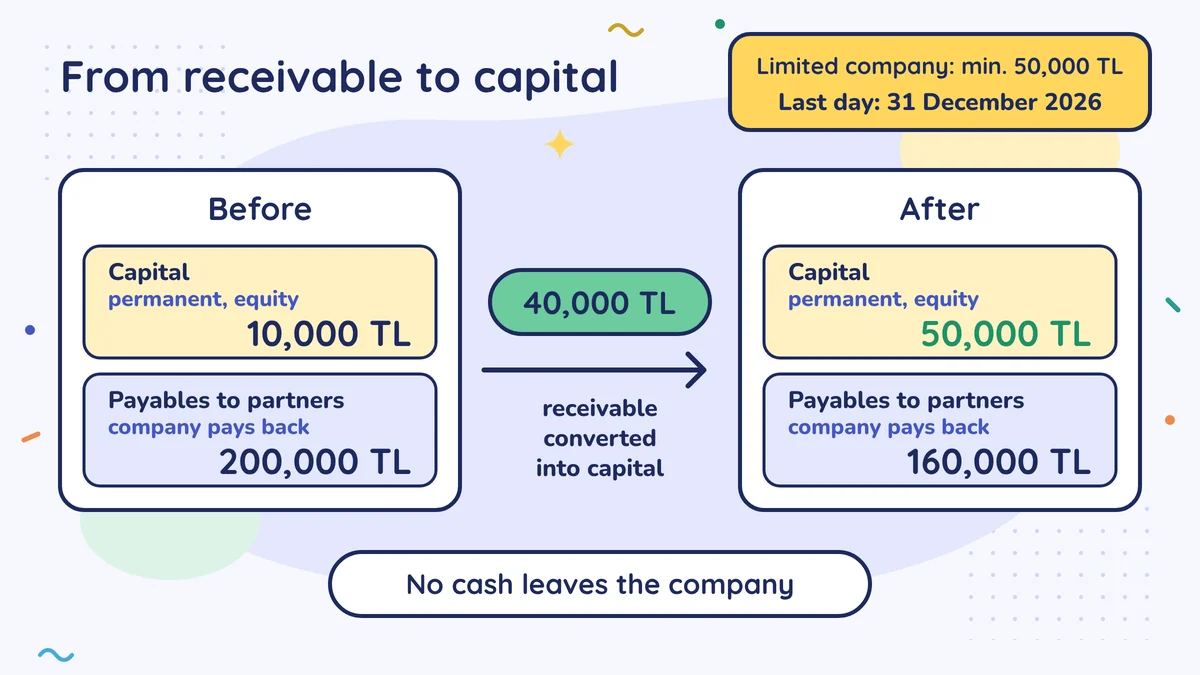
- The partner's receivable: Cemil Usta is owed 200,000 lira by the company. 40,000 lira of this receivable can be converted into capital. No cash leaves the company, payables to partners go down, and capital goes up. That the receivable is real should be shown by the bank receipts of the money going into the company; so keep the receipts for the money a partner puts into the company.
- Internal sources: If the company has undistributed profit from past years or reserves that can be added to capital, these are added to capital. Adding profit to capital does not count as a profit distribution, so no profit share withholding tax (stopaj) is deducted (Income Tax Law art. 94/6-b). However, if this capital is later reduced and paid out to the partners, withholding tax may arise as it would on a profit share; in a reduction made before five years have passed since the addition to capital, these kinds of items are deemed to be reduced first (Corporate Tax Law art. 32/B). If you have such a plan, ask your mali müşavir.
Depending on the source of the increase, the trade registry may ask for documents such as a mali müşavir's report and a certified balance sheet. Find out the list from the registry office or your mali müşavir before you apply.
Steps
- Look at the figures with your mali müşavir: Which source is available, and by how much will capital be increased?
- General meeting decision: A capital increase is a change to the articles of association; the decision is put in writing.
- Money or documents: If it is cash, it is paid into the bank; if it is a receivable or an internal source, the amounts are documented.
- Registration and announcement: The decision is registered with the trade registry and announced in the Turkish Trade Registry Gazette (Türkiye Ticaret Sicili Gazetesi).
Putting in capital is not profit
Capital put in by a partner is not company income; it does not increase profit and does not give rise to income tax or corporate tax (notary, registry and announcement costs are separate). Only equity grows. When banks and large customers look at the balance sheet, they see stronger equity. We explained the link between equity and losses, and the capital loss rule, in the lesson The balance sheet.
Partners' money is not the only way to put money into the company for a machine; we compare it with a loan and leasing in the lesson A loan, leasing or your own money?.
Cemil Usta decided to convert 40,000 lira of his receivable from the company into capital. Since he is the only partner, he signed the general meeting decision himself, and his mali müşavir prepared the documents. Capital rose to 50,000 lira and payables to partners fell to 160,000 lira.
In one sentence
Money you put into the company is either permanent capital or a loan you will take back; if your capital is below the minimum, complete the increase before 31 December 2026.
Do this this week
Look at your company's capital amount in the trade registry (it is also written in your articles of association and on the latest balance sheet; what matters is the stated amount, not whether it has been paid). If it is below 50,000 lira for a limited company or 250,000 lira for a joint-stock company, call your mali müşavir this week and set a date for the increase. If you have a sole proprietorship, this rule does not apply to you.
Common mistakes
- Thinking every lira you put into the company is capital. Without a general meeting decision and registration, that money is not capital; it is the company's debt to you.
- Leaving the minimum capital compliance to the end of the year. The decision, documents, registration and announcement take time; it must be finished before 31 December 2026.
- Thinking capital is profit or income. Capital put in does not increase profit; it only increases equity.
Sources
- KPMG Vergi, 07.09.2026: The period for joint-stock and limited companies to meet the minimum capital ends on 31 December 2026 (Presidential Decision No. 7887, TTK provisional art. 15, Law No. 7511)
- Cott, 22.07.2026: The deadline in the minimum capital compliance process is 31 December 2026 (decision quorum)
- Turkish Commercial Code No. 6102 (6102 sayılı Türk Ticaret Kanunu), provisional art. 15 (mevzuat.gov.tr)
- Corporate Tax Law No. 5520 (5520 sayılı Kurumlar Vergisi Kanunu), art. 12 (thin capitalisation) (mevzuat.gov.tr)
- Income Tax Law No. 193 (193 sayılı Gelir Vergisi Kanunu), art. 94/6-b (adding profit to capital) (mevzuat.gov.tr)
- Andersen: provisions of Law No. 7420 (7420 sayılı Kanun) (Official Gazette 09.11.2022), taxation on capital reduction, Corporate Tax Law art. 32/B
Translated from the Turkish lesson. Last checked against Turkish rules: 12 October 2026. Not yet reviewed by a licensed accountant.
This is general information about Turkish rules, not financial, tax or legal advice. Rules change; check the date and the sources, and ask a licensed accountant (mali müşavir) about your own situation. Disclaimer