Business money and pocket money: a separate account, money taken out, card spending
When one card is used for both the shop's and the home's shopping, every line on the statement becomes a question. Setting up a separate account, recording money taken out and put in for a sole proprietor, receivables from and debts to the shareholder in a company, the four cases of card spending, and sorting things out at month end.
Open a separate bank account and card for the business; let sales, rent and supplier payments go through it. In a sole proprietorship, money you take from the cash box for yourself is owner's drawings, not an expense; money you put in from your pocket is not income either; write both as separate lines. In a company, money a shareholder takes becomes the shareholder's debt to the company, and money a shareholder pays on the company's behalf becomes the company's debt to the shareholder; ask your mali müşavir (accountant) first about the legal limits on shareholder borrowing and about interest.
Cemal Usta the barber's single card
Cemal Usta runs a barber's shop in the neighbourhood. A sole proprietorship. He has a single credit card: the shampoo is bought with it, so are the household groceries and the child's shoes. At the end of the month there are 60 lines on the statement. His mali müşavir (accountant) asks about each one: "Is this business or home?" Cemal Usta remembers half of them.
In this lesson we see how to keep the business's money and your own money separate every day. We talked about how to take money for yourself, and the difference between salary, profit share and debt in a company, in the lesson Paying yourself a salary. Here we look at the daily routine.

First a distinction: sole proprietorship or company?
The rules change depending on the type of business:
- In a sole proprietorship you and the business are legally the same person. When the money gets mixed up, no debt relationship arises as in a company, but the accounts get blurred and your mali müşavir has to sort out every line one by one. And if a personal expense is recorded as a business expense by mistake, a tax problem arises.
- In a limited or joint-stock company the company is a separate person. The company's money is not the shareholder's money. When the money gets mixed up, it turns into a debt relationship and can run into legal limits.
A separate account: set it up once, use it every day
The first step is the same for both types: a separate bank account for the business. In a sole proprietorship this account is opened in your name but used only for business. How to open it is in the lesson Opening a business account and a POS terminal.
Once the account is open, link three things to it:
- Let the money from card sales (POS) go into the business account.
- Let automatic payments such as rent, electricity and phone come out of the business account.
- Let suppliers pay into the business account, and pay them from it too.
That way the bank statement becomes the business's record by itself.
In a sole proprietorship: money you take out and put in
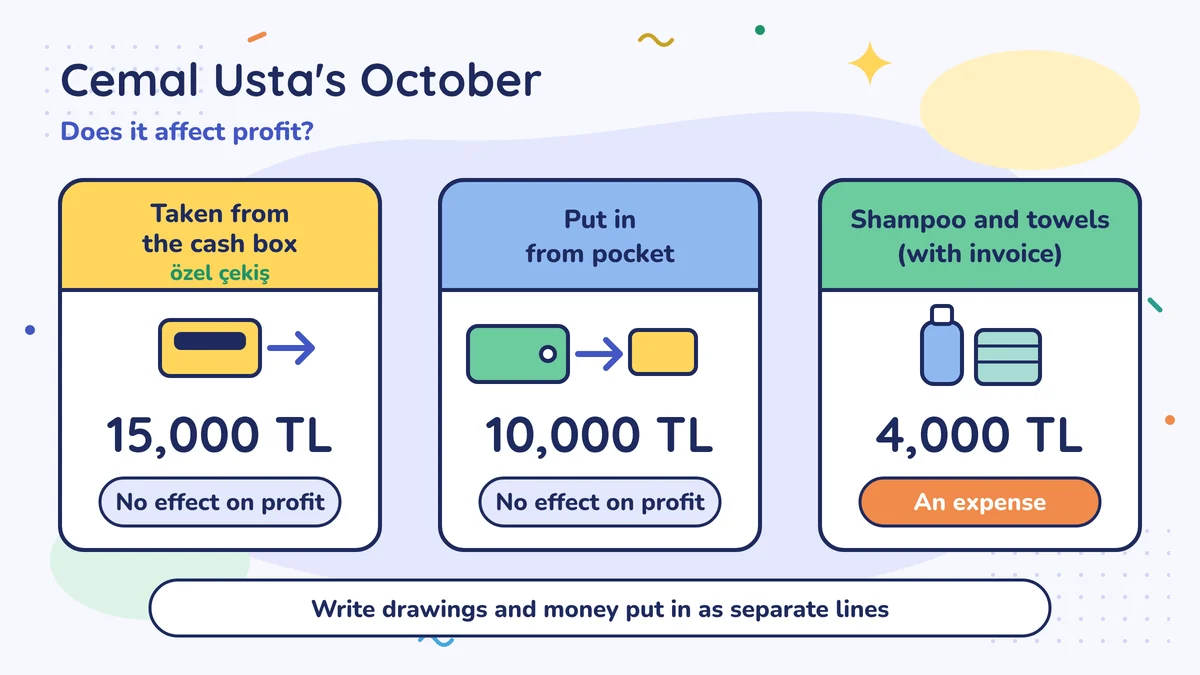
In October Cemal Usta took 5,000 lira from the cash box three times, 15,000 lira in total. This is owner's drawings (özel çekiş): taking the business's money for your own needs. It is not an expense; the law says so clearly (Income Tax Law art. 41/1). It doesn't reduce the profit either. But if it isn't written down, the cash box looks short.
In the same month he put in 10,000 lira from his own savings for the shop's rent. This is not income either; it is adding your own money to the business. If it isn't written down, the cash box looks over and your mali müşavir asks "where did this money come from?"
Write both as separate lines in your daily table: "Owner's drawings" and "Money put in from pocket". At the end of the month Cemal Usta's table looks like this:
| Item | Amount | Does it affect profit? |
|---|---|---|
| Taken from the cash box | 15,000 | No |
| Put in from pocket | 10,000 | No |
| Shampoo and towels (with invoice) | 4,000 | Yes, an expense |
In a company: receivables from the shareholder, debts to the shareholder
Serkan Bey is a shareholder in a small furniture workshop that is a limited company. In a company there are two directions:
If the shareholder takes money from the company. If it isn't salary or profit share, this is the shareholder's debt to the company. It stays in the records as "receivables from shareholders" and is paid back. Careful: a shareholder who hasn't paid a capital contribution that has fallen due cannot borrow from the company; nor can they if the company's profit and free reserves don't cover prior-year losses (Turkish Commercial Code art. 358; for limited companies art. 644). Where it is allowed, the company is expected to charge interest on this money in line with the market. In practice, the mali müşavir calculates interest on this debt at the end of the period, and the company issues an interest invoice to the shareholder. If no interest is charged, a tax audit may treat it as a hidden profit distribution (its name in the law is disguised profit distribution through transfer pricing, Corporate Tax Law art. 13); the company may face additional tax and penalties. Ask your mali müşavir before taking the money.
If the shareholder puts money into the company or pays a company expense from their own pocket. This time the company becomes indebted to the shareholder: "payables to shareholders". Serkan Bey paid for 20,000 lira of timber and glue with his own card. The invoice was issued in the company's name. The company now owed Serkan Bey 20,000 lira. At the end of the month 20,000 lira was sent from the company account to Serkan Bey's account, with the description "repayment of shareholder debt, timber invoice". The record closed cleanly. If a shareholder lends the company large amounts on a continuous basis, this too can have separate tax consequences (thin capitalisation, that is, money put in as a loan but used like capital; Corporate Tax Law art. 12); ask your mali müşavir.
In 2026, collections and payments of more than 30,000 TL made with a shareholder must also go through a bank or PTT (VUK General Communiqué No. 459, as amended by No. 575). Doing money transactions with a shareholder through the bank at any amount is the cleanest way.
Card spending: four cases
| Case | In a sole proprietorship | In a company |
|---|---|---|
| Business spending with the business card | Can be an expense if there is a document | Can be an expense if there is a document |
| Personal spending with the business card | Owner's drawings, not an expense | The shareholder's debt to the company |
| Business spending with a personal card | Can be an expense if the invoice is in the business's name | If the invoice is in the company's name, the company becomes indebted to the shareholder |
| Personal spending with a personal card | Doesn't concern the business | Doesn't concern the company |
Two details. First, the expense arises with the invoice for the spending, not on the day you pay off the card debt; paying the card statement is not a separate expense. Second, which spending counts as business-related is a separate question; see the article Which expenses can be recorded as expenses? (in Turkish). Your mali müşavir makes the decision; your job is to get the document in the business's name and say what it was.
Month end: sort out what got mixed up
Even the best system sometimes gets mixed up. At the end of the month, open the statements for the business account and the business card. Put a letter next to each line: "B" for business, "P" for personal. Send the "P" lines to your mali müşavir as a separate list. Also attach separately the invoices for business spending you made with your personal card.
These ten minutes save your mali müşavir an hour, and you a rush at the end of the year.
Cemal Usta's two cards
Cemal Usta asked the bank for a second card and linked it to the business account. All the shop's shopping goes on that card; the home's on the old card. He writes the money he takes from the cash box in the table as "personal". The November statement had 25 lines. His mali müşavir asked about only one line: the servicing of the shop's air conditioner. Its invoice was already in the file.
Do this this week
Open last month's bank and card statements and write "B" next to each business line and "P" next to each personal one. Send the "P" lines to your mali müşavir as a separate list. If you don't have a separate card linked to the business account, ask your bank for one this week.
Common mistakes
- Not writing down the money you take from the cash box. Even though it isn't an expense, if it isn't written down the cash comes out short and the reason gets lost. If money put in from your pocket isn't written down either, the cash looks over.
- Using the company's cash box as your own in a limited company. Money the shareholder takes is a debt to the company and is paid back; it can run into the legal limit and interest may need to be charged.
- Getting the invoice for business spending made with a personal card in your own name. If the invoice isn't in the business's name, it is not the business's expense. When buying, give the business's name and tax number.
Sources
- Income Tax Law No. 193, art. 41/1 (money withdrawn from the business is not recorded as an expense) (mevzuat.gov.tr)
- Turkish Commercial Code No. 6102, art. 358 and 644 (prohibition on shareholders borrowing from the company) (mevzuat.gov.tr)
- Corporate Tax Law No. 5520, art. 13 (disguised profit distribution through transfer pricing) (mevzuat.gov.tr)
- VUK General Communiqué No. 459, as amended by No. 575: 30,000 TL limit for collections and payments with shareholders (Ekonomi Gazetesi)
- Mehmet Maç (YMM), tax consequences of an interest-free loan to a shareholder: KVK art. 13, arm's-length interest, VAT (MuhasebeTR)
- Erdem & Erdem: the prohibition on borrowing from the company under the Turkish Commercial Code
Translated from the Turkish lesson. Last checked against Turkish rules: 12 October 2026. Not yet reviewed by a licensed accountant.
This is general information about Turkish rules, not financial, tax or legal advice. Rules change; check the date and the sources, and ask a licensed accountant (mali müşavir) about your own situation. Disclaimer