Taking on a partner or leaving a partnership: how does a share transfer work in a limited company?
Kenan Bey wants to transfer his half share in the café, and Nermin Hanım is looking for a new partner. The steps of a share transfer in a limited company (written contract, notary, general meeting, trade registry), the debts to check before the transfer, and the other ways of leaving a partnership.
In a limited company a share transfer is made by a written contract, the parties' signatures are certified by a notary, and unless the articles of association say otherwise the approval of the general meeting of partners is required (TTK art. 595). The managers then enter the transfer in the share register and have it registered with the trade registry. Because the transferor and the transferee can be held jointly liable for tax debt that relates to the period before the transfer and cannot be collected from the company, the transferee should check the debt position before the transfer.
Nermin Hanım's café and the partner who is leaving
The rules described in this lesson are those of Turkish law.
Four years ago Nermin Hanım and Kenan Bey opened a café. They set up a limited company with 100,000 lira of capital, split half and half. This year Kenan Bey is moving to another city and wants to give up his share. Nermin Hanım's cousin Elif Hanım is ready to buy the share and offers 300,000 lira.
Kenan Bey's first idea is simple: "Elif and I shake hands, I take the money and I'm out." In a limited company it is not that short. In this lesson we look at the steps of a share transfer, what to check before the transfer, and the other ways of leaving a partnership.

First, a distinction: a sole proprietorship cannot take on a partner
In a sole proprietorship (şahıs işletmesi) the business and its owner are the same person (Sole proprietorship or limited company?). So you cannot take on a partner in a sole proprietorship by selling a "share". An owner who wants to work together with someone has two paths: setting up an ordinary partnership (adi ortaklık), or setting up a company together and moving the business into it. Ask your mali müşavir (accountant) which one suits you and what tax the move involves. The rest of this lesson is for limited companies; in a joint-stock company (anonim şirket) the rules on share transfers are different.
A share transfer is like transferring the title deed of a flat
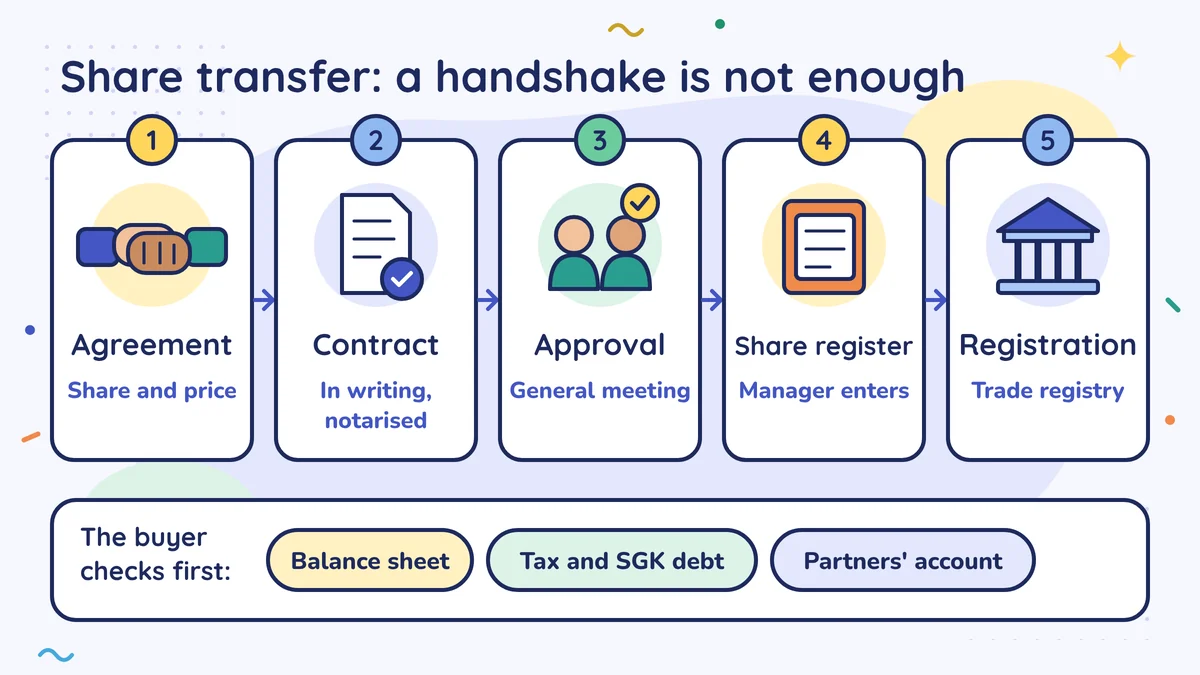
When you sell a flat, agreeing is not enough; an official procedure is done at the land registry and the new owner goes on record. A share in a limited company works the same way. The bargaining is done between the partners, but for the transfer to be valid the steps the law requires are completed (Turkish Commercial Code, Türk Ticaret Kanunu, art. 594, 595 and 598). The body that gives the approval is called the "general meeting of partners" (ortaklar genel kurulu) in the law (general meeting for short; under the old law it was called the partners' board, ortaklar kurulu):
| Step | What is done | Who does it |
|---|---|---|
| 1. Agreement | The share and the price are discussed | Transferor and transferee |
| 2. Contract | The transfer is made in writing, the signatures are certified by a notary | The parties, the notary |
| 3. Approval | Unless the articles of association say otherwise, the general meeting approves the transfer | The partners |
| 4. Share register | The new partner is entered in the share register (pay defteri) | The company manager |
| 5. Registration | The transfer is registered with the trade registry (ticaret sicili) | The company manager |
A few details:
- A notary is a must. A transfer contract whose signatures have not been certified by a notary is not valid. Unless the articles of association say otherwise, the transfer becomes valid with the approval of the general meeting.
- The general meeting can refuse without giving a reason, if the articles of association contain no other rule. If it does not refuse within three months of the application, it is deemed to have given its approval (TTK art. 595).
- There is a deadline for registration. If the managers do not apply within thirty days, the departing partner can apply himself to have his name removed from the registry (TTK art. 598). The list of documents the trade registry office asks for may change; ask the registry office or your mali müşavir before you apply.
Kenan Bey and Elif Hanım followed this order. After the contract at the notary, Nermin Hanım and Kenan Bey wrote up the general meeting decision, and Nermin Hanım, who is the manager, made the application to the trade registry.
Three papers on the table before the transfer
Before paying 300,000 lira, Elif Hanım should look at where the company stands today. If the company's unpaid tax debt cannot be collected from the company, it can be claimed from the partners in proportion to their shares (Law No. 6183, art. 35); partners have a similar liability for SGK (social security) premium debt. If a partner is also the manager, he can be held liable for the whole of the tax debt that cannot be collected from the company (Law No. 6183, repeated art. 35). The same article makes the transferor and the transferee jointly liable (müteselsilen, meaning the creditor can go to either of them if it wishes) for debt that relates to the period before the transfer and is unpaid on the transfer date. As the transfer date, the date of the transfer contract at the notary is usually taken; ask your mali müşavir which date counts in your case.
So the transferee should ask for these:
- The latest balance sheet (bilanço) and trial balance (mizan). What does the company own, and how much does it owe to whom? We explained how to read a balance sheet in the lesson The balance sheet: assets equal liabilities plus equity.
- Tax and SGK debt status. Does the company have overdue tax and premium debt? Your mali müşavir can check this in the tax office and SGK systems; if you wish, a "no debt" letter can also be obtained from the tax office and SGK in the company's name.
- The partners' account. Does the departing partner owe the company anything, or does the company owe him? If so, how it will be closed with the transfer should be written into the contract. Also check whether the capital owed on the share has been paid in full. If any part is unpaid, take it into account when discussing the price; before the contract, ask your mali müşavir or lawyer who will be liable for this debt after the transfer, and to what extent.
The tax and SGK side
- For the transferor: If you sell your share for more than it cost you, the difference may be subject to income tax (Income Tax Law, Gelir Vergisi Kanunu, repeated art. 80, capital gains). Kenan Bey's share cost him 50,000 lira and he is selling it for 300,000 lira; ask your mali müşavir how the calculation is done and whether a return is needed.
- For the transferee: Partners in a limited company are, as a rule, covered by Bağ-Kur, the social security scheme for the self-employed (Law No. 5510, art. 4/1-b); in a share transfer this registration starts on the date the general meeting approves the transfer, and the company's authorised person reports it to SGK within 15 days. If Elif Hanım works somewhere else, she should have her mali müşavir check in advance how this affects her.
Other ways of leaving a partnership
A share transfer is the most common way, but not the only one:
- Right to exit: If the articles of association provide for it, or if there is a just cause, a partner can leave the company; where the ground is just cause, the court decides (TTK art. 638).
- Expulsion: The expulsion of a partner can be sought on grounds written in the articles of association or on just cause (TTK art. 640).
Both of these paths are long and costly. If the partners write a partners' agreement at the start and answer the question "if one of us wants to leave, to whom must they first sell their share, and on what calculation?", most disputes never begin. It is best to prepare this agreement with a lawyer.
In one sentence
In a limited company a share transfer does not end with a handshake: it needs a written contract certified by a notary, the approval of the general meeting and registration with the trade registry; and the buyer first looks at the company's debts.
Do this this week
Open your articles of association and find the clause on share transfers. Note down, one by one, whether the general meeting's approval is required and whether the partners are given a right of first refusal. If there is no such clause, or there is something you don't understand, ask your mali müşavir or lawyer at your next meeting. If you have a sole proprietorship and are thinking of taking on a partner, write your mali müşavir a single question: "An ordinary partnership or a company?"
Common mistakes
- Treating the transfer as done with a handshake. Until the written contract certified by a notary, the general meeting approval and registration with the trade registry are complete, the transfer is incomplete.
- Not looking at the company's debts when buying a share. Unpaid tax and SGK debt from before the transfer can also fall on the new partner; ask for the balance sheet and the debt position first.
- Leaving without closing the partners' account. Any debt the departing partner owes the company, or the company owes him, should be settled in writing together with the transfer.
Sources
- Turkish Commercial Code No. 6102 (6102 sayılı Türk Ticaret Kanunu), art. 594, 595 and 598 (share register, share transfer, registration), art. 638 and 640 (exit and expulsion) (mevzuat.gov.tr)
- Ekrem Öncü (YMM), share transfer in a limited company: TTK 595 and 598, the transfer date and liability under art. 35 of Law No. 6183 (MuhasebeTR)
- Law No. 6183 on the Collection Procedure of Public Receivables (6183 sayılı Amme Alacaklarının Tahsil Usulü Hakkında Kanun), art. 35 (liability of partners) (mevzuat.gov.tr)
- Income Tax Law No. 193 (193 sayılı Gelir Vergisi Kanunu), repeated art. 80 (capital gains) (mevzuat.gov.tr)
- Alomaliye: Tax debt and the liability of a limited company partner (art. 35 of Law No. 6183; joint liability of the transferor and transferee for pre-transfer debt)
- Social Insurance and General Health Insurance Law No. 5510 (5510 sayılı Sosyal Sigortalar ve Genel Sağlık Sigortası Kanunu), art. 4/1-b (mevzuat.gov.tr)
- EY: Bağ-Kur insurance in all its aspects (start on a share transfer: the date the transfer is decided, notification within 15 days)
- Hukuki Haber: Liability of managers in limited companies for public debts (Law No. 6183, repeated art. 35)
- TÜRMOB
Translated from the Turkish lesson. Last checked against Turkish rules: 12 October 2026. Not yet reviewed by a licensed accountant.
This is general information about Turkish rules, not financial, tax or legal advice. Rules change; check the date and the sources, and ask a licensed accountant (mali müşavir) about your own situation. Disclaimer