The first 30 words 4: Books and accounts words
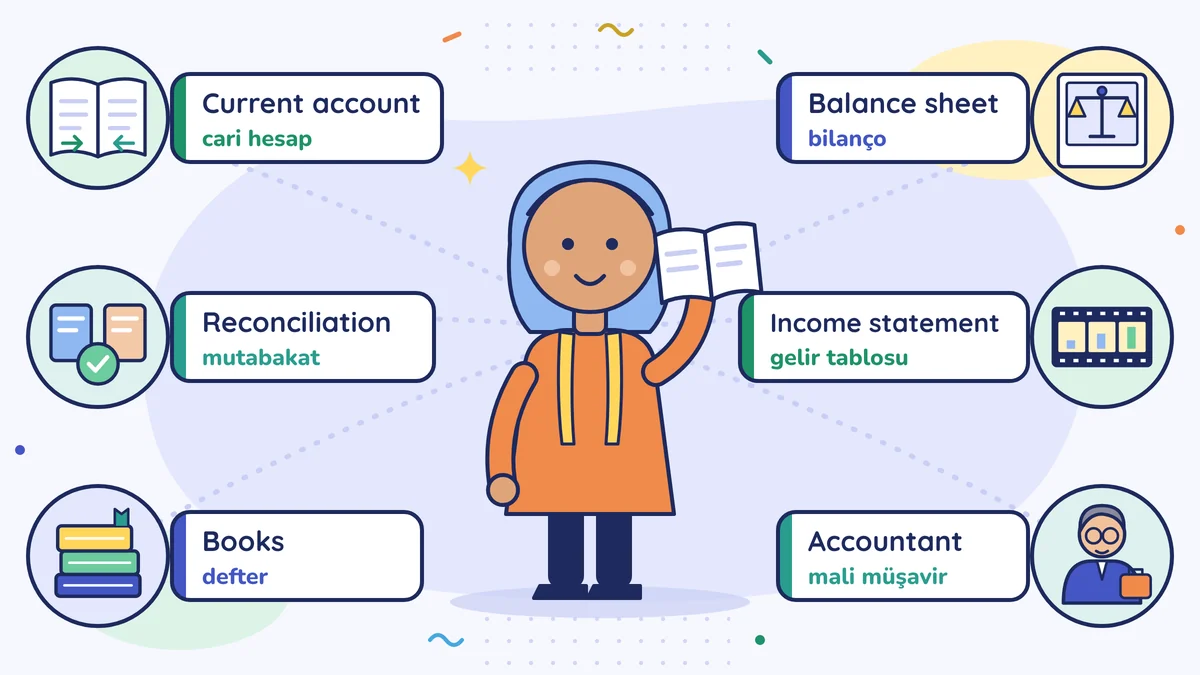
Cari hesap, mutabakat, defter, bilanço, gelir tablosu, mali müşavir (current account, reconciliation, books, balance sheet, income statement, accountant). Starting from a tailor's credit book, we get to know a business's record-keeping system and the person who keeps these records.
A current account (cari hesap) is a credit book showing who owes how much to whom; reconciliation (mutabakat) is confirming that both sides' books show the same figure. The balance sheet (bilanço) is a picture of one day, and the income statement (gelir tablosu) is a picture of a period. The person who keeps these in the books (defter) and guides you on tax matters is the mali müşavir (certified public accountant).
Fatma Hanım's book
Fatma Hanım is a tailor. She runs her workshop in her own name and keeps a business book (işletme defteri); because her work has grown, she is thinking of switching to a small limited company (limited şirket) next year. She buys fabric from Rıza Bey and delivers the sewing to her customers. Payments are not made straight away: sometimes Fatma Hanım owes Rıza Bey, and sometimes her customer owes her. She writes it all down in a book. That book is the root of the first three words in this lesson.
At the end of the year her mali müşavir (certified public accountant) came: "Let's reconcile your current accounts; I'll close the books and produce the year-end summary. If you switch to a company, from then on we'll also produce a balance sheet and an income statement." When she heard this, Fatma Hanım clung to her book. Now let's translate that sentence.
Current account (cari hesap): the credit book
A current account (cari hesap) is the record of what is owed and receivable between you and a person or firm. Think of it as a separate page for each customer and each supplier: what you sold, what they bought, what they paid, how many lira are left. The same thing as the corner shop's credit book (veresiye defteri); only more orderly.
It has two directions. If your customer owes you, this is your receivable (alacak). If you owe a supplier, this is your payable (borç). The same person can be both your customer and your supplier.
Mini example: You bought 8,000 lira of fabric from Rıza Bey and have not paid yet: in Rıza Bey's current account, you have an 8,000 lira payable. You sewed Nilüfer Hanım's dress for 2,000 lira and have not received the money: in her current account, you have a 2,000 lira receivable.
Reconciliation (mutabakat): two books showing the same figure
Reconciliation (mutabakat) is when two sides compare their current accounts and say, "yes, we have this figure too". Because two separate people write the same debt in separate books, an invoice forgotten on one side, an amount entered wrongly, or money paid but not recorded may turn up.
Usually one side sends the other an account summary or writes a letter; the other side confirms the figure, or points out the difference if there is one. If it is done regularly, it saves you from "I paid you" / "no you didn't" arguments.
Mini example: Fatma Hanım's book shows that she owes Rıza Bey 8,000 lira. Rıza Bey's book shows a receivable of 7,500 lira. Fatma Hanım looked for the 500 lira difference together with him; she found that one payment had not gone into Rıza Bey's records.
Books (defter): the business's record book
The books (defter) are the system in which the business's income, expenses and transactions are written down in an orderly way. The invoices and documents you have are first entered in the books, and then reports come out. Without books, nobody can know how much you earned or how to calculate your tax.
Which books are kept depends on the type and size of the business; small sole proprietorships use a simpler system (the business book, işletme defteri), while companies and large businesses use a more detailed system (the balance-sheet basis, bilanço esası). Tradespeople under the simplified method (basit usul), however, do not keep either of these books; their purchase and sales documents are recorded in the online Defter Beyan System (Defter Beyan Sistemi), and this is usually done by the mali müşavir. Most books can be kept electronically today. Don't decide on your own: your mali müşavir decides which books you keep, and you hand over the documents in full.
Mini example: Every month Fatma Hanım gives the invoices she has collected to her mali müşavir, and the mali müşavir enters them in the business book. By the end of the year, 480,000 lira of sales and 400,000 lira of spending have added up in the book.
Balance sheet (bilanço): the business's photograph
A balance sheet (bilanço) is a table showing the business's position on a particular day. Like a photograph: what you have on that day (cash box, bank, your receivables, your machines, your stock), what you owe, and the part left over that is yours (capital and accumulated profit). The left side is "what I have", the right side is "whose money these were bought with", and the two sides always come out equal.
This equality says: everything the business owns was bought either with borrowed money or with its own money. A balance sheet is generally produced on a date such as the end of the year. Know one distinction: the balance sheet and the income statement are produced by businesses that keep books on the balance-sheet basis (all limited and joint-stock companies, and large sole proprietorships). In a small business that keeps a business book, a simpler summary is prepared at the end of the year instead.
Mini example: After Fatma Hanım switches to a company, let's say that at the end of the first year the company has a total of 100,000 lira in the cash box, in the bank, in machines and in receivables. Of this, 40,000 lira is owed to the fabric seller and the bank, and 60,000 lira is the capital Fatma Hanım put in as a partner plus accumulated profit. 40,000 + 60,000 = 100,000.
Income statement (gelir tablosu): the business's film
An income statement (gelir tablosu) is a table showing how much income was earned in a given period, what was spent, and in the end how much profit or loss was left. If the balance sheet is a photograph, the income statement is a film: what happened from January to December.
At the top of the table are sales, in the middle expenses, and at the bottom profit or loss. It is the official form of the income minus expenses difference from the lesson How money moves (in Turkish). Banks look at it first when giving credit, partners when making decisions, and you when looking at your own business.
Mini example: Fatma Hanım's figures for this year are 480,000 lira of sales, 400,000 lira of expenses and 80,000 lira of profit before tax. Today these appear in the simple summary that comes out of the business book; once she switches to a company, the same kind of figures will be written in the income statement.
Mali müşavir: the business's travelling companion
A mali müşavir (the professional title is usually serbest muhasebeci mali müşavir, certified public accountant) is the person who keeps your books, prepares your tax returns and guides you on tax matters. What your family doctor is for your health, they are for the business's financial health. You bring them the documents; they keep the records, file the tax returns and tell you what you need to do.
A mali müşavir does not do everything in your place. Collecting documents, giving correct information and setting money aside to pay tax stay with you. We covered what they do and do not do in detail in a separate lesson.
Mini example: In the first week of every month, Fatma Hanım leaves her document folder with her mali müşavir. The mali müşavir enters them in the books and prepares the tax returns at the end of the month.
Putting all six together
Fatma Hanım keeps a current account (cari hesap) for each of her customers. Once a year, with a reconciliation (mutabakat), she matches the figures with the other side. The documents are entered in the books (defter). Once she switches to a company, two reports will come out of the books: the balance sheet (bilanço), which is the photograph of one day, and the income statement (gelir tablosu), which is the film of a year. And the person who runs this work and guides her is the mali müşavir.
Do this this week
Choose the two people you sell to on credit most, or owe the most to. For each, prepare a note saying "on this date my records show this much" and send it to that person; see whether the figure matches. If it doesn't, you will have done your first reconciliation.
Common mistakes
- Keeping credit sales in your head. A payable or receivable that you don't write on paper or in a program gets forgotten, and then a dispute breaks out.
- Never doing a reconciliation. A difference that turns up years later is much harder to sort out than one that could have been sorted out on the day.
- Mixing up the balance sheet and the income statement. One is the position on a single day; the other is the movement over a period.
Sources
Translated from the Turkish lesson. Last checked against Turkish rules: 7 October 2026. Not yet reviewed by a licensed accountant.
This is general information about Turkish rules, not financial, tax or legal advice. Rules change; check the date and the sources, and ask a licensed accountant (mali müşavir) about your own situation. Disclaimer