Updating prices under inflation: passing cost increases on to your prices
Hüseyin Bey the restaurant owner hasn't touched his prices since January; the dining room is full, but his profit has melted away. We see in figures how to pass cost increases on to prices, why adding only the difference in ingredient costs is not enough, and how often you should update your prices.
If all your costs have gone up by 20%, you need to raise your price by about 20% just to keep the purchasing power of your profit; adding only the lira difference in ingredients does not cover the rise in rent, salaries and energy. A practical rule is to keep the contribution margin ratio: new price = new variable cost ÷ (1 − contribution margin ratio). Measure costs every month and set a trigger; for example, recalculate the price when variable costs rise by more than 5% or every three months.
Hüseyin Bey the restaurant owner's menu
The rules described in this lesson are those of Turkish law.
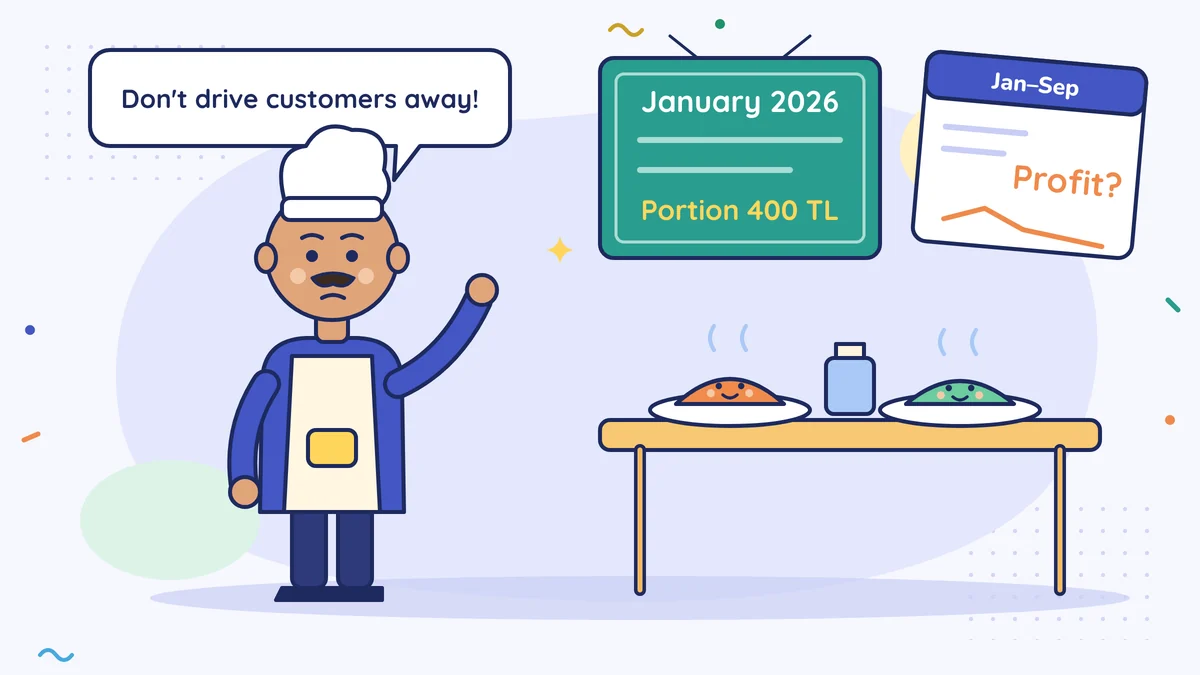
Hüseyin Bey runs a tradesmen's restaurant (esnaf lokantası) in the market district. In January 2026 he had his new menu printed and hasn't touched the prices since. "I don't want to drive customers away," he says. In October, when he saw his mali müşavir's (accountant's) table for January–September, he was surprised: the restaurant is full every day, but there is almost no profit.
Keeping prices fixed under inflation means lowering them. In this lesson we look at how to pass cost increases on to prices and how often to do it.
Like the air in a tyre
A car tyre doesn't go flat in a day. It loses a little air every week, and you don't notice. One day the steering gets heavy and fuel use goes up. A driver who checks regularly never has that day.
Under inflation, the profit margin melts away in the same way. Every month a few items go up in price from suppliers, rent rises once a year, the energy bill grows. One by one they look small; the total shows up in the table months later.
Hüseyin Bey's calculation
The figures for an average portion, rounded and excluding VAT. He sells 3,000 portions a month.
| January 2026 | October 2026 | |
|---|---|---|
| Variable cost per portion (meat, vegetables, oil, bread, packaging) | 200 | 240 |
| Monthly fixed costs (rent, staff, energy, other) | 420,000 | 504,000 |
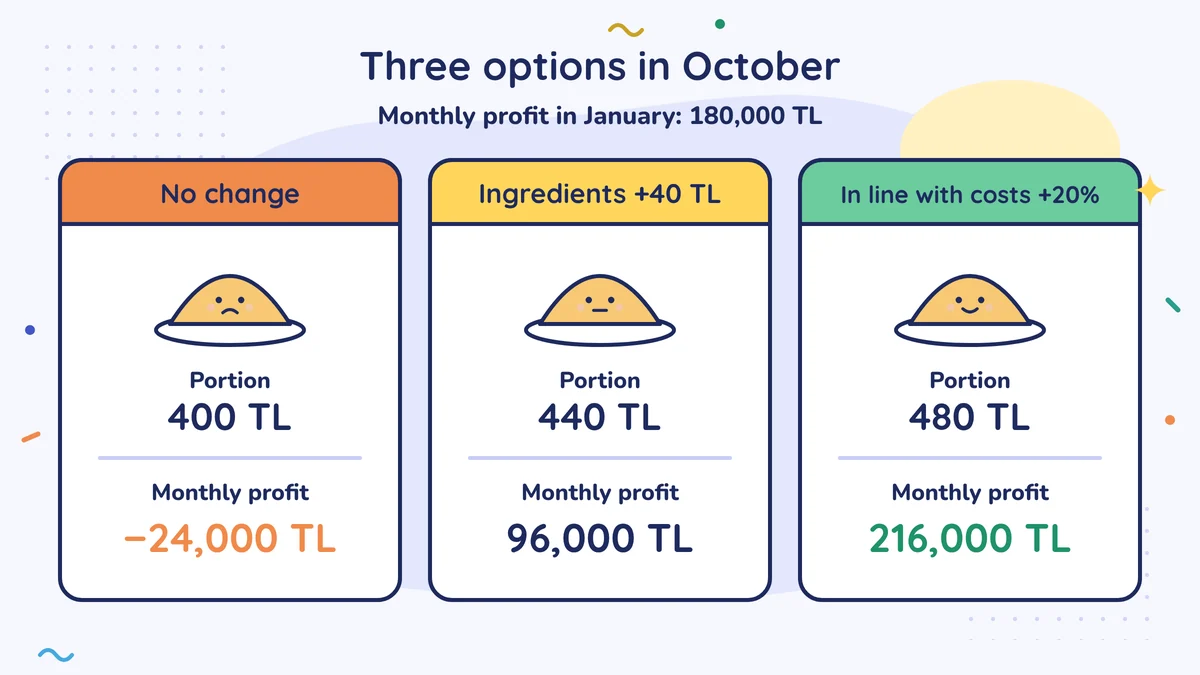
From January to October both his variable and his fixed costs went up by 20%. In January he sold a portion for 400 lira: 200 lira of contribution margin (katkı payı) per portion, 3,000 × 200 = 600,000 lira of contribution a month, and 180,000 lira of profit once fixed costs were taken out.
Let's put three options for October side by side:
| Option | Price | Contribution per portion | Monthly contribution | Fixed costs | Monthly profit |
|---|---|---|---|---|---|
| Leave the price as it is | 400 | 160 | 480,000 | 504,000 | −24,000 |
| Add the ingredient difference (+40 TL) | 440 | 200 | 600,000 | 504,000 | 96,000 |
| In line with the total cost increase (+20%) | 480 | 240 | 720,000 | 504,000 | 216,000 |
Three lessons come out of this:
- Leaving the price as it is pushed the restaurant into a loss, despite the full dining room.
- Adding only the lira difference in ingredients was not enough. Rent, salaries and energy went up too; the 200 lira of contribution per portion now has to carry bigger fixed costs.
- If costs went up by 20% and the price also goes up by 20%, profit rises from 180,000 to 216,000, that is, by the same rate. This is not growth; it is standing still. Under inflation you have to update prices even just to stand still. You saw this side of the comparison in the lesson Comparing with last year.
The worry that "customers drop off when prices go up" is fair. Do the sums: even if sales at the 480 lira price fall to 2,700 portions a month, 2,700 × 240 = 648,000 lira of contribution, 504,000 of fixed costs, and 144,000 lira of profit remain. Far better than leaving the price alone and making a loss.
A practical rule: keep the contribution margin ratio
In January the contribution margin was half the price (200 ÷ 400). To keep this ratio, the new price is found like this:
New price = new variable cost ÷ (1 − contribution margin ratio) = 240 ÷ 0.50 = 480 lira.
This rule gives the right result when fixed costs have also gone up at roughly the same rate. If rent or salaries have gone up much faster, check the new fixed costs with the break-even calculation.
One more note for businesses that buy and sell: think about the price not according to the old purchase price of the goods on the shelf, but according to the replacement cost (yerine koyma maliyeti). If there are goods on the shelf bought for 100 lira and the supplier now wants 120, then when you sell at a price based on 100, you cannot buy the same goods again.
How often?
There is no single right frequency; but set up a routine:
- Measure every month. Write down the unit prices of the ten items you use most from your supplier invoices. Recalculate the variable cost per portion, product or service.
- Set a trigger. For example, recalculate the price if variable costs have risen by more than 5% since your last price update, or if three months have passed.
- Take small, regular steps. Waiting nine months and then putting prices up by 20% scares customers more; and the loss of those nine months doesn't come back.
For general price increases, people look at TÜİK's (Turkish Statistical Institute) consumer price index (TÜFE). In September 2026 the CPI rose 1.84% month on month and 29.73% year on year (TÜİK, 5 October 2026). If a monthly 1.84% continues for three months, prices rise by about 5.6%. But the CPI is everyone's average; your price for meat, fabric or spare parts may rise faster or slower than that. Update your price according to your own costs, and use the CPI only for comparison.
In long-term work (an annual maintenance agreement, regular sales to a wholesaler, catering for companies), write into the contract which index the price will be updated by and how often. Have your lawyer or mali müşavir review the clause.
When changing prices
- Prices on labels and menus are shown including all taxes (Price Label Regulation, Fiyat Etiketi Yönetmeliği). If you are a VAT taxpayer, do the calculation excluding VAT, then add VAT and write the price. If you are under simplified taxation, you don't add VAT; you write the price you worked out.
- Keep your cost records. Law No. 6585 regulating retail trade (additional article 1) prohibits producers, suppliers and retail businesses from making exorbitant, that is, excessive and unjustified, increases in the prices of goods and services. Passing a real cost increase on to prices is a different thing; your purchase invoices and your price calculation help you show the reason for the increase if a question comes.
- Tell your customers. A short note on the door or at the bottom of the menu is enough. Regular customers are more bothered by a sudden, unexplained increase.
In October Hüseyin Bey raised the menu by 15%; he will close the remaining gap in January. From now on, on the first Monday of every month he writes down the prices of the ten items.
Do this this week
From your latest supplier invoices, write down today's unit purchase price of the ten items you use most. Recalculate the variable cost of your best-selling product with these prices and find out by what percentage it has risen since your last price update.
Common mistakes
- Keeping the price fixed for months, then putting it up sharply in one go. The loss of the months in between doesn't come back, and a big increase scares customers more.
- Adding only the lira difference in ingredients to the price. Rent, salaries and energy go up too; if you don't keep the contribution margin ratio, profit melts away anyway.
- Setting the price according to the old purchase price of the goods on the shelf. When you sell, you cannot replace the same goods at the new price; look at the replacement cost.
Sources
- TÜİK (Turkish Statistical Institute), Consumer Price Index bulletins
- Alomaliye: Consumer Price Index, September 2026 (TÜİK data)
- Gazete Oksijen: Inflation in September 29.73% year on year, 1.84% month on month (5 October 2026)
- Amendment to the Price Label Regulation (Fiyat Etiketi Yönetmeliği, Official Gazette 28.06.2014/29044), Official Gazette 18.02.2022/31754 (selling price: including all taxes), TÜRMOB copy
- Erdem & Erdem: additional article 1 added to Law No. 6585 by Law No. 7244 (prohibition of exorbitant price increases)
- Ekonomim: Law No. 6585, additional article 1 (prohibition of exorbitant price increases) and the Unfair Price Evaluation Board (Haksız Fiyat Değerlendirme Kurulu)
- Law No. 6585 on the Regulation of Retail Trade (Perakende Ticaretin Düzenlenmesi Hakkında Kanun) (mevzuat.gov.tr)
Translated from the Turkish lesson. Last checked against Turkish rules: 12 October 2026. Not yet reviewed by a licensed accountant.
This is general information about Turkish rules, not financial, tax or legal advice. Rules change; check the date and the sources, and ask a licensed accountant (mali müşavir) about your own situation. Disclaimer