Comparing with last year: growth or inflation?
Turnover rose by 23%, but the workshop sold 10 fewer sets of furniture than last year. The right way to compare a figure with last year: choose the same period, take inflation into account, look at the number of units, compare expenses as a share of sales, and set aside one-off items.
When inflation is high, a rise in TL turnover does not mean you have grown. When comparing with last year, put the same periods side by side, compare the increase with inflation, count the units you sold or the number of customers if you can, and compare each expense as a share of sales. Your mali müşavir's tables show each year in its own lira, and in tax records no inflation adjustment is made in 2025, 2026 and 2027 either; you make this adjustment yourself, in your head.
Mehmet Usta's "record year"
The rules described in this lesson are those of Turkish law.
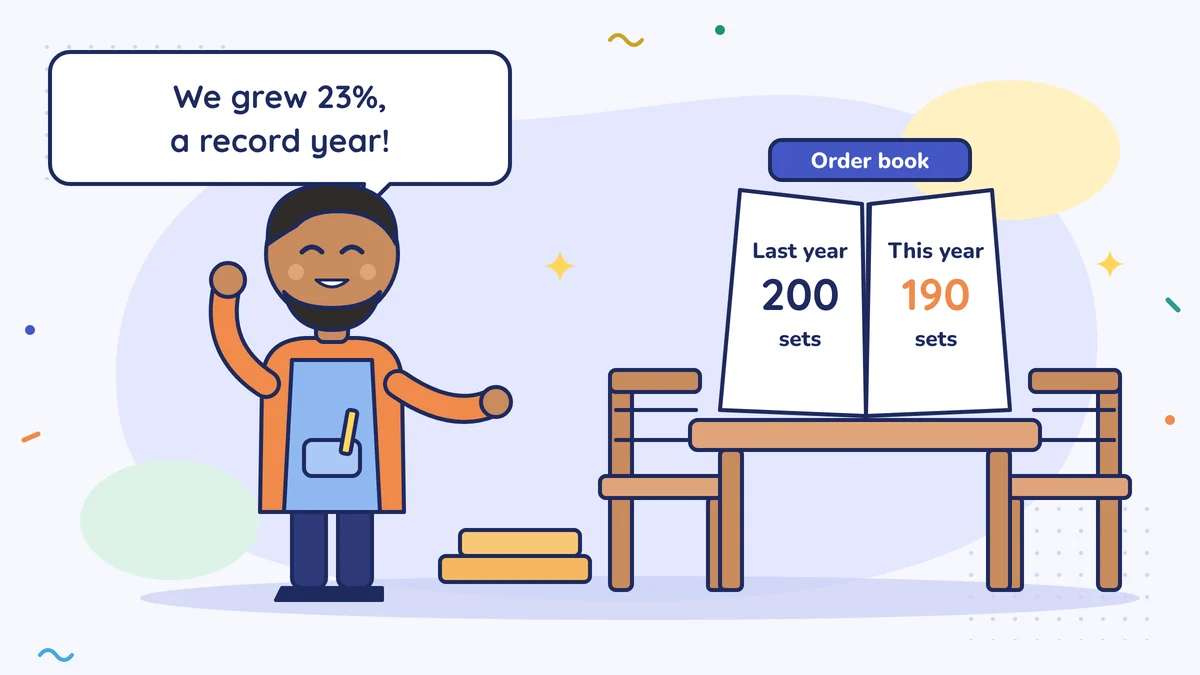
Mehmet Usta runs a furniture workshop; he makes and sells dining table sets. At the beginning of November, before the provisional tax (geçici vergi) return, he got the January–September table from his mali müşavir (accountant) and compared it with the same period last year. Sales had gone up from 4,000,000 lira to 4,940,000 lira. "We grew 23%, a record year," he said.
Then he looked at the order book in the workshop. Last year in this period he had sold 200 sets; this year, 190. Turnover is up, but the work is down. How can both be true at once?
A tailor does not sew this year's jacket to last year's measurements. Figures are the same: last year's lira is not this year's lira. In this lesson we look at five steps to make the comparison correctly.
1. Put the same period side by side
Comparing January–September with the whole of last year is like weighing half a loaf against a whole loaf. Compare nine months with nine months, December with December. This matters even more in seasonal businesses: the school season, religious holidays or the wedding season pile up in one month.
The most ready-made material for a mid-year comparison is the period tables your mali müşavir already prepares for provisional tax. In 2026 there are four provisional tax periods; the January–September table is prepared for the return whose last day is 17 November 2026. If you are under simplified taxation (basit usul), there is no provisional tax; you make the comparison with your own records.
2. Take inflation into account
Annual inflation (CPI, TÜFE) announced by TÜİK (Turkish Statistical Institute) was 30.89% in December 2025. As of September 2026, inflation over the last 12 months is 29.73% (TÜİK, 5 October 2026). The figure for the whole of 2026 is announced at the beginning of January 2027.
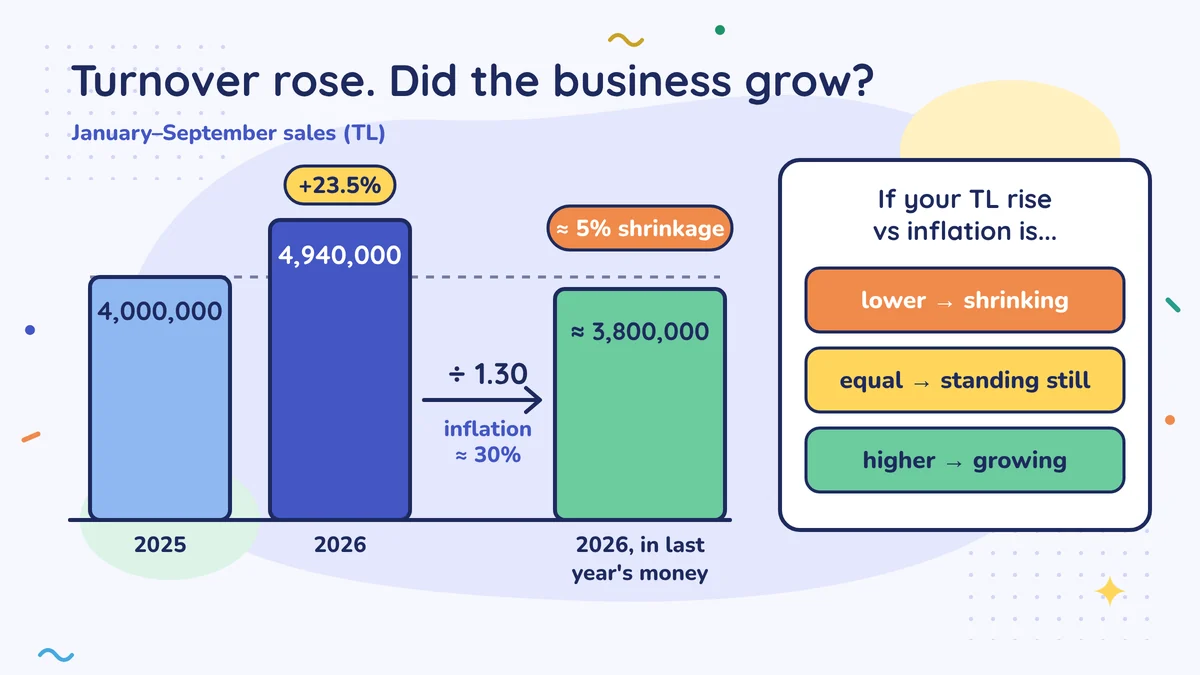
Mehmet Usta's turnover rose by 23.5%. If prices in general rose by about 30%, this year's 4,940,000 lira is worth about 3,800,000 lira in last year's money (4,940,000 ÷ 1.30). So in real terms, the workshop's turnover shrank by around 5%.
The rule in short: if your TL increase is lower than inflation, you are really shrinking; if it is equal, you are standing still; if it is higher, you are growing.
3. Count the units and the customers
CPI is an average for everyone. Mehmet Usta's timber and labour costs may have risen faster or slower than CPI. That is why the cleanest measures are numbers that do not depend on the lira:
- How many sets did I sell? 200 → 190.
- What happened to my average price? 20,000 → 26,000 lira, that is, a 30% increase.
- How many customers did I sell to, and how many new customers came?
In a café the number of cups, at a hairdresser's the number of customers, for a haulier the number of trips does the same job. If units are falling and the price rises by as much as inflation, the increase in turnover is not growth, it is a price increase.
4. Compare expenses as a share of sales
It is natural for expenses to rise in TL. The real question is whether they rose faster than sales. For this, divide each line by sales and compare the percentages. Mehmet Usta's January–September table:
| Line | 2025 (TL) | Share of sales | 2026 (TL) | Share of sales | TL increase |
|---|---|---|---|---|---|
| Sales | 4,000,000 | 100% | 4,940,000 | 100% | 23.5% |
| Materials | 2,000,000 | 50% | 2,470,000 | 50% | 23.5% |
| Staff | 1,000,000 | 25% | 1,350,000 | 27.3% | 35% |
| Rent | 240,000 | 6% | 360,000 | 7.3% | 50% |
| Other expenses | 360,000 | 9% | 420,000 | 8.5% | 16.7% |
| Profit before tax | 400,000 | 10% | 340,000 | 6.9% | −15% |
The share of materials in sales stayed the same: Mehmet Usta adjusted his price well to the increase in materials. But staff and rent grew faster than sales. Result: profit fell by 15% even in TL; once inflation is taken into account, the fall is bigger. The "record year" was in fact a year in which the profit margin fell from 10 to 6.9. You saw what the margin tells you in the lesson Profit margin.
5. Set aside one-off items
If last year you got a large one-off order from a hotel, or this year there was a machine repair or a moving cost, write these separately. An item that will not be repeated distorts the result when you compare two years. Ask your mali müşavir: "Is there an item last year or this year that will not be repeated?"
Why don't the figures in the table show inflation?
The tables your mali müşavir prepares show each year in that year's lira; they do not convert last year's sales into this year's money. When you put two years of income statements (gelir tablosu) side by side, the difference you see also includes price increases.
On the balance-sheet side there is also this: those who keep books on the balance-sheet basis made an inflation adjustment at the end of 2023 and 2024. Provisional article 37, added to the Tax Procedure Law (Vergi Usul Kanunu) by Law No. 7571 (Official Gazette, 25 December 2025), says that in the 2025, 2026 and 2027 accounting periods, including provisional tax periods, the financial statements in tax records will not be subject to inflation adjustment. So a machine bought after 2025 stands in the balance sheet (bilanço) at its TL amount on the day it was bought; those bought earlier also stay at their adjusted amount at the end of 2024 and have not been updated since. The only exception to this rule is businesses that deal solely in buying, selling and manufacturing worked gold and silver; if you are a jeweller, ask your mali müşavir. On the business account basis (işletme hesabı esası) there is no inflation adjustment anyway.
Your mali müşavir knows the tax side of this rule. What it means for you: when you compare figures between years, the table does not make the inflation adjustment; you make it yourself, in your head.
What did Mehmet Usta do?
He made three notes: bring the share of staff and rent in sales back down, ask his customers the reason for the fall in units (price, a competitor or the season), and prepare the 2027 price list according to total cost, not according to the increase in materials. He will go to the year-end meeting with these notes.
Do this this week
Write this year's and last year's January–September sales (excluding VAT) side by side; you can get the figures from your mali müşavir or from your own invoice records. Because inflation over the last 12 months was about 30% in September 2026, divide this year's figure by 1.30 and compare it with last year's. Then choose a number that does not depend on the lira (units sold, number of customers or jobs) and count it for both years too. Note whether the two point in the same direction.
Common mistakes
- Thinking a TL increase is growth. If prices rose by 30%, a 23% increase in turnover is really shrinkage; check with the number of units or customers.
- Comparing periods of different lengths. Compare nine months not with a year, but with the same nine months of last year.
- Following expenses only in TL. Every expense rises; if its share of sales is rising, the margin is melting away.
Sources
- TÜİK (Turkish Statistical Institute), Consumer Price Index bulletins
- Alomaliye: December 2025 CPI (TÜFE), annual 30.89% (TÜİK data)
- Capital: TÜİK September 2026 inflation figures, annual 29.73%
- KPMG Vergi: Rule that inflation adjustment will not be applied in 2025, 2026 and 2027 (Law No. 7571, Tax Procedure Law (Vergi Usul Kanunu) provisional art. 37, Official Gazette 25.12.2025/33118)
- PwC Tax Bulletin: Tax provisions of Law No. 7566 (the fourth provisional tax period brought back for periods starting from 1.1.2025)
Translated from the Turkish lesson. Last checked against Turkish rules: 12 October 2026. Not yet reviewed by a licensed accountant.
This is general information about Turkish rules, not financial, tax or legal advice. Rules change; check the date and the sources, and ask a licensed accountant (mali müşavir) about your own situation. Disclaimer