Cheques, promissory notes, credit sales and card payments: when does the money come into the cash box?
The sale is made and the profit is recorded, but the money is on the way. Using Tuncay Bey the furniture maker's cheques dated January, we look at the day money comes into the cash box for each payment method, why VAT is paid before the money is collected, endorsing and discounting a cheque, and where a cheque you write yourself sits in your cash plan.
Cash and bank transfers come in the same day; card sales come in after the holding period in your agreement with the bank, minus commission; and a cheque comes into the cash box when the date on it arrives and it is collected at the bank. VAT, however, does not wait for the money: it arises when the goods are delivered or the service is performed, or when the invoice is issued if it is issued earlier (VAT Law art. 10). That is why, on a credit sale, you often pay the VAT before the money comes in from the customer.
Tuncay Bey the furniture maker's cheques dated January
The rules described in this lesson are those of Turkish law.
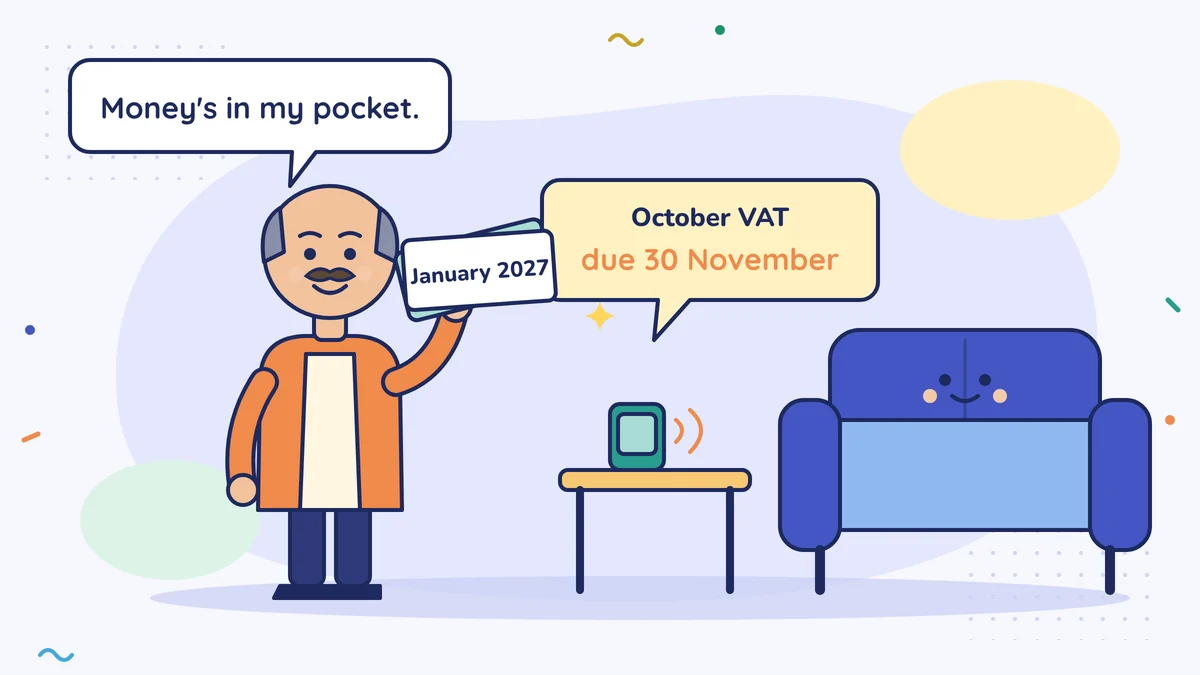
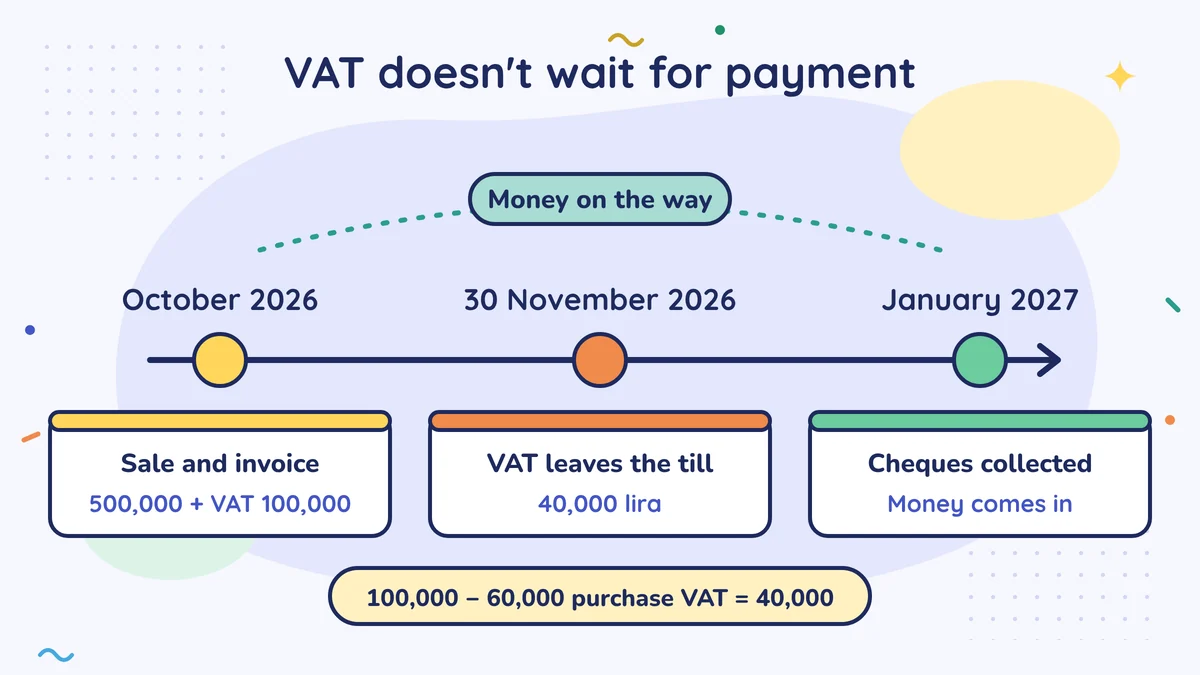
Tuncay Bey's workshop makes furniture for shops. In October 2026 he made a good sale: 500,000 lira excluding VAT. The customer, a shop, paid with cheques dated January 2027. Tuncay Bey put the cheques in a drawer and relaxed: "The money is in my pocket."
In mid-November his mali müşavir (accountant) called: "October's VAT has come out; it must be paid by 30 November." Tuncay Bey was surprised: "But I haven't received the money yet."
In this lesson we measure the distance between the sale and the day the money comes into the cash box. As the payment method changes, this distance changes too.
The tracking number
You ordered something online. You have a tracking number. The parcel is on its way, but it is not at your door. Sometimes it is a day late. Now and then it gets lost.
A cheque (çek), a promissory note (senet) and an invoice for a credit sale are like this tracking number. The sale has been made and the profit has gone into the accounts; the money, though, is on the way. In the cash plan you write the day the money will arrive at your door, not the day the order was placed.
When does the money come in, by payment method?
| Payment method | When does the money come into the cash box? | How do you write it in the plan? |
|---|---|---|
| Cash or bank transfer | The same day | The day of the sale |
| Card, single payment | Depending on your agreement with the bank: the next day, a few days or weeks later (holding period). With the commission deducted | The end of the holding period, the amount after commission |
| Card sale in instalments | Depending on the agreement: either instalment by instalment, or all at once but with a higher deduction | The payment schedule in the bank agreement |
| Open account (invoice on credit) | The due date, often a little later | The customer's real payment habit |
| Cheque | When the date on it arrives and it is collected at the bank | The cheque date and the bank's collection time |
| Promissory note | The due date, if the debtor pays | The due date, cautiously |
You saw the holding period and commission side of card payments in the lesson A month's calendar. What is new here is this: in a card sale in instalments, the money may not come all at once. Find the clause on "payment for sales in instalments" in your POS agreement and work out your own schedule from there.
VAT arises on delivery and does not wait for the money
The rule that surprised Tuncay Bey is in article 10 of the VAT Law. VAT arises when goods are delivered or a service is performed. If the invoice is issued earlier, it arises when the invoice is issued. The day the money is collected plays no part in this rule.
In 2026 the general VAT rate is 20%. Tuncay Bey's calculation:
| Item | Amount |
|---|---|
| Sale (excluding VAT) | 500,000 |
| VAT on the invoice | 100,000 |
| VAT on materials bought in October (VAT you paid on purchases, deducted) | −60,000 |
| VAT payable for October | 40,000 |
| Last day | 30 November 2026 |
| Date of the cheques | January 2027 |
Tuncay Bey will pay the 40,000 lira from his own cash box, before he has received the money from the customer. If he bought the materials for cash, he has also already paid their 60,000 lira of VAT to the supplier. So the whole 100,000 lira of VAT on the invoice has left his cash box until the cheques are collected. The longer the credit period on the sale, the longer this advance payment is carried. For commercial earnings, income or corporate tax also does not, as a rule, look at collection; provisional tax (geçici vergi) is calculated on the profit from sales that have been delivered and invoiced, even if the money has not yet come in.
If you are under simplified taxation (basit usul), you do not calculate VAT or pay provisional tax; this section does not concern you.
How do you write a cheque in your plan?
Don't let a cheque sit. In practice, a cheque is handed to your own bank "for collection" a few days before its date; the bank presents it to the other bank when the date arrives, and if there are funds, the money usually goes into your account that day or the next working day. The time for taking it to the bank after its date is short: from the date on it, ten days for a cheque payable in the place where it was issued, and one month for a cheque payable somewhere else (Turkish Commercial Code, Türk Ticaret Kanunu, art. 796). If you miss this period and the cheque bounces, you may lose the right to claim against those who endorsed the cheque over to you. In the plan, write not the date of the cheque but the day the bank will put the money into your account.
Keep the cheques you hold in a list: from whom, amount, date, bank. Every Monday, transfer them from this list to your cash plan.
Two points to watch:
Endorsing a cheque to your supplier. Signing the back of a cheque you hold and giving it to your supplier is like using the money early. But if the cheque is not paid, the supplier can come back to you: whoever endorses a cheque is also liable for payment. Put this in the plan as a risk note.
Discounting a cheque. You can hand a cheque to a bank or a factoring company before its due date and get the money early. In return you pay a deduction. Example: if you get 90,000 lira for a 100,000 lira cheque dated three months from now, 10,000 lira is the price of those three months. The real deduction varies with the bank, the period and the standing of whoever wrote the cheque; get the offer in writing and write that amount in your cash plan.
A cheque you write yourself
If you gave your supplier a cheque, that cheque's date is the most rigid line in your plan. A collection can be late, rent can be talked over; but on the date of the cheque you gave, there must be money in your account. So keep the cheques you give in a separate list and write each one in your cash plan with its date.
What did Tuncay Bey change?
On the next big order he did the following:
- He offered a small discount on the price to bring the cheque date from three months down to two. He worked out how much of the profit the discount would eat.
- He asked for an advance payment of 20% of the invoice. The advance covered the VAT and part of the materials.
- He started tracking the cheques he holds and the cheques he gave in the same table, in date order.
You saw how to measure the number of receivable days once a year in the lesson Cash conversion cycle. This lesson is that figure's week-by-week counterpart.
Do this this week
Write the cheques and promissory notes you hold, plus the cheques you have given, in one table: from whom or to whom, amount, date, bank. Find the holding period in your POS agreement and how the money is paid for sales in instalments, and add them to the table.
Common mistakes
- Counting a cheque as money. Until its date arrives and it is collected at the bank, a cheque is money on the way. Write the collection day in the plan.
- Forgetting the VAT on a credit sale. VAT arises when the goods are delivered (or with the invoice, if it was issued earlier); even if the customer pays three months later, the VAT is paid in the month after delivery.
- Thinking an endorsed cheque is a closed matter. If the cheque is not paid, the supplier you gave it to can come back to you. Keep endorsed cheques on the list too.
Sources
- Value Added Tax Law No. 3065 (3065 sayılı Katma Değer Vergisi Kanunu), art. 10 (taxable event), art. 29 (deduction) (mevzuat.gov.tr)
- Turkish Commercial Code No. 6102 (6102 sayılı Türk Ticaret Kanunu), art. 776 (promissory note), art. 780 and following (cheque), art. 795–796 (payment of a cheque and presentation periods) (mevzuat.gov.tr)
- Cheque Law No. 5941 (5941 sayılı Çek Kanunu) (mevzuat.gov.tr)
- Harbiye Hukuk: Due dates and presentation periods for cheques (summary of TTK art. 795–796; secondary source)
- Bank Cards and Credit Cards Law No. 5464 (5464 sayılı Banka Kartları ve Kredi Kartları Kanunu) (member merchants) (mevzuat.gov.tr)
- Law No. 6361 on Financial Leasing, Factoring, Financing and Savings Financing Companies (6361 sayılı Finansal Kiralama, Faktoring, Finansman ve Tasarruf Finansman Şirketleri Kanunu) (mevzuat.gov.tr)
- KPMG: Presidential Decision on VAT rates (general rate 20%)
Translated from the Turkish lesson. Last checked against Turkish rules: 12 October 2026. Not yet reviewed by a licensed accountant.
This is general information about Turkish rules, not financial, tax or legal advice. Rules change; check the date and the sources, and ask a licensed accountant (mali müşavir) about your own situation. Disclaimer