When does a second company make sense?
When a new line of business comes along, you either run it inside your existing company or set up a second company. Through Tarık Bey the carpet cleaner's removals idea, we see when a second company is useful, when it only adds costs, and which questions to decide it with your mali müşavir (accountant).
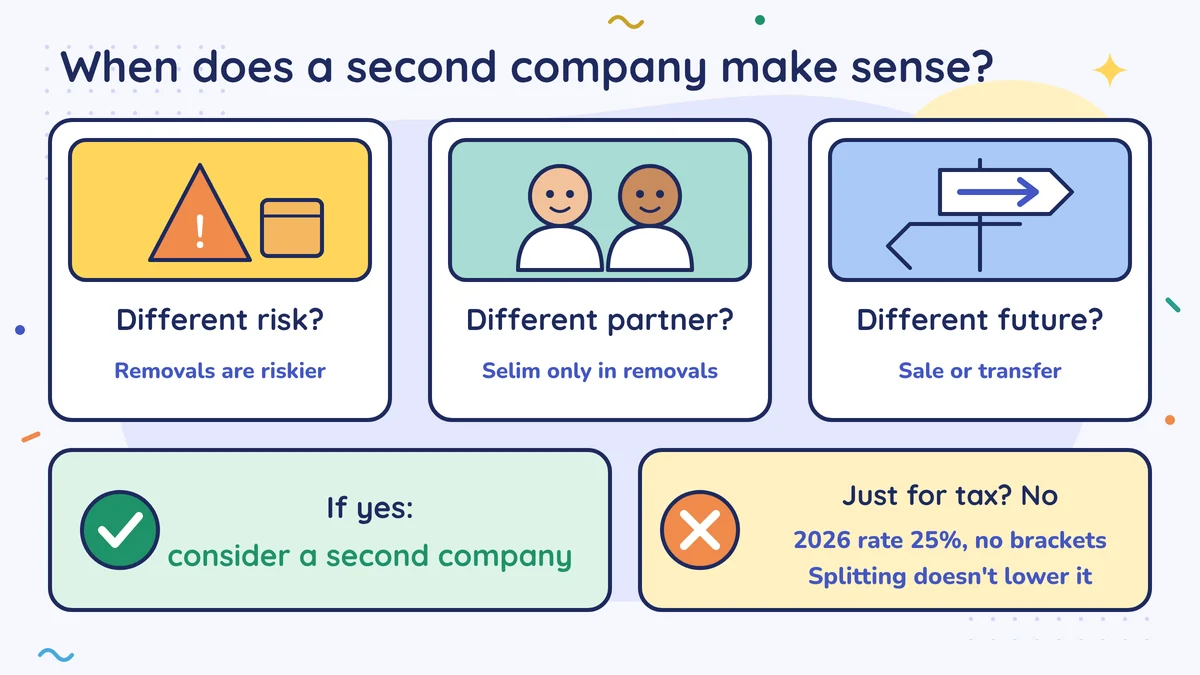
A second company usually makes sense when the new business's risk, partner or future is different from the existing business. Setting one up only for tax does not work: corporate tax (kurumlar vergisi) is not banded like income tax (the general rate in 2026 is 25%), so splitting the profit does not lower the rate; instead it brings costs that repeat every year, such as separate books, a separate accountant's fee and paperwork for transactions between the companies. Make the decision with your mali müşavir, using your own figures.
Tarık Bey the carpet cleaner's truck
The rules described in this lesson are those of Turkish law.
Tarık Bey's carpet-washing business is ten years old. He has a limited company and six employees, and he collects carpets from homes in his own vans and brings them back. For a while now customers have been asking the same thing: "When we move house, could you carry our furniture too?" Tarık Bey's cousin Selim is in the removals business; he wants to come in with two trucks and become a partner in this work, but only in the removals.
Tarık Bey has two options in mind: start removals as a new line of business inside the existing company, or set up a second company with Selim. A friend offers a third idea: "Split it into two companies and your tax will go down."
In this lesson we talk about when a second company is useful, when it only adds costs, and how to make the decision with your mali müşavir. You saw company types in the lesson Sole proprietorship or limited company?, and the calculation for a second branch in the lesson A new employee or a second branch?.

Same counter or a separate shop?
When the neighbourhood grocer opens a deli section next to it, he sells at the same counter, through the same till. When he opens a butcher's, things change: a separate licence, a separate butcher, a separate cold room, perhaps a separate partner. Even under the same roof, they become separate shops.
The second-company question is the same. If the new business resembles the old one, it runs at the same counter. If its risk, partner or future is different, a separate shop is worth considering.
Three options
| Option | What it means | Books |
|---|---|---|
| New business in the same company | Removals becomes a new service of the carpet-washing company | One |
| New workplace (branch) in the same company | The same company operates at another address | One |
| Second company | A new legal entity is set up; its partners may be different | Separate |
To start a new business in the same company, you first look at the field of activity in the articles of association (ana sözleşme). If it does not cover the new business, the articles of association are amended. Your mali müşavir or lawyer does this.
When does a second company make sense?
If the risk is different. Removals bring accidents, broken furniture and trucks breaking down on the road. The risks of carpet washing are smaller than these. A separate company, as a rule, keeps the removals business's debts apart from the carpet-washing company. We say "as a rule" because a personal guarantee (kişisel kefalet) asked for by the bank, and unpaid tax and SGK (social security) debts, carry a separate liability for the partner and the manager; the details are in the lesson Sole proprietorship or limited company?. When a bank lends to a new company, it also often asks for the old company to act as guarantor; then the two companies' debts are tied together again.
If the partner is different. Selim wants to be a partner only in removals. If you make him a partner in the carpet-washing company, he also becomes a partner in the profit of a ten-year-old business. In a separate company you discuss shares only on the basis of the new business. You saw how partnerships are arranged in the lesson Taking on a partner or leaving a partnership.
If the future is different. If one day you are thinking of selling the removals business, handing it over, or opening it up to a large firm as an investor, a separate company makes this easier. A business with its own books and its own balance sheet (bilanço) is easier to value.
When does it only add costs?
Splitting only for tax. Corporate tax is not banded like income tax: in 2026 the general rate is 25%, and it stays the same whether profit grows or shrinks. Splitting the profit between two companies does not lower the rate. A reduced rate applies to some earnings, such as exports and manufacturing by companies holding an industrial registry certificate (sanayi sicil belgesi); but this reduction depends on the type of business, not on splitting the company in two. The tax administration looks at the real nature of a transaction, not at what it is called on paper (Tax Procedure Law art. 3). Splitting on paper a business that runs with the same employees, the same customers and the same shop can become a matter for a tax audit.
If you are a sole proprietorship. Income tax is banded, but all the business income of the same person is added up in a single return at the end of the year; opening a second business in your own name does not lower the rate. And if a business is opened in your spouse's or your child's name but you actually run it, the tax administration may treat it as your business.
If everything is shared. If the customers, the employees, the vehicles and the premises are the same, the two companies have to invoice each other every month. These invoices must be issued at the arm's length price (emsal bedel), that is, the price you would charge a stranger. We explain this in the next lesson of this module.
The yearly cost of a second company
Tarık Bey wrote down the costs of the new company with his mali müşavir. The figures are examples:
| Item | Note |
|---|---|
| Setting up (notary, trade registry) | Once |
| Capital | In 2026 at least 50,000 TL for a new limited company and 250,000 TL for a joint-stock company; companies set up before 1 January 2024 whose capital is below this amount must raise their capital to this amount by 31 December 2026 |
| Mali müşavir's fee | Every month; example: 12,000 TL a month |
| Separate bank account, card terminal (POS), e-Invoice | Every month |
| Separate returns | VAT, muhtasar (withholding tax return), provisional tax, corporate tax |
| If there are employees, a separate SGK workplace file and payroll | Every month |
| Chamber of commerce fee, certification of the books, annual general meeting | Every year |
| Paperwork for transactions between the companies | Every year |
With the example fee, this item alone comes to 144,000 TL a year. The fee varies with the city, the number of employees and the type of business; for example, in the scale recommended for 2026 by the Bursa Chamber of Certified Public Accountants (Bursa SMMM Odası), the monthly fee for a service limited company with no employees is a little over 10,000 TL including VAT. A separate company is set up if the protection and order it brings are worth more than this cost.
Tarık Bey's decision
He answered the three questions: is the risk different? Yes, removals are riskier. Is the partner different? Yes, Selim is only in removals. Is the future different? Perhaps. Splitting for tax was not on the list.
On his mali müşavir's advice, he and Selim set up a new limited company with shares of 60% and 40%. They also put in writing from the start what happens when the carpet-washing company and the removals company send customers to each other.
Take these to your mali müşavir
- "Does the new business fall within the existing company's field of activity?"
- "If we set up a separate company, how much will it cost us a year?"
- "If the two companies are going to provide services to each other, how will we set the price and document it?"
In one sentence
A second company is set up for a business whose risk, partner or future is different; splitting only for tax does not lower the rate, and it adds costs and paperwork.
Do this this week
For your new business idea, write three questions on a page: is its risk different from your existing business, is the partner different, and are you thinking of selling it or handing it over separately in the future? Write yes or no next to each. Then ask your mali müşavir in writing for the yearly cost of a second company (accountant's fee, bank, e-Invoice, returns) and put the two pages side by side.
Common mistakes
- Splitting because "the tax will go down". Corporate tax is not banded; in 2026 the general rate is 25%. Both companies pay the same rate, and on top of that the costs of books, accountant and bank come up a second time.
- Thinking that setting up a limited company separates every debt. For a personal guarantee given to a bank, and for unpaid tax and SGK debts, the liability of the partner and the manager continues.
- Running two companies with the same shop, the same employees and the same till. Every shared use needs an invoice and an arm's length price; a business split on paper may be treated as a single business in a tax audit.
Sources
- Tax Procedure Law No. 213, art. 3 (taxation is based on real nature) (Vergi Usul Kanunu) (mevzuat.gov.tr)
- Corporate Tax Law No. 5520, art. 32 (rate and reduced rates) (Kurumlar Vergisi Kanunu) (mevzuat.gov.tr)
- PwC Tax Bulletin: Law No. 7456 sets the general corporate tax rate at 25%; reduction for export earnings and for manufacturing with an industrial registry certificate
- Bursa Chamber of Certified Public Accountants: fee scale recommended for 2026 (monthly bookkeeping fees for limited companies) (Bursa SMMM Odası)
- KPMG Tax, 07.09.2026: minimum capital of 50,000 TL for limited companies and the deadline to comply (Turkish Commercial Code provisional art. 15)
- Turkish Commercial Code No. 6102, art. 573 onwards (limited company) (Türk Ticaret Kanunu) (mevzuat.gov.tr)
- Law No. 6183 on the Collection Procedure of Public Receivables, art. 35 and repeated art. 35 (liability of partners and legal representatives) (Amme Alacaklarının Tahsil Usulü Hakkında Kanun) (mevzuat.gov.tr)
- Social Insurance and General Health Insurance Law No. 5510, art. 88 (managers' liability for premium debts) (Sosyal Sigortalar ve Genel Sağlık Sigortası Kanunu) (mevzuat.gov.tr)
Translated from the Turkish lesson. Last checked against Turkish rules: 13 October 2026. Not yet reviewed by a licensed accountant.
This is general information about Turkish rules, not financial, tax or legal advice. Rules change; check the date and the sources, and ask a licensed accountant (mali müşavir) about your own situation. Disclaimer