Invoices, loans and interest between companies: the arm's length price
Even if the two companies have the same owner, the rent, loans and services between them must have a price. Through Serkan Bey the wholesaler's warehouse rent, his interest-free loan and the bookkeeper who works for both companies, we look at the arm's length price, the consequences of disguised profit distribution and the paperwork to keep every month.
Rent, loans and services between sister companies must be at the arm's length price (emsal bedel) under Corporate Tax Law art. 13, that is, at the price you would charge someone you have never met. If the price does not match the arm's length price, the difference may be treated as disguised profit distribution: it is added to the income of the company that passed it on, it is treated as a distributed profit share, and penalties and late-payment interest may follow. For every transaction keep a written contract, a monthly invoice and a bank record; have interest calculated on loans at an arm's length rate.
Serkan Bey's two companies
The rules described in this lesson are those of Turkish law.
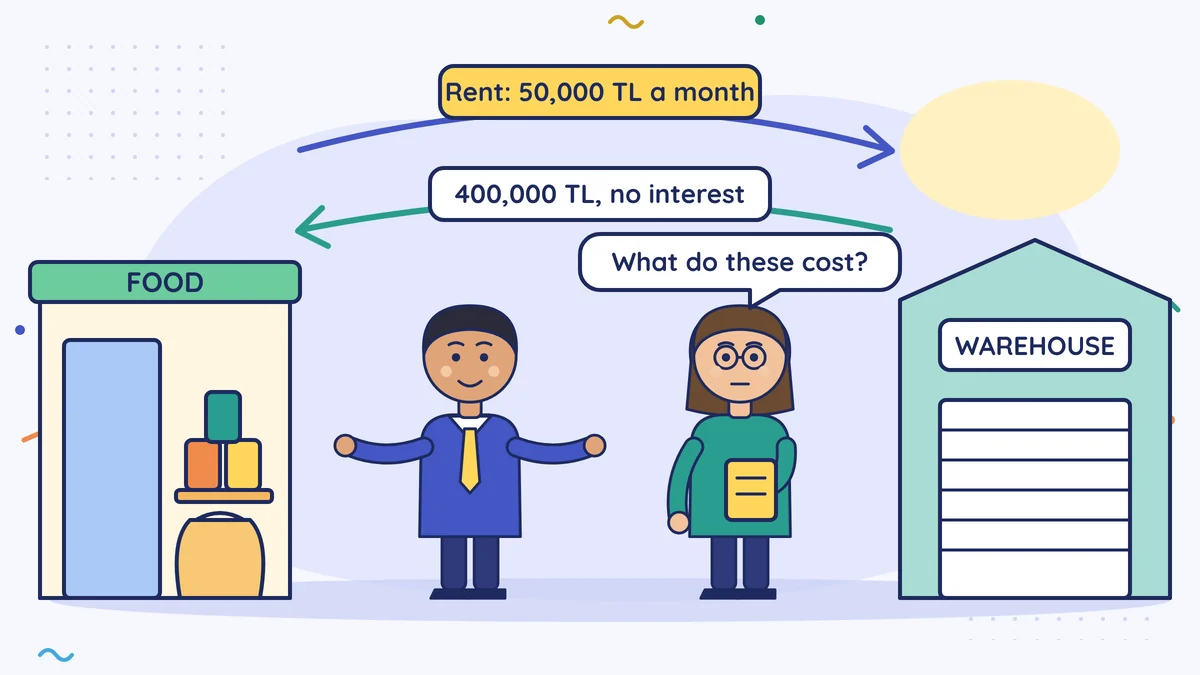
Serkan Bey has two limited companies. One sells food wholesale: pulses, oil, tinned goods. The other only owns a warehouse; the warehouse is rented to the food company. Serkan Bey is the only partner in both companies.
The warehouse company receives 50,000 TL a month in rent from the food company. In the same industrial estate, similar warehouses rent for 120,000 TL a month. Last year, when the food company was short of money, the warehouse company transferred 400,000 TL to it; interest was never discussed. Elif Hanım, who does the companies' bookkeeping, is on the food company's payroll, but she spends half her time on the warehouse company's work.
At the year-end meeting, his mali müşavir (accountant) asked about these one by one: "What is the price of this rent, this loan and this work?"
Even in the coffee house, the tea is written down
Two old friends sit in a coffee house (kahvehane), and one of them buys the teas. The tea maker still writes it in his notebook: "Table 4, six teas." Being friends does not wipe out the bill; it only changes who pays.
Sister companies are the same. Even if they have the same owner, they are two separate persons; everything one gives the other has a price and a document.
The arm's length price: what you would charge a stranger
Corporate Tax Law art. 13 requires the price in a company's transactions with related persons (ilişkili kişiler) to be the arm's length price (emsal bedel). The arm's length price is the price you would charge if you did the same deal with someone you have never met.
"Related person" is defined broadly: the company's partners, other companies the partner is connected with, the partner's spouse, the ascendants and descendants of the partner or the spouse, such as parents, children and grandchildren, and blood relatives and relatives by marriage up to and including the third degree (relatives by marriage: your spouse's relatives). So a sister company, and your spouse's company, are both covered.
If the price does not match the arm's length price, the difference may be treated as disguised profit distribution through transfer pricing (transfer fiyatlandırması yoluyla örtülü kazanç dağıtımı), that is, profit quietly passed to the other side through a price that is too low or too high. Roughly, the consequences are:
- The difference is added to the income of the company that passed it on, and corporate tax is demanded; penalties and late-payment interest may also follow.
- The amount passed on is treated as a profit share distributed as of the last day of that year. On the part treated as distributed to a real person, such as a partner, profit share withholding tax (kâr payı stopajı) also comes into play; in 2026 the rate is 15% (Profit share distribution). If the difference went to another company, ask your mali müşavir how it will be treated there.
- An adjustment can be made in the other company, but only after the tax assessed on the company that passed it on has become final and been paid (Corporate Tax Law art. 13/7).
There is a similar rule between your sole proprietorship and your company (Income Tax Law art. 41/5).
Serkan Bey's three transactions
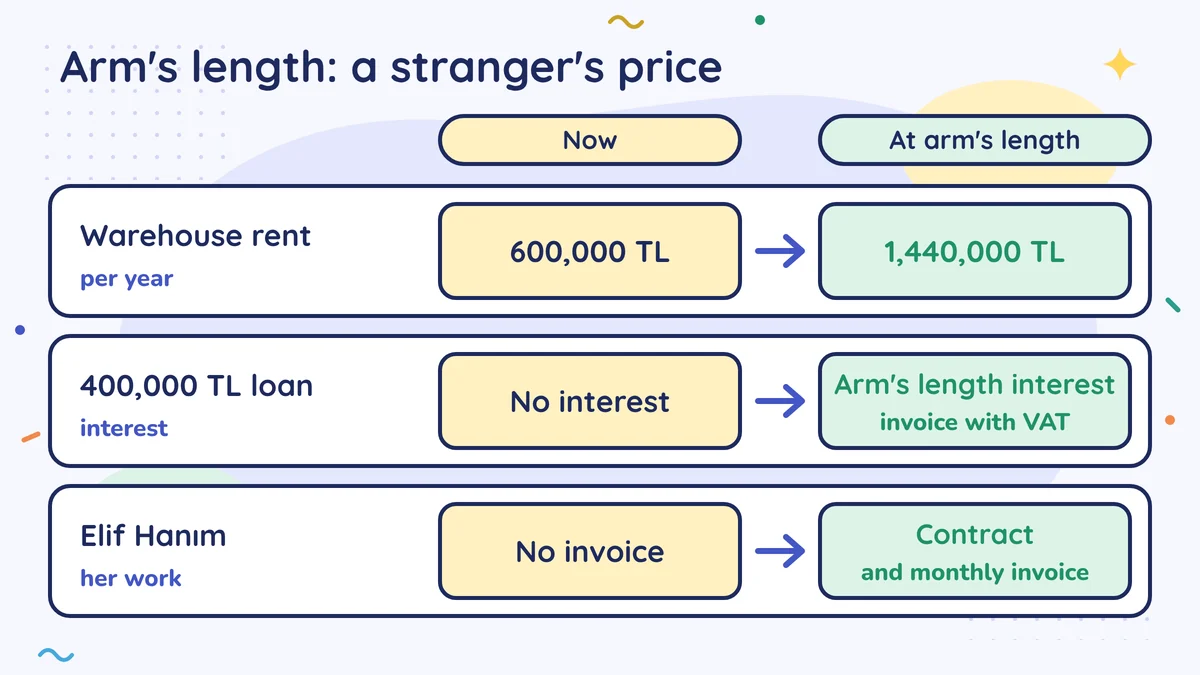
1. Rent. The warehouse company receives 600,000 TL a year in rent; the arm's length figure is 1,440,000 TL. The difference is 840,000 TL a year. Profit appears to have shifted from the warehouse company to the food company. The defence "both companies pay 25%, so no tax is lost" does not always hold: if one of the companies is making a loss or benefits from a reduction, a tax loss arises and it becomes a matter for a tax audit. The simplest course is to work at the arm's length rent from the start.
How do you show the arm's length price? Two or three adverts for similar warehouses in the same area or quotes from estate agents, and if possible a valuation report. Keep them in the same file as the contract.
No withholding tax is deducted on rent paid from one company to another; this is often confused in practice. If the warehouse were registered in your name rather than the company's, the company would deduct withholding tax when paying you rent, and you would declare the rental income; there too, the rent needs to be close to the arm's length price.
2. Loan. The 400,000 TL the warehouse company gave the food company is a loan. If it stays interest-free, the warehouse company has given up interest income. The mali müşavir calculates interest on this loan at an arm's length rate; the warehouse company issues an interest invoice. In the tax administration's view, VAT is also charged on the interest; since there are also court decisions to the contrary, settle the practice with your mali müşavir. You saw the logic of the calculation and how the rate is chosen in the lesson A partner taking money out of the company; it is the same for loans from one company to another.
There is also the opposite direction. If the borrowing the food company receives from a partner or a related company exceeds three times its equity at the start of the period on any day during the year, the interest on the excess part cannot be recorded as an expense and is treated as a distributed profit share. This is called thin capitalisation (örtülü sermaye) (Corporate Tax Law art. 12). As the borrowing grows, ask your mali müşavir about this ratio.
3. A shared employee. Elif Hanım works for both companies, but her salary is paid by the food company. The right arrangement is this: a written service contract is made between them, and every month the food company passes on the share of Elif Hanım's time spent on warehouse work (for example, half of the cost, plus a reasonable profit) to the warehouse company with an invoice that includes VAT. The other way is for Elif Hanım to be insured as a part-time employee in both companies; decide with your mali müşavir which suits you.
| Transaction | Now | At arm's length |
|---|---|---|
| Warehouse rent (yearly) | 600,000 TL | 1,440,000 TL |
| Interest on the 400,000 TL loan | None | At an arm's length rate, invoice with VAT |
| Elif Hanım's work | No invoice | Contract and monthly invoice |
The paperwork
- A written contract for every transaction between the companies: rent, loan, service.
- An invoice every month: rent, interest, service fee.
- Money moves only through the bank, with a written description. Do not pay one company's invoice from the other's account; if you did, it is a debt and is recorded as such.
- Month-end account reconciliation (cari mutabakat): do the two companies show the same balance owed to and by each other?
- Year-end form: companies with transactions with related persons fill in the transfer pricing form attached to the corporate tax return filed in April. For domestic transactions, the detailed annual report is generally required only from companies attached to the Large Taxpayers Tax Office (Büyük Mükellefler Vergi Dairesi) and from companies in free zones; ask your mali müşavir about your situation.
Serkan Bey made a plan: from January the rent will be brought up to the arm's length level, interest on the loan will be calculated at the rate set by the mali müşavir, and a service contract will be signed for Elif Hanım. He will decide with his mali müşavir what to do about past years.
In one sentence
Even if you own the sister company, the price of the rent, loans and services you give it is the price you would give a stranger; its contract, invoice and bank record must be ready every month.
Do this this week
Write every relationship between your companies on a sheet of paper: rent, loans, shared employees, vehicles or premises. Next to each line note three things: is there a written contract, is it invoiced every month, and is the price close to what you would charge a stranger? Take the empty boxes to your mali müşavir.
Common mistakes
- Saying "they're both mine" and setting no price. A sister company is a separate person; free or low rent and interest-free loans may be treated as disguised profit distribution.
- Paying one company's invoice from the other's account. This creates a debt; if it is not recorded, the books of both companies will be wrong.
- Leaving the paperwork until year end. The contract must be ready before the transaction starts and the invoice every month; a document written afterwards loses its credibility.
Sources
- Corporate Tax Law No. 5520, art. 12 (thin capitalisation) and art. 13 (disguised profit distribution through transfer pricing) (Kurumlar Vergisi Kanunu) (mevzuat.gov.tr)
- Income Tax Law No. 193, art. 41/5 (Gelir Vergisi Kanunu) (mevzuat.gov.tr)
- KPMG Tax: Presidential Decision No. 9286 raises the profit share withholding rate to 15% (Official Gazette 22.12.2024)
- Kulaçoğlu Law Office: VAT on loans between companies (the administration's view and a Council of State decision)
- General Communiqué on Disguised Profit Distribution through Transfer Pricing (Serial No: 1) (Transfer Fiyatlandırması Yoluyla Örtülü Kazanç Dağıtımı Hakkında Genel Tebliğ) (Alomaliye copy)
- Ekonomi Gazetesi: Disguised profit distribution through transfer pricing (related persons, arm's length methods, distributed profit share, adjustment on the other side)
- PwC: transfer pricing documentation obligations in 5 questions (form and annual report)
- MuhasebeTR, Ersin Kocakoğlu: the transfer pricing form and the annual report
- Alomaliye, Serhat Özdemir (Tax Inspector): points to watch when calculating thin capitalisation
- MuhasebeTR, Mehmet Maç (Sworn Financial Adviser, YMM): tax consequences of an interest-free loan to a related person, arm's length interest and VAT
Translated from the Turkish lesson. Last checked against Turkish rules: 13 October 2026. Not yet reviewed by a licensed accountant.
This is general information about Turkish rules, not financial, tax or legal advice. Rules change; check the date and the sources, and ask a licensed accountant (mali müşavir) about your own situation. Disclaimer