Sole proprietorship or limited company? Decide in 4 questions
Should you set up a sole proprietorship (şahıs işletmesi) or a limited company (limited şirket)? Without memorising any figures, you weigh up your own situation with four questions: do you have a partner, where is the debt risk, how much will you earn, and what is your growth plan.
If you are on your own, and your business is small and low-risk, a sole proprietorship is usually simpler. If you have a partner, if the debt risk is large or if you are thinking of growing fast, a limited company may suit you better. Make the final decision together with your mali müşavir (accountant), using your own figures.
Nuran the tailor's shop
For years Nuran Hanım worked as a tailor for someone else. Now she wants to open her own shop. Her neighbour says "set up a limited company, it will be like a real company". Her older brother says "a sole proprietorship is enough, don't bother". Each of them says what they think they know. Who should Nuran Hanım believe?
The answer is not to believe anyone. It is to give your own answer to four questions. First, let's explain two words.
- Sole proprietorship (şahıs işletmesi): You and the business are the same person. The shop's earnings are your earnings, and its debts are your debts.
- Limited company (limited şirket): A separate legal entity (tüzel kişi), that is, a separate "person" on paper. The shop belongs to the company, and you are a partner.
For a detailed comparison, you can read the article Sole proprietorship or limited company? (in Turkish). Here there are four questions that make the decision easier.
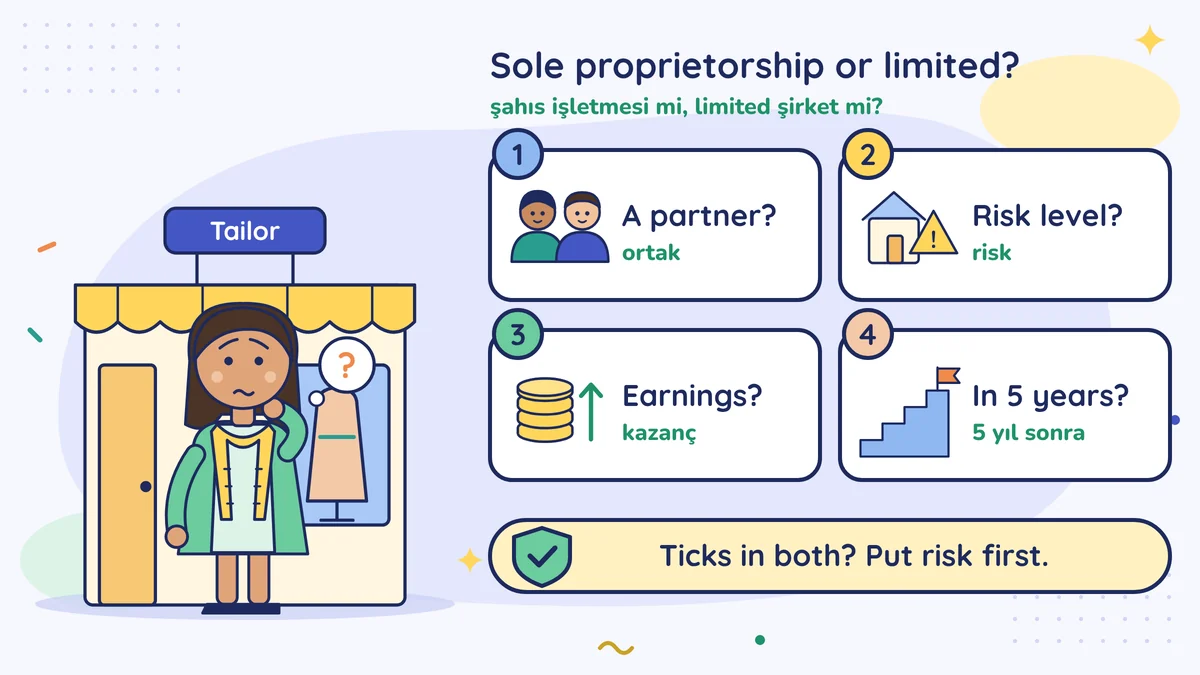
Question 1: Do you have a partner?
If you are on your own, a sole proprietorship is possible and simple. One person can also set up a limited company, so having no partner does not close the limited option. If you are going to start a business 50/50 with someone, there are two ways: an ordinary partnership (adi ortaklık) or a company. If "who put in how much, and how will the profit be shared" is not put in writing between partners, you end up on bad terms. A company makes this written arrangement compulsory, which is why most people in partnerships lean towards a limited company.
Question 2: If something goes wrong, what could I lose?
In a sole proprietorship, the business's debt is directly your debt. If it is not paid, collection proceedings can also be started against your home, your car and your savings. In a limited company, your liability is, as a rule, limited to the capital you put into the company. But don't overstate this; there are two exceptions:
- Personal guarantee (kefalet): Banks and landlords often ask small limited companies for a personal guarantee.
- Tax and SGK debt: If the company's unpaid tax and SGK (Social Security Institution) premium debt cannot be collected from the company, it can be claimed from the partners in proportion to their shares. The manager who runs the company also has a separate liability.
So don't think "I set up a limited company, everything is safe".
Ask yourself: Will I buy a lot of stock? Will I sign an expensive lease? Will I hire many employees? If the answer is mostly yes, the risk is large.
Question 3: How much do I expect to earn?
In a sole proprietorship, you own the earnings; all of your earnings go into the personal income tax (gelir vergisi) calculation. In a company, the earnings are first taxed in the company, and then if the profit is distributed to a partner, a separate calculation arises. Which one will cost you less depends on how big your earnings are and how much of them you will leave in the company. Don't do this calculation with made-up figures; you should ask your mali müşavir for it, based on your own estimated earnings.
Count not only tax but also fixed costs. When you set up a limited company there are set-up costs such as the notary and the trade registry (ticaret sicili), and you also put capital into the company. A company always keeps its books on the balance sheet basis (bilanço esası), that is, in the most detailed way; that is why the mali müşavir's fee is usually higher than for a sole proprietorship. And the company's money is not your pocket: every lira you take from the cash box is recorded separately, and there are rules for this (Paying yourself a salary: taking money from the cash box). Then there is Bağ-Kur (social security for the self-employed): as a rule, both the owner of a sole proprietorship and a partner in a limited company are covered by Bağ-Kur; setting up a limited company does not free you from the premiums.
There is one more thing to watch here: with a sole proprietorship there is also the possibility of "simplified taxation (basit usul)". Whether it suits you is covered in the lesson Simplified taxation or real taxation?.
Question 4: Where do I want to be in five years?
If you are thinking of taking on investors, adding a partner, handing the business over one day or selling to large firms, a company structure makes your work easier. If you are going to stay a small neighbourhood business, a sole proprietorship is enough for years. Moving from a sole proprietorship to a limited company later is possible, but it brings some work and cost; if you know from day one that you will grow, setting up a company from the start is less tiring.
Quick summary table
| Question | Answer closer to a sole proprietorship | Answer closer to a limited company |
|---|---|---|
| Is there a partner? | No, I am on my own | Yes, a written arrangement is needed |
| Risk? | Small, no stock, low rent | Large stock, heavy rent, many employees |
| Expected earnings? | Low or medium | High, profit will stay in the company |
| Plan? | Will stay a neighbourhood business | Growth, partner, investment |
If you have ticks in both columns, put the risk column first: risk costs more than any tax advantage.
What not to do when deciding
- Don't copy your neighbour's decision; their business, risk and partners are not like yours.
- Don't work out the tax advantage from a table on the internet; do it with your own figures.
- Before saying "I'll open a sole proprietorship first and see later", ask about the transfer and its cost.
Nuran Hanım answered the four questions: she is on her own, her shop is small, the rent is reasonable, and she has no growth plan. She started with a sole proprietorship, and she also made a note to tell her mali müşavir clearly if, in the third year, she thinks of taking on a partner and growing.
Two small stories for your own situation
Murat the barber. He is opening a two-chair shop on his own. The rent is reasonable, he does not buy stock, and he is not thinking of hiring. A sole proprietorship is enough for him; keeping the business simple is a big gain for him.
Selin and Cem, the furniture makers. The two of them are opening a workshop together. They will buy machines with a bank loan and employ a few craftsmen. Here there is a partnership, a loan and employees. A limited company structure gives them order, written sharing and a clearer framework. But they need to know from the start that the bank may ask for a personal guarantee.
What will you ask your mali müşavir?
When making the decision, ask your accountant these three questions:
- "With my estimated earnings, roughly what would the yearly difference in tax and costs be between a sole proprietorship and a limited company?"
- "If I move from a sole proprietorship to a limited company later, how much work and cost will it involve?"
- "Is there another option for my business, for example simplified taxation or the tradesman exemption (esnaf muafiyeti)?"
Ask for the answers in writing. A calculation made with your own figures is worth much more than a general table on the internet.
Do this this week
Write the four questions on a sheet of paper and answer each one in a sentence or two. Then take or send that sheet to your mali müşavir and ask: "With these answers, which one do you think?" If you get the answer in writing, you will later remember what you based your decision on.
Common mistakes
- Thinking "if I set up a limited company I won't be responsible for anything". Banks and landlords often ask for a personal guarantee; the company's unpaid tax and SGK debt can also be claimed from the partners in proportion to their shares.
- Using the limited company's cash box as if it were your own pocket. Money you take from the company stays in the records as "the company's receivable from the partner"; if you don't put it back, it can create extra tax at the end of the year.
- Not putting the partnership in writing. Saying "we're 50/50" means nothing on paper; when you fall out, this is the most expensive issue.
Sources
- GİB, Tax Guide for Taxpayers Earning Commercial Income (Ticari Kazanç Elde Eden Mükellefler İçin Vergi Rehberi)
- Turkish Commercial Code (Türk Ticaret Kanunu), Law No. 6102, art. 573 onwards (limited company)
- Income Tax Law (Gelir Vergisi Kanunu), Law No. 193
- Law No. 6183 on the Collection of Public Receivables (Amme Alacaklarının Tahsil Usulü Hakkında Kanun), art. 35 and repeated art. 35 (liability of partners and legal representatives)
Translated from the Turkish lesson. Last checked against Turkish rules: 7 October 2026. Not yet reviewed by a licensed accountant.
This is general information about Turkish rules, not financial, tax or legal advice. Rules change; check the date and the sources, and ask a licensed accountant (mali müşavir) about your own situation. Disclaimer